
Ōba Gakusen: A Japanese Painter Who Had Started His Career as a Painter in the Town of Hagi and Ended up Winning a Reputation in Tokyo During the Meiji Era.

Mandarin Ducks on a Snowed Plum Stem / Long-Tailed Cocks on a Magnolia Branch
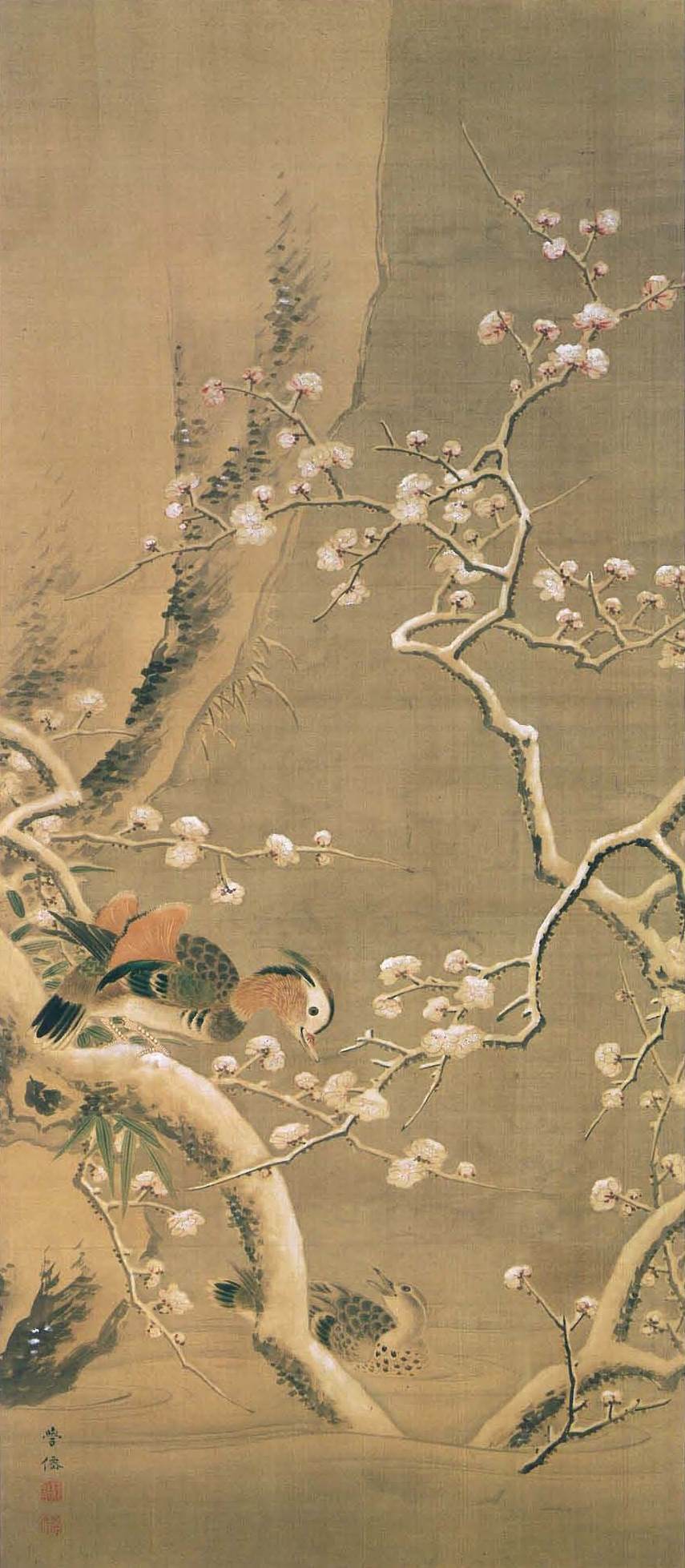
Mandarin Ducks on a Snowed Plum Stem (Left) / Long-Tailed Cocks on a Magnolia Branch by Ōba Gakusen
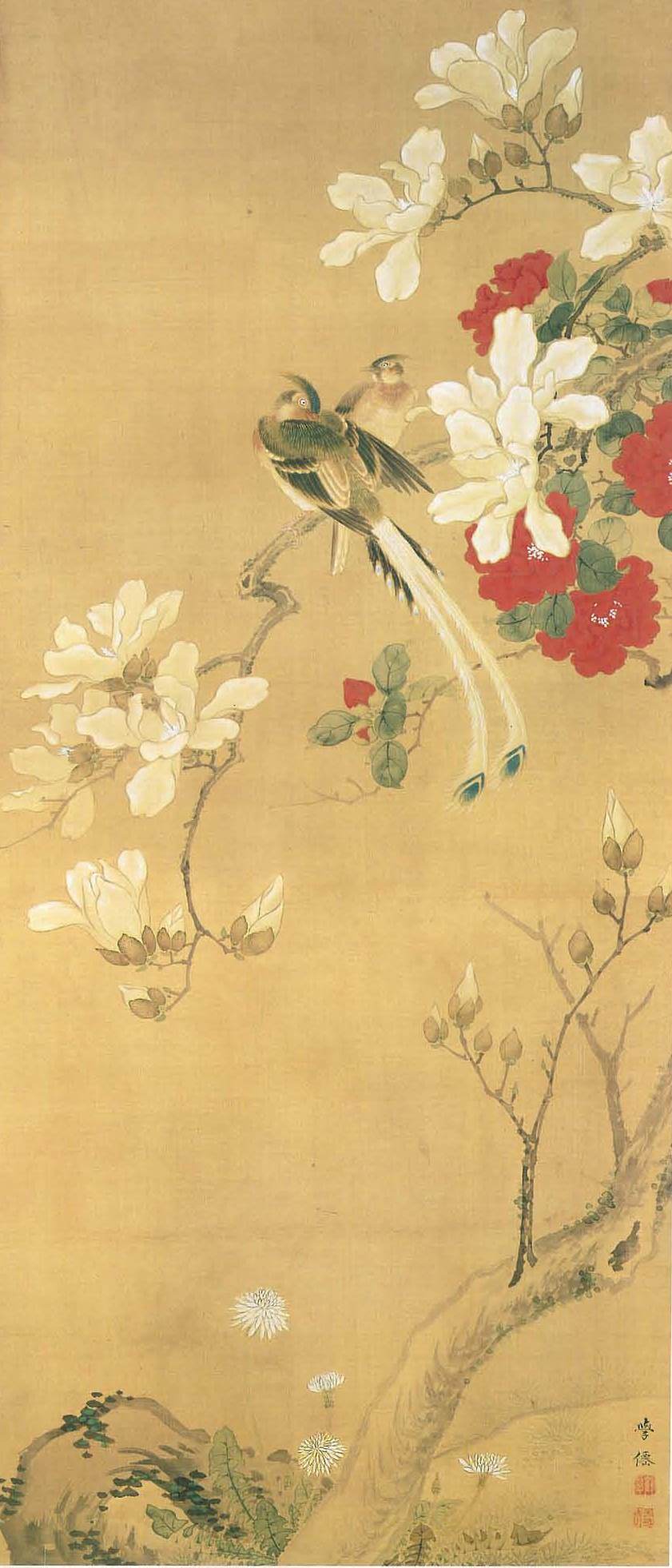
Long-Tailed Cocks on a Magnolia Branch by Ōba Gakusen

In 1820, Ōba Gakusen was born in Yamagata Prefecture. Gakusen had started his learning under the guidance of Asakura Nanryō, a painter of Tokuyama Domain, but later went to Kyoto and asked Oda Kaisen, a Nanga painter, for the instruction. After the Restauration of Meiji (around 1868), Ōba Gakusen moved to Tokyo and exhibited his works at the 1st Naikoku Kangyō Hakurankai exhibition in 1877, and at the 2nd in 1881. And at the 2nd exposition, he received an honorable mention. Moreover, Gakusen served as a judge at the 1st Naikoku Kaiga Kyōshinkai exhibition held in 1882. Also in 1882, Gakusen exhibited his works at the Japanese Art Inspection in Paris. In the following year, 1883, Gakusen was assigned as a judge at the 2nd Naikoku Kaiga Kyōshinkai exhibition, and there, he himself won the silver prize. Later, Gakusen was involved in various art works including the production of Sugito-e (painting on cedar-board doors) at the Imperial Palace which was completed in 1888. In August 1899, Gakusen died in Shimonoseki, Yamaguchi. Takashima Hokkai, a Japanese painter, who gave an influence to the Art Nouveau Nancy School, was Gakusen’s son-in-law. Among Gakusen’s works, Chinese figure paintings which he learned from his master, Oda Kaisen, were the best and he frequently created works of this genre. Gakusen created some fine works of bird-and-flower paintings, too. And these pair scrolls are two of his masterpieces in this genre. One of these pair scrolls, “Mandarin Ducks on a Snowed Plum Stem”, has symmetrical and coherent composition; peculiar rock cliff on the left in contrast to plum branch on the right; a cock mandarin duck on the upper side of the left plum stem and a plum blanch below that stem. In comparison to the size of mandarin ducks, plum flowers were drawn bigger. One may feel that it is to create a decorative canvas. Almost the same can be said to another, “Long-Tailed Cocks on a Magnolia Branch”. Larger Magnolia tree and camellia flowers, compared to the size of long-tailed cocks, exhibit a sufficient decorative effect that Gakusen intended.
    NameRequired

    SexRequired

    MaleFemale

    CountryRequired

    e-mailRequired

    CommentRequired

    Attached File
    ※Up to 3 MB for each file.


    ← ← "MUST CHECK" / Please confirm the above contents again and check this button.

    Contact Us

    Please fill out the form below and submit for your inquiry.

    ❈FirstName
    ❈LastName
    Country
    ❈E-mail
    (❈Confirm E-mail)
    ❈Inquiry category Question
    Consultation
    Impression
    Request
    Others
    ❈Comment

    is the mark for required item.


    Your privacy is important to us. We are committed to protecting your privacy.

    (or press ESC or click the overlay)

    CEO Message

    Our Feelings For Kakejiku


     The Japanese people have long set a high value on aesthetic senses since ancient times. As a result, the
    peculiar culture which is not seen in other countries blossomed and many aspects of the modern Japanese
    culture come from it. Parts of Japanese culture has been introduced to people in other countries recently,
    so the number of people from other countries who are interested in Japanese culture has been increasing.
    However, the Japanese aesthetic senses, which are the bases of Japanese culture, have been nurtured
    through a long history, intertwining various elements intricately, such as climate, geographical features,
    religion, customs and so on. Therefore, they are very difficult to understand not only for people from other
    countries, but even for the Japanese people. I think the best tool which conveys these difficult senses
    understandably is a “kakejiku.”
     The kakejiku (a hanging scroll; a work of calligraphy or a painting which is mounted and hung in an
    alcove or on a wall) is a traditional Japanese art. It's no exaggeration to say that paintings are what
    express aesthetic senses at all times and places. The kakejiku is an art which expresses the Japanese
    aesthetic senses. The kakejiku has long been used in traditional Japanese events, daily life and so on since
    ancient times. As a result, there are various customs of kakejiku in Japan; kakejiku and the life of the
    Japanese are closely related. We can see Japanese values through kakejiku.
     The kakejiku is a cultural tradition which the Japanese people should be proud of. However, many people
    in other countries don't know much about it because it hasn't been showcased as much. This is why I
    decided to try to introduce it. The kakejiku world is very interesting and beautiful. We want not only the
    Japanese, but also many people from other countries to know and enjoy it. I hope that many people will
    love kakejiku someday.

    (or press ESC or click the overlay)
    Company Profile
    syaoku.jpg(120220 byte)

    Name Art Nomura


    President Tatsuji Nomura


    Founded1973


    Established1992


    Address7-23 Babadori, Tarumi-ku, Kobe city,
    Hyougo Prefecture, 655-0021, Japan


    Capital10 million yen


    URLhttp://nomurakakejiku.com


    Our Business

     Art Nomura is an art dealer which produces kakejiku (hanging scrolls). We mount many paintings and calligraphic works in kakejiku in my factory. Kakejiku are our main product. We also remount and repair old or damaged kakejiku. We share the traditional Japanese art of kakejiku with people all over the world.


    (or press ESC or click the overlay)
    Access Map

    Access Map


     The Japanese people have long set a high value on aesthetic senses since ancient times. As a result, the
    peculiar culture which is not seen in other countries blossomed and many aspects of the modern Japanese
    culture come from it. Parts of Japanese culture has been introduced to people in other countries recently,
    so the number of people from other countries who are interested in Japanese culture has been increasing.
    However, the Japanese aesthetic senses, which are the bases of Japanese culture, have been nurtured
    through a long history, intertwining various elements intricately, such as climate, geographical features,
    religion, customs and so on. Therefore, they are very difficult to understand not only for people from other
    countries, but even for the Japanese people. I think the best tool which conveys these difficult senses
    understandably is a “kakejiku.”
     The kakejiku (a hanging scroll; a work of calligraphy or a painting which is mounted and hung in an
    alcove or on a wall) is a traditional Japanese art. It's no exaggeration to say that paintings are what
    express aesthetic senses at all times and places. The kakejiku is an art which expresses the Japanese
    aesthetic senses. The kakejiku has long been used in traditional Japanese events, daily life and so on since
    ancient times. As a result, there are various customs of kakejiku in Japan; kakejiku and the life of the
    Japanese are closely related. We can see Japanese values through kakejiku.
     The kakejiku is a cultural tradition which the Japanese people should be proud of. However, many people
    in other countries don't know much about it because it hasn't been showcased as much. This is why I
    decided to try to introduce it. The kakejiku world is very interesting and beautiful. We want not only the
    Japanese, but also many people from other countries to know and enjoy it. I hope that many people will
    love kakejiku someday.

    (or press ESC or click the overlay)