Shikoku Pilgrimage Temple: No. 31 Godai-zan Konjiki-in Chikurin-ji
The Temple Associated with Junshin, the Monk from the “Yosakoi Bushi” Song.
- Name: Godai-zan Konjiki-in Chikurin-ji
- Principal Image: Monju Bosatsu (Mañjuśrī)
- Goeika (Pilgrimage Song):
- I have heard that Monju, to whom I offer my devotion, is the mother of the Buddhas of the three worlds; since I too am her child, I long for her milk.
Access From Temple No. 30, Zenraku-ji
- On foot: Return along the approach of Tosa Shrine towards Tosa-Ikku Station, and head south on Prefectural Route 44. The last 1 km is a mountain road with a rather steep uphill slope. Approx. 6 km, 2 hours.
- By Car: Drive from Prefectural Route 384 to Prefectural Route 44, and turn right at the intersection where the East Fire Station is located. Cross the Kokubu River, turn left, head south along the river, cross Aoyagi Bridge, and enter the road going up to Godaisan Park, where Chikurin-ji is located. Incidentally, the road in Godaisan Park is one-way, entering from the Aoyagi Bridge side on the north and exiting to the south.
- Public Transport: From the Ichinomiya Jinja-mae bus stop, take the Tosaden Kōtsū Bus bound for Kōchi City for 20 minutes, get off at Harimayabashi, and transfer to the Tosaden Kōtsū MY-Yū Bus bound for Katsurahama.
A Temple on a Scenic High Ground
The temple’s mountain name, Godai-zan, comes from Mount Wutai in China, one of the sacred mountains of Chinese Buddhism where Monju Bosatsu is said to have appeared. As a sacred site with a mountain shape resembling that Godaishan, it was founded in the 1st year of Jinki (724) by Gyōki, who enshrined Monju Bosatsu here by the imperial decree of Emperor Shōmu.
The temple stands near the summit of Mt. Godai, at an elevation of 145 meters, in the suburbs of Kōchi City. The entirety of Mt. Godai is maintained as a park, dotted with an observation deck, rest areas, and shops. It is a famous cherry blossom viewing spot representing Kōchi, and is bustling with sightseers in the spring. There is also the Makino Botanical Garden named after Tomitarō Makino, a botanist from Kōchi.
Because it is a temple in such a location, there are many tourists in the precincts. It is a temple with a bright atmosphere, built in a scenic tourist spot.
Historic Buildings Scattered Throughout the Temple Grounds
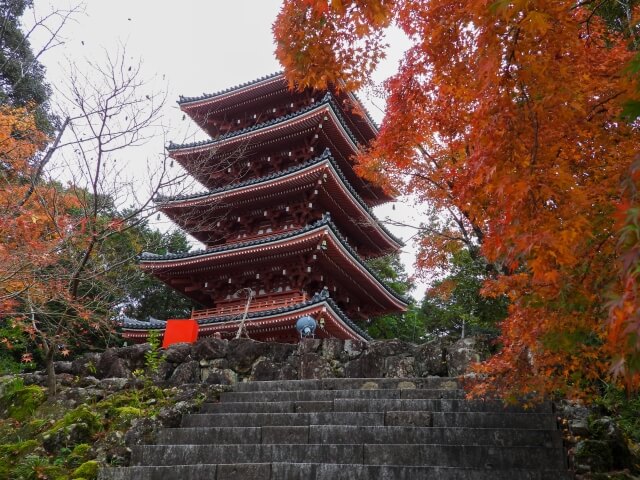
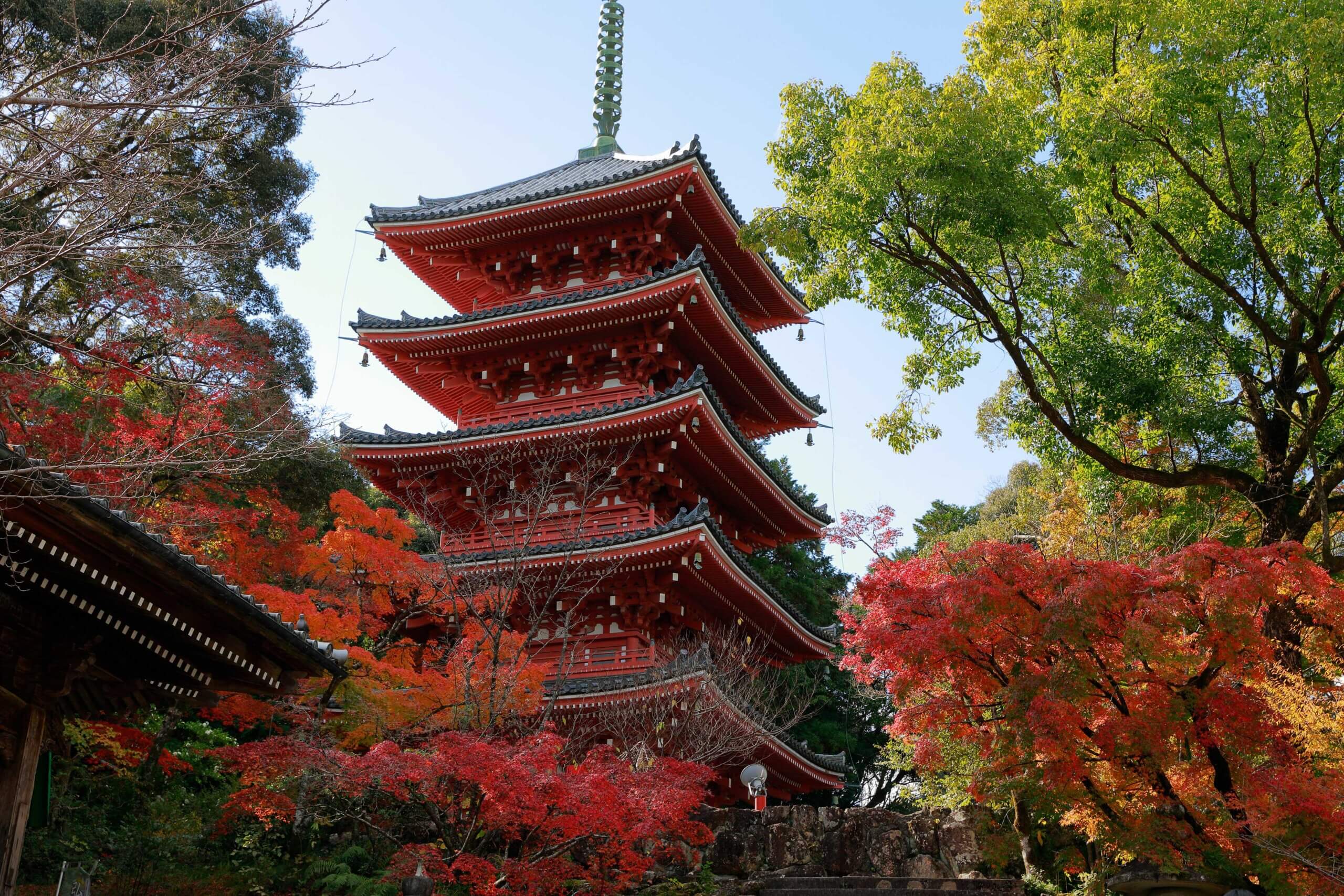
Although it is a temple on a mountain, the precincts are spacious. Climbing the stone steps surrounded by trees, you will find the Niō-mon Gate with a magnificent atmosphere. Climbing the stone steps further, the Daishi-dō Hall is on the left, the Five-Storied Pagoda (Gojūnotō) towers behind it, and the Hondō (Main Hall) stands facing the Daishi-dō.
The Five-Storied Pagoda was rebuilt in 1980 (Shōwa 55), but in Kōchi Prefecture, where the impact of the Haibutsu Kishaku (anti-Buddhist movement) was significant, this tower is currently the only five-storied pagoda in the prefecture.
Both the Hondō and the Daishi-dō are Muromachi-style buildings constructed in the 21st year of Kan’ei (1644) by Yamauchi Tadayoshi, the 2nd lord of the Tosa Domain, and are National Important Cultural Properties. In the Hondō, a plaque reading “Monju-kaku” written by Yamauchi Toyosuke, the 12th lord of the Tosa Yamauchi Domain, is hung, and it is also called the Monju-dō. The principal image, Monju Bosatsu, is carved from a single piece of camphor wood. It is the oldest wooden statue of Monju Bosatsu in Japan and is also a National Important Cultural Property.
Treasure House Lined with Buddhist Statues from the Fujiwara to Kamakura Periods
The principal image, Monju Bosatsu, is a statue created in the Heian period. It depicts the Godai-zan Monju riding a lion and accompanied by four attendants, including Zenzai Dōji (Sudhana). It is a hidden Buddha (hibutsu). Incidentally, in the sutra called the Kegonkyō (Avatamsaka Sutra), Zenzai Dōji is introduced as follows.
Following the guidance of Monju, the youth visited 53 people who could be called masters in various fields to receive teachings from spiritual friends and wise guides, and opened his eyes to the world of enlightenment. Those from whom the youth asked for teachings ranged from Buddhas and Bodhisattvas to wealthy people, doctors, fishermen, and courtesans. He practiced the principle that “everyone other than myself is my teacher” and opened his path. It is also said that the number of spiritual teachers the youth visited became the basis for the number of post stations in the “Fifty-Three Stations of the Tōkaidō.”
The Treasure House exhibits Important Cultural Property Buddhist statues such as the Yakushi Nyorai statue and the Eleven-Faced Kannon (Jūichimen Kannon) statue from the Fujiwara period, as well as the majestic Daiitoku Myōō and Aizen Myōō. It is said to be the foremost treasury of cultural properties in Kōchi Prefecture, as one-third of the Important Cultural Property Buddhist statues in Kōchi Prefecture can be seen here.
A Scenic Garden Beautiful in All Seasons
Within the grounds, there is also a garden designated as a National Scenic Spot, said to have been built by the Zen monk Musō Kokushi in the Muromachi period. Built utilizing the natural topography, the North Garden and West Garden spread out surrounding the Shoin (Study Hall). The North Garden is a bright garden typical of the southern region. The West Garden is an elegant garden consisting of an artificial hill imitating Mount Lu in China and a pond where lotuses bloom. Seasonal flowers beautifully color the garden, such as azaleas in early summer and autumn leaves in autumn.
Incidentally, the Shoin from which to appreciate the garden is a beautiful Shoin-style building constructed in the mid-Edo period as a place to host the Yamauchi clan, the lords of the Tosa Domain, when they visited the temple. It is a National Designated Cultural Property.
The Temple Associated with “Yosakoi Bushi”
Chikurin-ji is also known as the temple where Junshin, the monk who bought a hairpin sung about in the “Yosakoi Bushi” song, lived. According to legend, around the end of the Edo period, Ouma, the daughter of a tinker, began to have feelings for the monk Junshin while visiting Chikurin-ji, brought along by her mother who did volunteer work such as cleaning and washing at the temple. On the other hand, Junshin likely bought a hairpin as a token of gratitude for Ouma, who took care of him.
However, in the Edo period, it was strictly forbidden for monks to associate with women. Perhaps someone saw Junshin buying the hairpin, and the rumor spread quickly. Junshin could no longer stay at the temple and decided to elope. The two who fled hand in hand settled in Kotohira, where Ouma worked as an inn maid and Junshin as a terakoya (temple school) teacher, but eventually, their identities were discovered and they were captured. It is said that the two were exposed to the public in the castle town of Kōchi and later sentenced to banishment. Harimayabashi, where Junshin bought the hairpin, is about 6 km from this temple. It might be nice to walk the one-way journey of over an hour and think about the feelings of Junshin, who went to buy the hairpin.
DATA
Address: 3577 Godaisan, Kōchi City, Kōchi Prefecture
Phone: 088-882-3085
Access: From JR Kōchi Station on the Dosan Line, take the Tosaden Kōtsū MY-Yū Bus bound for Katsurahama for 29 minutes, and get off at Chikurin-ji-mae.
Parking: Available (Free)
Lodging: None
*The Scenic Garden and Treasure House are open from 8:30 to 17:00, no holidays. Admission fee: 400 yen.
Your Pilgrimage, Your Art
Completing the Shikoku Pilgrimage is a once-in-a-lifetime journey—but what if you could preserve it in a form that lasts forever?
Many pilgrims collect red stamps and calligraphy from each temple on a special silk scroll called a nōkyōjiku.
This sacred record of your path can be transformed into a kakejiku—a traditional Japanese hanging scroll—not only preserving the memories, but turning them into a work of cultural and spiritual art.
It’s more than a souvenir—it’s a way to honor your journey, your prayers, and your growth.
To learn more about how a nōkyōjiku becomes a kakejiku, and what makes this transformation so meaningful, please refer the below link.