Kaneshige Ankō: A Female Japanese-Style Painter in Combat Over Adversity, Master of Kachō-ga
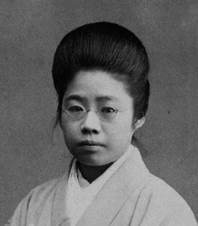
Kaneshige Ankō

Gyokuran Sōkujakuzu (Picture of White Magnolia And Two Peacocks)
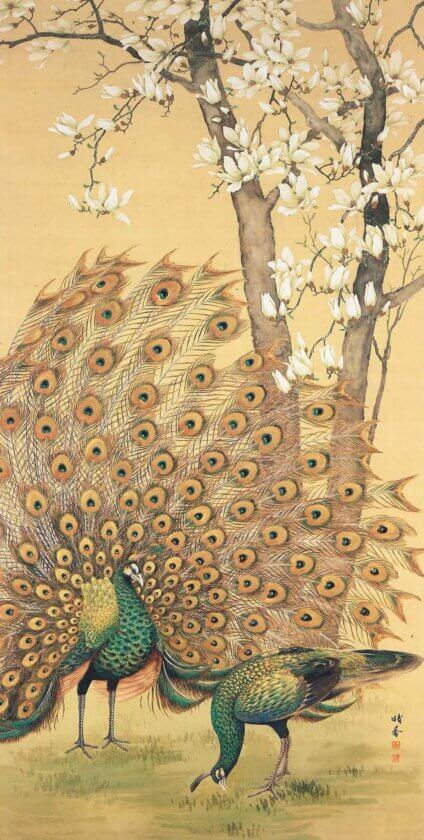
Gyokuran Sōkujakuzu (Picture of White Magnolia And Two Peacocks) by Kaneshige Ankō

Kaneshige Ankō was born in Yamaguchi prefecture in 1872. She lost the complete freedom of her legs in an accident when she was 5 years old, which has no denying that this had a significant impact on the development of her painting career. She followed her father to Tōkyō in 1880, where she initially studied Western-style painting. She then switched to Japanese-style painting to study it under Noguchi Shōhin, a female Nanga painter who later became an Imperial Household Artist. Gaining experience under Shōhin, Ankō was very active in the Japan Art Association and the Japanese Painting Association to be selected for the 2nd Bunten exhibition in 1908. She returned to Yamaguchi Prefecture during World War II for evacuation, where she died in 1946.

“Gyokuran Sōkujakuzu” was painted in 1927. Completing large paintings one after another at this period, Ankō placed herself at her best. Ankō summed up this large painting in a concise and powerful composition with a finish of the peacocks in gold paint and vivid colors to beautifully depict their lustrous feathers.

Shunjū Kachōzu (Picture of Spring / Autumn, Flower / Bird)
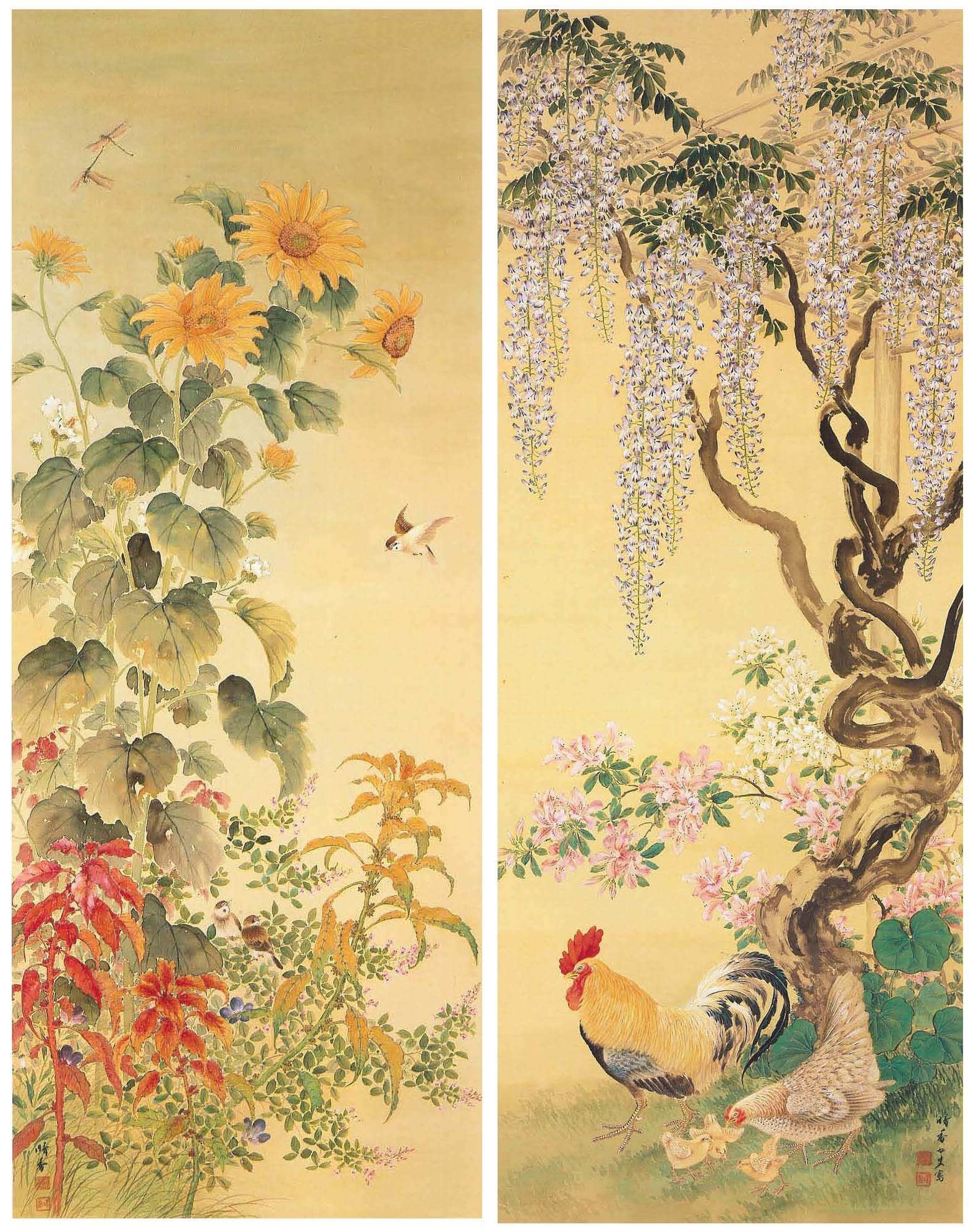
Shunjū Kachōzu (Picture of Spring / Autumn, Flower / Bird) by Kaneshige Ankō

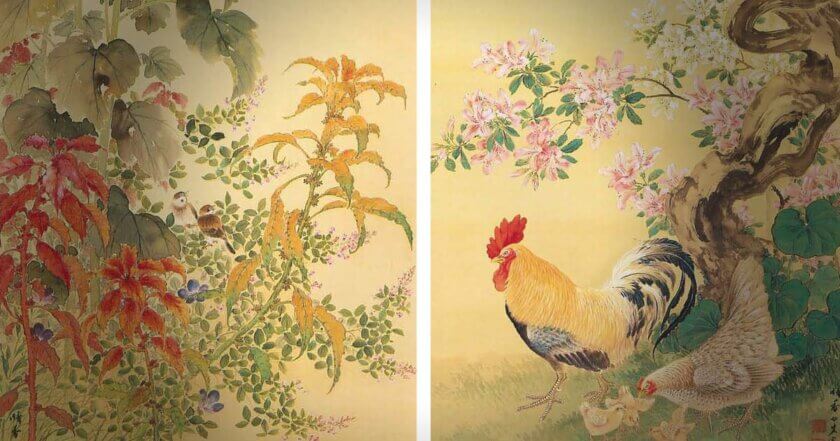
This is a 1928 painting by Kaneshige Ankō. She was lame as mentioned earlier, which seems to make landscape painting out of her forte. Many of Ankō’s landscape paintings, available from the data, are patterned in the Nanga style, which is thought to have been learned from her master, Noguchi Shōhin. In terms of Kachō-ga, on the other hand, she showed her great ability as you can see even in this work. Similar to this work, Ankō’s works include “Kouka Zenkei,” in which wisteria and chicken are depicted (a traditional painting of a male and female chicken with a flock of chicks), and “Shūen Kinshū,” in which autumn plants are depicted (an autumn garden with autumn leaves and flowers). Particularly in this work, azaleas, Farfugium japonicum, sunflower, and sparrows are added to each of its scrolls to make it more decorative. It is accordingly inevitable that the painting looks a little complicated. In terms of technique, the depiction of the wisteria trunk is splendid. She skillfully devises different shades of sumi (black ink) along with the use of brush’s blur to depict the smooth but uneven texture uniquely of the wisteria trunk. In addition to the vivid depiction of sparrows and dragonflies in autumn, the considered use of the tarashikomi technique (Tarashikomi: A high-level technique of Japanese-style painting for attaining natural blur by making use of the difference in the specific gravity of pigments.) for the depiction of sunflower leaves cannot be overseen.

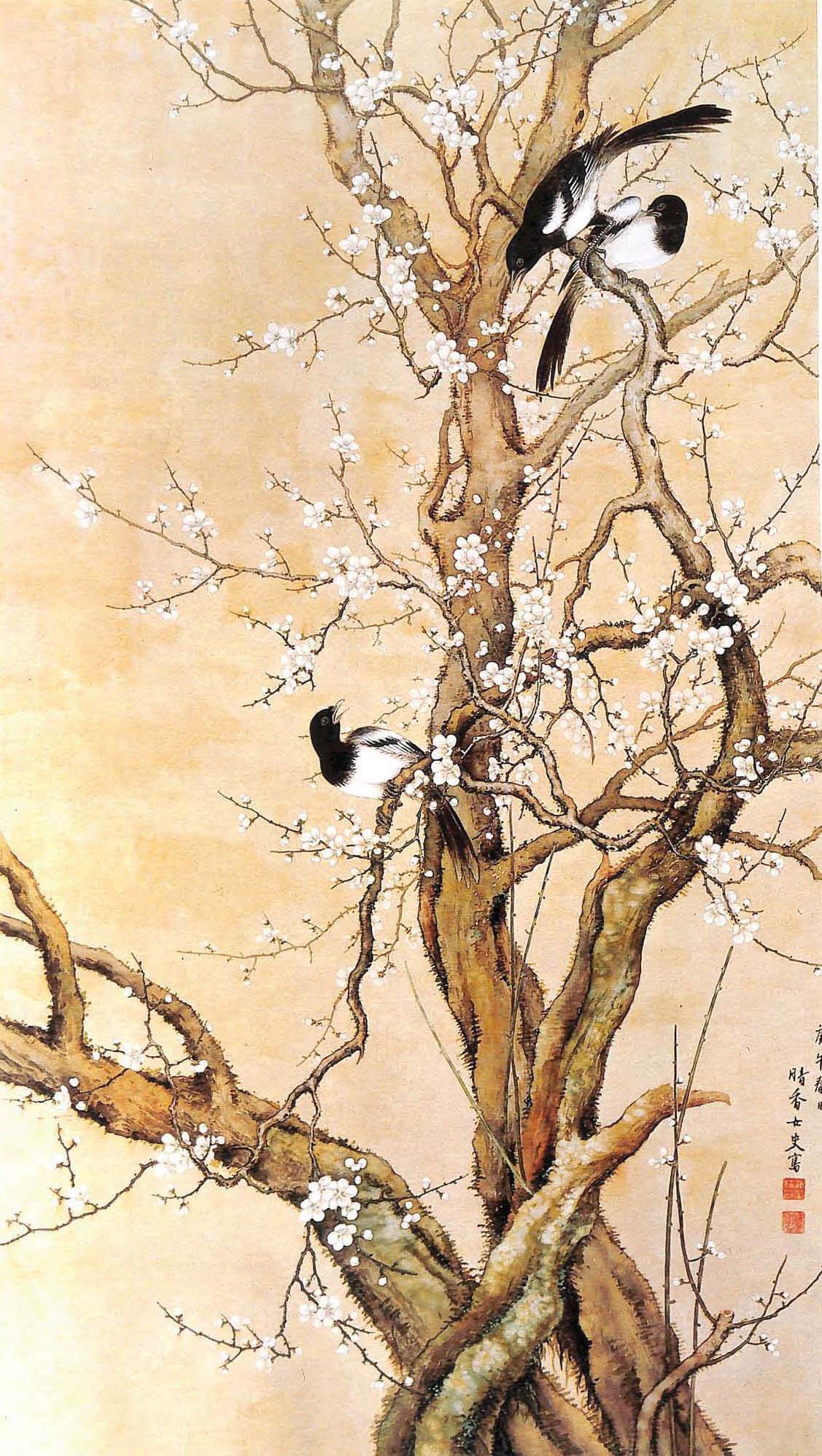
Ume-ni Kasasagi (Plum and Magpie)
Ume-ni Kasasagi (Plum and Magpie) by Kaneshige Ankō

The free-growing trunks of the giant mossy plum tree are very powerfully depicted, adding intensity to the painting. You may wonder if this way of depicting a plum is quite rare. The scene is composed around the tree trunk, which is drawn up to the very top, leaning slightly to right. 3 magpies are placed diagonally from the upper right to the lower left to give the composition some variety and movement. The absence of splendor with colors through the combination of the white plum blossoms and the magpies gives a sense of withdrawn strength. This work is one of Ankō’s masterpieces.
    NameRequired

    SexRequired

    MaleFemale

    CountryRequired

    e-mailRequired

    CommentRequired

    Attached File
    ※Up to 3 MB for each file.


    ← ← "MUST CHECK" / Please confirm the above contents again and check this button.

    Contact Us

    Please fill out the form below and submit for your inquiry.

    ❈FirstName
    ❈LastName
    Country
    ❈E-mail
    (❈Confirm E-mail)
    ❈Inquiry category Question
    Consultation
    Impression
    Request
    Others
    ❈Comment

    is the mark for required item.


    Your privacy is important to us. We are committed to protecting your privacy.

    (or press ESC or click the overlay)

    CEO Message

    Our Feelings For Kakejiku


     The Japanese people have long set a high value on aesthetic senses since ancient times. As a result, the
    peculiar culture which is not seen in other countries blossomed and many aspects of the modern Japanese
    culture come from it. Parts of Japanese culture has been introduced to people in other countries recently,
    so the number of people from other countries who are interested in Japanese culture has been increasing.
    However, the Japanese aesthetic senses, which are the bases of Japanese culture, have been nurtured
    through a long history, intertwining various elements intricately, such as climate, geographical features,
    religion, customs and so on. Therefore, they are very difficult to understand not only for people from other
    countries, but even for the Japanese people. I think the best tool which conveys these difficult senses
    understandably is a “kakejiku.”
     The kakejiku (a hanging scroll; a work of calligraphy or a painting which is mounted and hung in an
    alcove or on a wall) is a traditional Japanese art. It's no exaggeration to say that paintings are what
    express aesthetic senses at all times and places. The kakejiku is an art which expresses the Japanese
    aesthetic senses. The kakejiku has long been used in traditional Japanese events, daily life and so on since
    ancient times. As a result, there are various customs of kakejiku in Japan; kakejiku and the life of the
    Japanese are closely related. We can see Japanese values through kakejiku.
     The kakejiku is a cultural tradition which the Japanese people should be proud of. However, many people
    in other countries don't know much about it because it hasn't been showcased as much. This is why I
    decided to try to introduce it. The kakejiku world is very interesting and beautiful. We want not only the
    Japanese, but also many people from other countries to know and enjoy it. I hope that many people will
    love kakejiku someday.

    (or press ESC or click the overlay)
    Company Profile
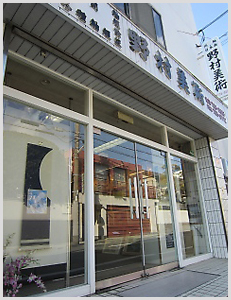
    syaoku.jpg(120220 byte)

    Name Art Nomura


    President Tatsuji Nomura


    Founded1973


    Established1992


    Address7-23 Babadori, Tarumi-ku, Kobe city,
    Hyougo Prefecture, 655-0021, Japan


    Capital10 million yen


    URLhttp://nomurakakejiku.com


    Our Business

     Art Nomura is an art dealer which produces kakejiku (hanging scrolls). We mount many paintings and calligraphic works in kakejiku in my factory. Kakejiku are our main product. We also remount and repair old or damaged kakejiku. We share the traditional Japanese art of kakejiku with people all over the world.


    (or press ESC or click the overlay)
    Access Map

    Access Map


     The Japanese people have long set a high value on aesthetic senses since ancient times. As a result, the
    peculiar culture which is not seen in other countries blossomed and many aspects of the modern Japanese
    culture come from it. Parts of Japanese culture has been introduced to people in other countries recently,
    so the number of people from other countries who are interested in Japanese culture has been increasing.
    However, the Japanese aesthetic senses, which are the bases of Japanese culture, have been nurtured
    through a long history, intertwining various elements intricately, such as climate, geographical features,
    religion, customs and so on. Therefore, they are very difficult to understand not only for people from other
    countries, but even for the Japanese people. I think the best tool which conveys these difficult senses
    understandably is a “kakejiku.”
     The kakejiku (a hanging scroll; a work of calligraphy or a painting which is mounted and hung in an
    alcove or on a wall) is a traditional Japanese art. It's no exaggeration to say that paintings are what
    express aesthetic senses at all times and places. The kakejiku is an art which expresses the Japanese
    aesthetic senses. The kakejiku has long been used in traditional Japanese events, daily life and so on since
    ancient times. As a result, there are various customs of kakejiku in Japan; kakejiku and the life of the
    Japanese are closely related. We can see Japanese values through kakejiku.
     The kakejiku is a cultural tradition which the Japanese people should be proud of. However, many people
    in other countries don't know much about it because it hasn't been showcased as much. This is why I
    decided to try to introduce it. The kakejiku world is very interesting and beautiful. We want not only the
    Japanese, but also many people from other countries to know and enjoy it. I hope that many people will
    love kakejiku someday.

    (or press ESC or click the overlay)