
Ikegami Shūho: The Star Japanese Artist Under Araki Kanpo

Picture of Butterfly on the Morning Glory
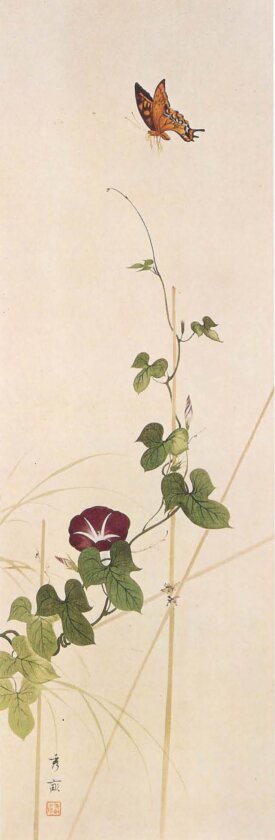
Picture of Butterfly on the Morning Glory by Ikegami Shūho

Ikegami Shūho was born in Nagano Prefecture. His father was Ikegami Shūka, a painter of the Shijō school. He studied under Araki Kanpo and had preferences for the landscape paintings by the painting style of the North-South Combinatorial School by Tani Bunchō and flower and bird paintings by Okamoto Shūki. In 1908, he was selected for the second Bunten exhibition for the first time and received awards, and after 1916 he received special awards three times in a row. As an elder of the Dokugakai painting school held by the father and son of Araki Kanpo and Araki Jippo, he was a leader of the school. While his paintings of flowers and birds were based on the scientific observations he got from Kanpo and some solidities differ from the Shijō School’s light-hearted style, as a representative flower and bird painters of the Tokyo area at the Bunten and Teiten exhibitions, he painted pictures in a profound style.

Although this painting is made by light brushstroke which is exceptional as his brushstrokes, his depiction of the leaves is somewhat uniform and stiff, and the butterfly in flight seems heavy. Rather, the morning glory tree looks unreliable. On the other hand, the vividness of the morning glory and the puffy buds are making this painting more fascinating.
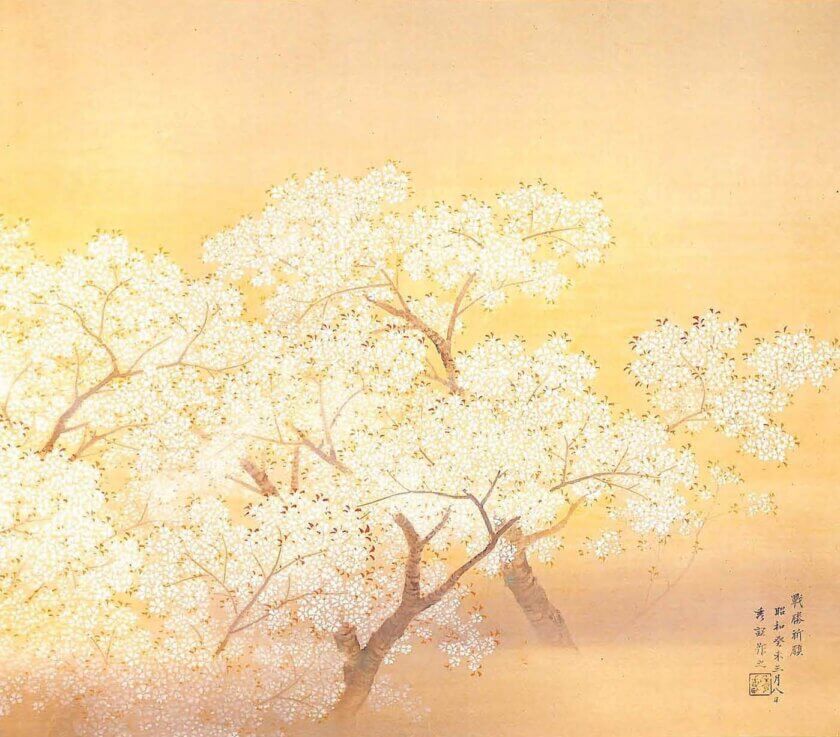
Mountain Cherry Blossom by Ikegami Shūho

Shūho received a special prize at the Tenth and Eleventh Bunten exhibition respectively and established his position as a Japanese-style painter. Since he was not satisfied with the examinations of the Bunten exhibition, he established a new organization, which became the basis of the Bunten reform. He also hosted the Densindō Gajuku School and trained his pupils. In his later years, in the Second World War and art materials are short, but he drew pictures and dedicated them to the various shrines. This painting is thought to be one of those paintings. It was painted in 1943 when goods were in short supply and the war was going on recklessly and the shadow of defeat was beginning to hang over the war situation. Shūho, who believed in the holy war, used his talent to paint the flowers and birds that symbolized Japan and continued to dedicate them to the shrine where the gods reside. This painting depicts a huge mountain cherry blossom tree in full bloom at the height of its maturity, and in the screen with a thin layer of gold paint, mountain cherry blossoms blooming in profusion are clearly painted up to their five petals. The young buds that emerge along with the flowers are also a beautiful color, befitting the name “redbuds.” Cherry blossom is so representative flower of Japan that it is often referred to as “cherry blossoms” in the spring and “autumn leaves” in the fall, and as if Shūho’s strong feelings for his country were reflected in the cherry blossoms in this work, they are blooming beautifully on both sides of this picture.

Flowers and Birds Paintings
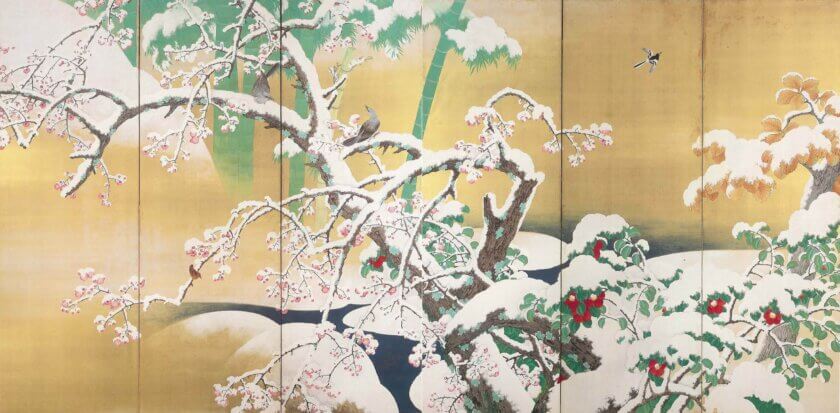
Flowers and Birds Paintings by Ikegami Shūho

Ikegami Shūho belonged to the Japan Art Association and received the second prize at the this institution’s exhibition or Tokyo Kangyō Hakurankai exhibition in 1907, and at the first Bunten exhibition, he belonged to the Seiha Dōshikai, which opposed it, but after the second Bunten exhibition, he exhibited his works every year, and since the fourth exhibition, he won the second prize once, the third prize twice, and the honorable mentions with three times in a row, besides, he received special selections for the tenth, eleventh, and twelfth exhibitions, and he was a star painter. At the first Teiten exhibition in 1919, he was recommended (Permanently uninspected), and in 1924, he was appointed as a member of the Teiten committee.
This work was submitted to the Seventh Teiten exhibition in 1926, when he was the most exuberant period. He was regarded as a representative of the technical painters, he may have excessively painted in this work, but the San-yū (pine, bamboo, and plum blossoms) is drawn in a narrow space, and cold camellia, turtle dove, and wagtail are arranged between them, and the soil covered with running water and snow is treated in a Rinpa style, and show decorative consideration. It is interesting to note that Araki Kanpo’s heir, Araki Jippo, also frequently integrated the Rinpa school style in the early Taishō era, which may have inspired Shūho, a rival of Jippo, to paint this work.
    NameRequired

    SexRequired

    MaleFemale

    CountryRequired

    e-mailRequired

    CommentRequired

    Attached File
    ※Up to 3 MB for each file.


    ← ← "MUST CHECK" / Please confirm the above contents again and check this button.

    Contact Us

    Please fill out the form below and submit for your inquiry.

    ❈FirstName
    ❈LastName
    Country
    ❈E-mail
    (❈Confirm E-mail)
    ❈Inquiry category Question
    Consultation
    Impression
    Request
    Others
    ❈Comment

    is the mark for required item.


    Your privacy is important to us. We are committed to protecting your privacy.

    (or press ESC or click the overlay)

    CEO Message

    Our Feelings For Kakejiku


     The Japanese people have long set a high value on aesthetic senses since ancient times. As a result, the
    peculiar culture which is not seen in other countries blossomed and many aspects of the modern Japanese
    culture come from it. Parts of Japanese culture has been introduced to people in other countries recently,
    so the number of people from other countries who are interested in Japanese culture has been increasing.
    However, the Japanese aesthetic senses, which are the bases of Japanese culture, have been nurtured
    through a long history, intertwining various elements intricately, such as climate, geographical features,
    religion, customs and so on. Therefore, they are very difficult to understand not only for people from other
    countries, but even for the Japanese people. I think the best tool which conveys these difficult senses
    understandably is a “kakejiku.”
     The kakejiku (a hanging scroll; a work of calligraphy or a painting which is mounted and hung in an
    alcove or on a wall) is a traditional Japanese art. It's no exaggeration to say that paintings are what
    express aesthetic senses at all times and places. The kakejiku is an art which expresses the Japanese
    aesthetic senses. The kakejiku has long been used in traditional Japanese events, daily life and so on since
    ancient times. As a result, there are various customs of kakejiku in Japan; kakejiku and the life of the
    Japanese are closely related. We can see Japanese values through kakejiku.
     The kakejiku is a cultural tradition which the Japanese people should be proud of. However, many people
    in other countries don't know much about it because it hasn't been showcased as much. This is why I
    decided to try to introduce it. The kakejiku world is very interesting and beautiful. We want not only the
    Japanese, but also many people from other countries to know and enjoy it. I hope that many people will
    love kakejiku someday.

    (or press ESC or click the overlay)
    Company Profile
    syaoku.jpg(120220 byte)

    Name Art Nomura


    President Tatsuji Nomura


    Founded1973


    Established1992


    Address7-23 Babadori, Tarumi-ku, Kobe city,
    Hyougo Prefecture, 655-0021, Japan


    Capital10 million yen


    URLhttp://nomurakakejiku.com


    Our Business

     Art Nomura is an art dealer which produces kakejiku (hanging scrolls). We mount many paintings and calligraphic works in kakejiku in my factory. Kakejiku are our main product. We also remount and repair old or damaged kakejiku. We share the traditional Japanese art of kakejiku with people all over the world.


    (or press ESC or click the overlay)
    Access Map

    Access Map


     The Japanese people have long set a high value on aesthetic senses since ancient times. As a result, the
    peculiar culture which is not seen in other countries blossomed and many aspects of the modern Japanese
    culture come from it. Parts of Japanese culture has been introduced to people in other countries recently,
    so the number of people from other countries who are interested in Japanese culture has been increasing.
    However, the Japanese aesthetic senses, which are the bases of Japanese culture, have been nurtured
    through a long history, intertwining various elements intricately, such as climate, geographical features,
    religion, customs and so on. Therefore, they are very difficult to understand not only for people from other
    countries, but even for the Japanese people. I think the best tool which conveys these difficult senses
    understandably is a “kakejiku.”
     The kakejiku (a hanging scroll; a work of calligraphy or a painting which is mounted and hung in an
    alcove or on a wall) is a traditional Japanese art. It's no exaggeration to say that paintings are what
    express aesthetic senses at all times and places. The kakejiku is an art which expresses the Japanese
    aesthetic senses. The kakejiku has long been used in traditional Japanese events, daily life and so on since
    ancient times. As a result, there are various customs of kakejiku in Japan; kakejiku and the life of the
    Japanese are closely related. We can see Japanese values through kakejiku.
     The kakejiku is a cultural tradition which the Japanese people should be proud of. However, many people
    in other countries don't know much about it because it hasn't been showcased as much. This is why I
    decided to try to introduce it. The kakejiku world is very interesting and beautiful. We want not only the
    Japanese, but also many people from other countries to know and enjoy it. I hope that many people will
    love kakejiku someday.

    (or press ESC or click the overlay)