Kakejiku Mounting of a Daruma Artwork Commissioned by a Customer in Germany
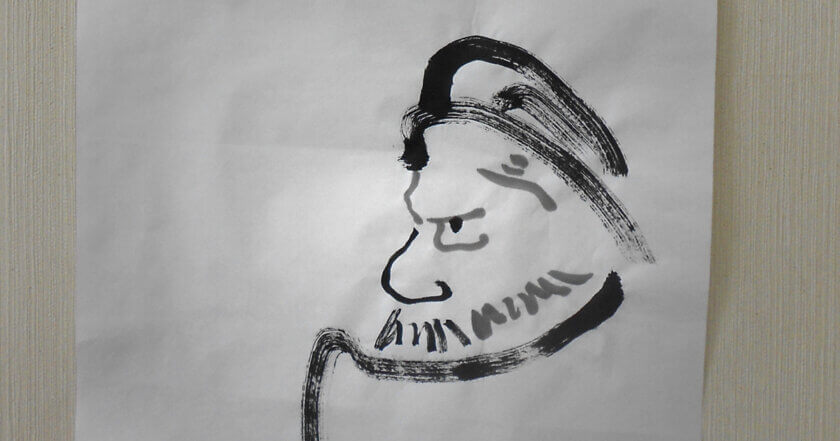
We often receive inquiries from overseas customers who would like to have their own artwork mounted as a Japanese kakejiku.
In this article, we would like to introduce the kakejiku mounting of a Daruma artwork commissioned by a customer living in Germany.
Consultation from a Customer in Germany Regarding Kakejiku Mounting of a Daruma Artwork
The customer wished to visit our shop during their trip to Japan, so we were able to see the artwork in person and discuss the mounting directly with them.
Being able to check the texture of the paper and the overall atmosphere of the artwork, which cannot be fully understood from photos alone, was very meaningful when considering the mounting direction.
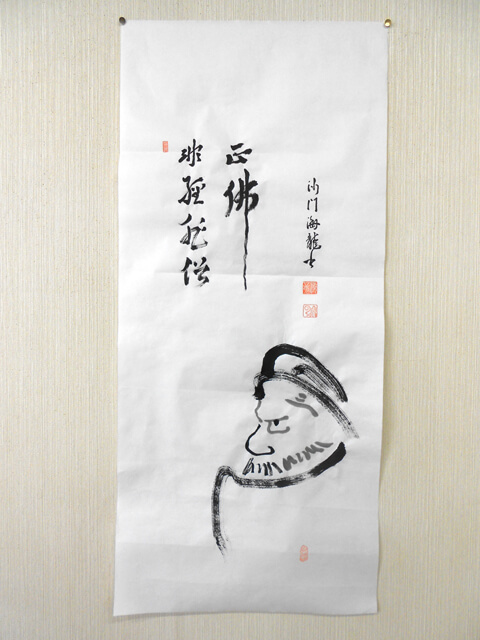
Especially in the case of artwork created by the customer themselves, the nature of the paper, ink, and red seal paste used is sometimes unknown.
In order to mount an artwork as a kakejiku, it is important to check not only its size and appearance, but also whether the work can withstand the mounting process.
Ink and Red Seal Bleeding: What to Be Careful About When Mounting Your Own Artwork as a Kakejiku
When mounting your own calligraphy or ink painting as a kakejiku, one of the first things to be careful about is the possibility of ink or red seal bleeding.
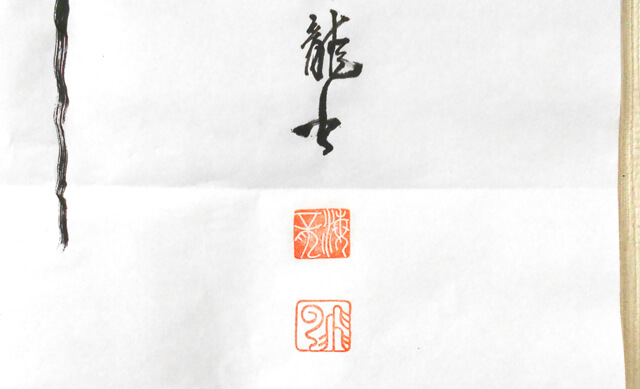
A kakejiku is not made simply by attaching fabric around the artwork.
The backing and mounting processes involve work that requires moisture.
Therefore, if the ink or red seal used in the artwork is weak against moisture, it may bleed during the mounting process.
In this Daruma artwork as well, the details of the materials used were not clear, so we first had to proceed carefully while checking the condition of the colors.
As we proceeded with the work, we found that there was not as much bleeding as initially expected. Therefore, we carefully checked the condition, applied color-fixing, and continued the work so that the piece could be mounted as a kakejiku.
Mounting an artwork as a kakejiku is not only about making the piece look more beautiful. It is also important to determine whether the artwork itself can withstand the mounting process.
Choosing Mounting Fabrics to Suit the Daruma Theme
This artwork featured Daruma as its main subject.
Daruma is a subject derived from Bodhidharma, who is known as the founder of Zen.
When mounting such a subject as a kakejiku, rather than decorating it too extravagantly, it is important to consider how to bring out the quiet presence held by the artwork itself.
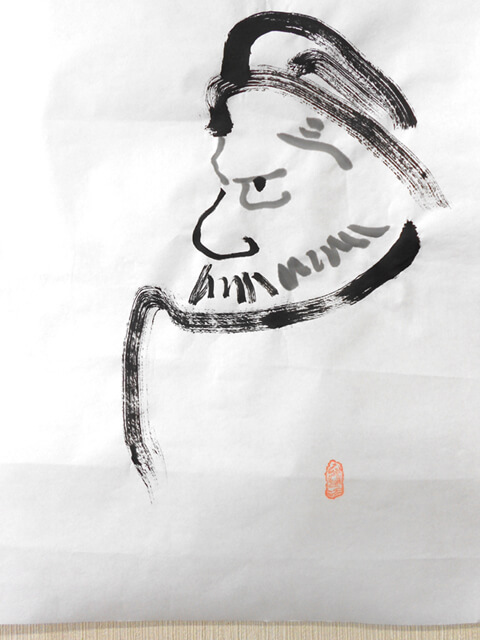
When choosing the fabrics, we considered not only the colors of the artwork itself, but also the customer’s wishes and the atmosphere they wanted the piece to have, which we learned through our conversation during their visit.
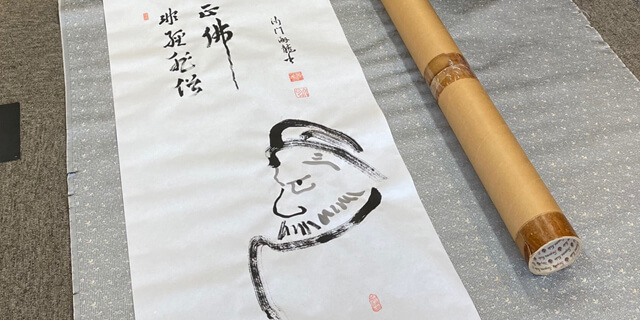
For the ichimonji fabric placed above and below the artwork, we selected a calm green fabric.
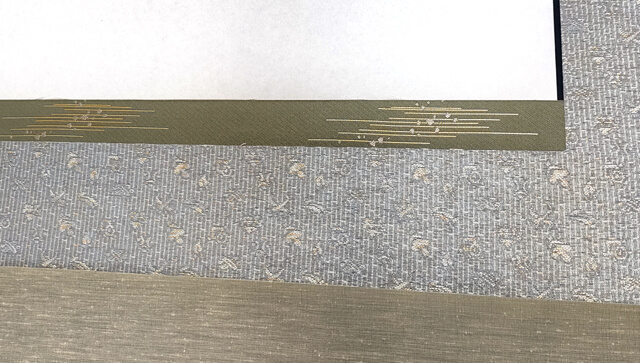
We also decided to add navy-blue suji-mawashi around the artwork. This navy-blue suji-mawashi acts like a boundary line, tightening the outline of the entire piece and creating the impression that the artwork is emerging from the surrounding fabric.
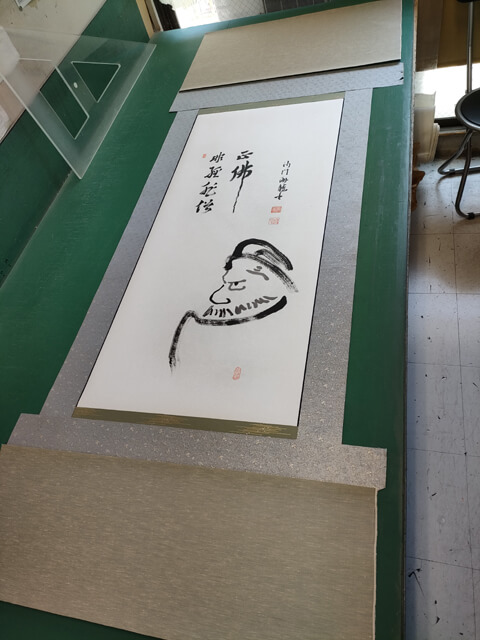
The green ichimonji gives softness and calmness to the piece, while the navy-blue suji-mawashi firmly supports the presence of the Daruma artwork.
The choice of mounting fabric for a kakejiku is not decided simply by personal preference.
We consider the subject of the artwork, the strength of the brushwork, the atmosphere of the blank space, and how the piece will look when displayed. From these factors, we think carefully about which fabric will bring out the artwork most naturally.
Mounting Process
The general flow of this mounting work was as follows.
Color-Fixing
We treated the artwork while checking its condition so that the ink and red seal paste would not bleed.
First Backing
We adhered Japanese paper to the reverse side of the artwork with paste, creating the foundation needed to mount it as a kakejiku.
Fabric Preparation
We cut the fabrics selected for the artwork to the required dimensions.
Assembling the Fabric Sections
We joined the fabrics to the main artwork in sequence with paste, gradually forming the shape of the kakejiku.
Middle Backing and Final Backing
We applied backing in stages so that the kakejiku would become stable.
Final Finishing
We attached the roller rod, the hassō (the upper wooden bar used to hang the scroll), the hanging cord, and the tying cord to complete the kakejiku.
The process itself follows the general flow of kakejiku mounting. However, in a case like this, where the properties of the ink and red seal paste were not clearly known, the initial color-fixing and condition check were extremely important.
For that reason, instead of rushing the work, we proceeded carefully while observing the condition of the artwork.
The Completed Daruma Kakejiku
After completion, the expression and brushwork of the Daruma were naturally brought out in the finished kakejiku.
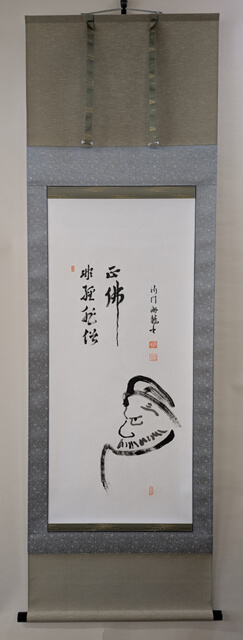
The calm green ichimonji gently supports the artwork, while the navy-blue suji-mawashi gives the whole piece a crisp and refined appearance.
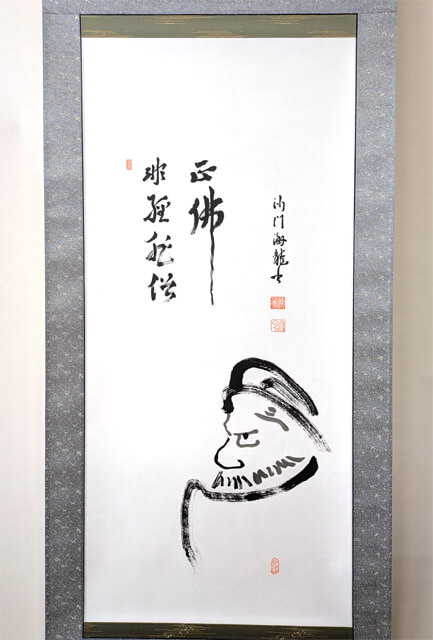
The subject of Daruma contains both strength and stillness.
For this piece, we did not aim for a flashy mounting. Instead, we focused on arranging the quiet strength of the artwork as a kakejiku.
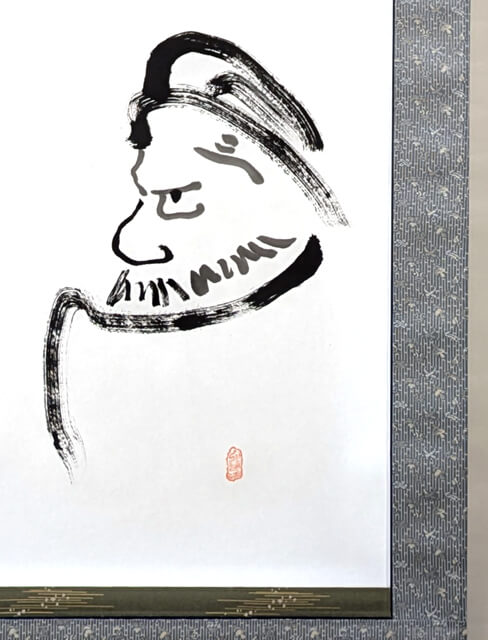
After seeing the finished photos, the customer kindly expressed their happiness that the kakejiku looked beautiful, that there was no color fading or bleeding, and that they appreciated our choices for the ichimonji and suji-mawashi.
The scroll looks beautiful and I‘m happy that the colors didn‘t fade. We appreciate your choices for the Ichimonji and the Sujii-mawashi.
Feedback After the Kakejiku Arrived at the Customer’s Home in Germany
After the final inspection, we shipped the completed kakejiku to the customer’s home in Germany.
Later, we received a message from the customer letting us know that it had arrived safely.
They expressed their gratitude for the beautifully mounted kakejiku, as well as for the careful packing and the information about how to handle the hanging scroll.
They also sent us photos showing the kakejiku displayed in their home.
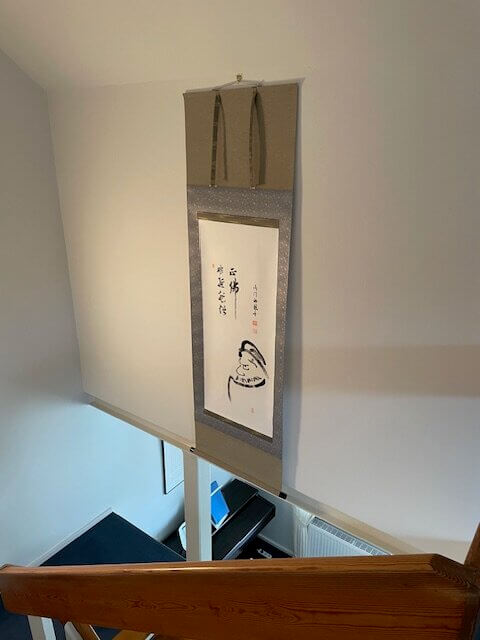
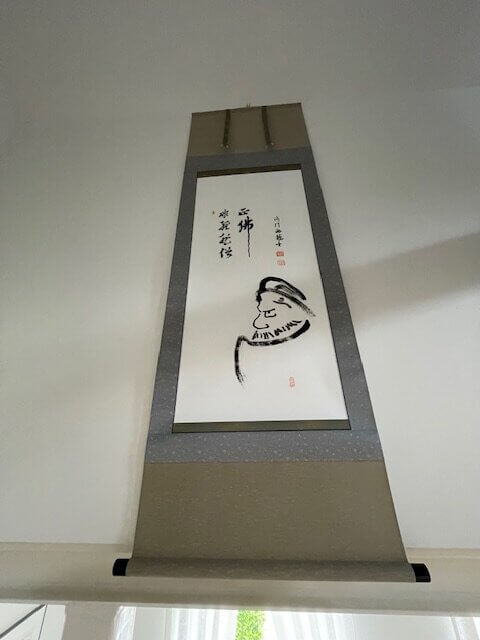
They told us that they eventually hung it in a different place from the one they had originally planned.
It was a very happy report for us, as it showed that they had chosen the place by considering how the kakejiku would fit into their actual living space.
A kakejiku truly fulfills its role only when it is hung in the customer’s daily life and can be appreciated day by day.
We are very happy that this Daruma artwork is now displayed as a kakejiku in the customer’s home far away in Germany.
Your Own Calligraphy or Ink Painting Can Be Beautifully Mounted as a Kakejiku
When mounting your own calligraphy or ink painting as a kakejiku, it is important to check not only the size of the artwork, but also the condition of the paper, ink, and red seal paste.
Especially when the materials used are not clearly known, careful judgment is needed because bleeding may occur during the mounting process.
The final impression of a kakejiku also changes greatly depending on the choice of fabric.
In kakejiku mounting, it is very important to consider the subject and atmosphere of the artwork, as well as the customer’s wishes, and to think about what kind of mounting will bring out the artwork most naturally.
At our company, we carefully examine the actual condition of each work and propose mounting that suits the artwork.
We welcome inquiries from both Japan and overseas.
If you would like to preserve your own artwork as a kakejiku, please feel free to contact us.