
Kamisaka Sekka: A successor of the Rinpa School at the Modern Age
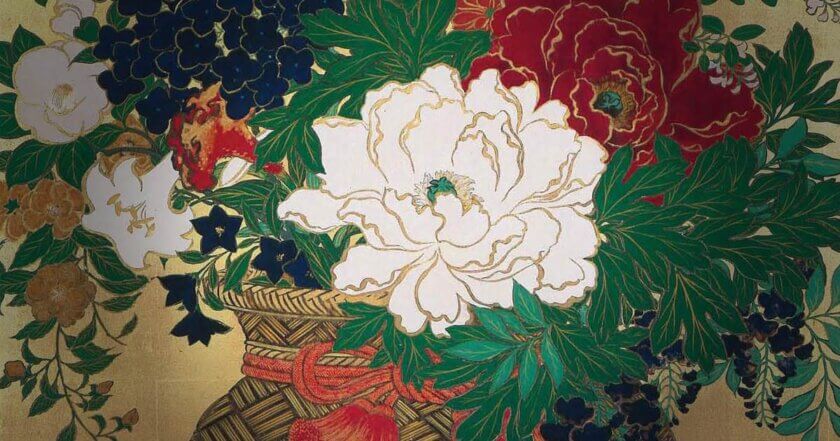
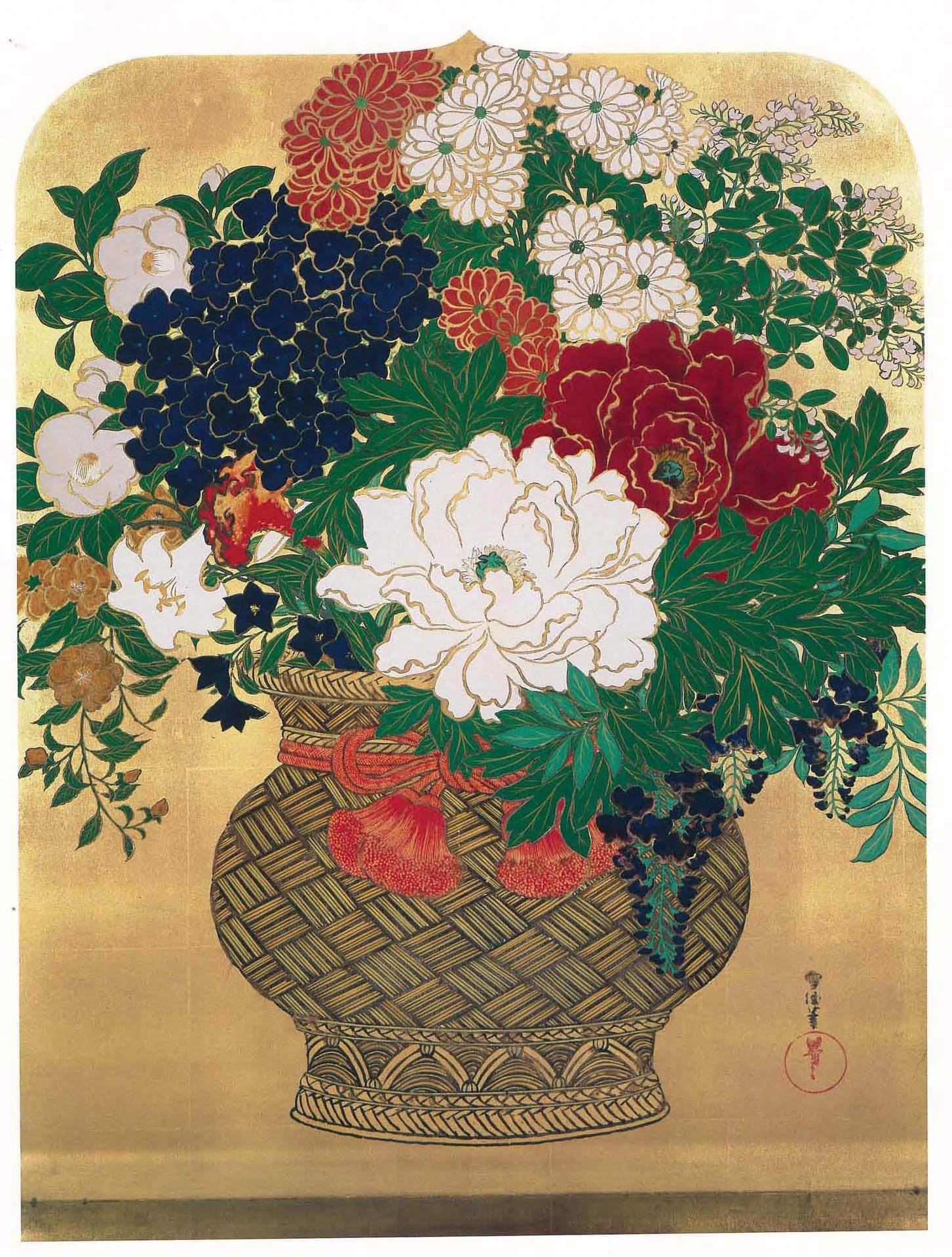
Plenty of Flowers
Kamisaka Sekka (1866-1942) was a unique painter of the Meiji, Taishō, and Shōwa period of Japan. From the ending of the Edo period to the mid Meiji period (1860s – 1900s), painters living in Kyoto were supporting their living with drawing the drafts of Yūzen kimono design. Most of them wished their career status as a painter advanced more than just playing lower roles of drawing works. Those who were working as just a painter hated that their fortune was to draw only for Yūzen, Nishijin kimono, Kyoto pottery, and wooden lacquer for traditional industry and as a second-class career. They thought their world of arts was different from the traditional arts, and those thoughts were not the object to devote themselves. They even considered that the traditional arts were worthless. Their thoughts had long-lasting repercussions for a long time. Also, even people in Kyoto segregated design painters with artist painters. Kyoto people called artist painters who submitted their works to exhibitions as “Honekakihan (real painters)” and kept their eyes supporting them.

Over the era with mixed atmosphere, Sekka was seeking an intersection of paintings and craftwork, and he devoted himself into traditional art industry. Along with pursuing Rinpa School techniques, he explored various methods and had interests with the movement of European arts. If it could be expressed in the modern terminology, Sekka played a role of an art director or designer.

f we discuss his career, we should say that he had a great influence that was equivalent to Takeuchi Seihō, who left distinctive footprints for the post-modernization of Japanese painting styles. This could be expressive for now: in reality Takeuchi Seihō was the first recipient of the Order of Culture.

This flower drawing, which painters of Rinpa School were good at, clearly presents what he was aiming at. He found the essence of decorative features of Japanese style painting in the Rinpa School, attempted to integrate painting and craftwork, and envisioned a creation of new aesthetics. We are able to see his intention in this drawing.

What makes Sekka’s painting technique unique is his usage of gold paint and foil. It is not easy to use them correctly. And if it were in a wrong track of using either gold paint or foil, a work might end up with the nasty taste of nouveau riche. Although gold is a noble color, it is not easy to use.

Sekka was one of the painters who manipulated the tough color effectively. He did not ruin the class of the color and presented splendid atmosphere in this painting. It was because of his instinct to present this gorgeous atmosphere.

Kamisaka Sekka (1866-1942) was a pre- and modern Japanese painter and designer. Living in Kyoto, he actively played a various pivotal role both paintings and craftworks.

Sekka was born in Kyoto at the time almost the Edo Tokugawa Dynasty fell. At the age of 16, he started to learn painting from Suzuki Mizuhiko, a Shijyō School of Japanese painting. After Sekka increased his interest toward decorative art, he followed to learn craft design art from Kishi Kōkei in 1890. Sekka started studying about the Rinpa School work at around this time. To researching design drawings all over the world, Sekka traveled in Europe to visit Glasgow International Exhibition in Glasgow of Britain in 1901. At that time, Japanism was a norm in Europe, and art nouveau was blossom. Sekka admitted that he realized the distinctiveness of Japanese decorative arts. At the same time he was influenced and immersed himself in the Rinpa School, such as dynamic frame structures, deformation, closed-up, trimming, or tarashikomi (a technique in which colors are dripped or brushed into wet ink) techniques, eventually he established his modern and vivid works. He also actively worked on craft design for dying, pottery, and lacquer art that decorate daily life.

Although his reputation as a painter in Japan was not quite high, he received an acclaim in the United States as a successor of the Rinpa School in the pre-modern period. As a result, abundant of his great works have outflown to abroad. His works are re-evaluated in Japan recently, but not many of them are left in Japan actually.
Contact Us

Please fill out the form below and submit for your inquiry.

❈FirstName
❈LastName
Country
❈E-mail
(❈Confirm E-mail)
❈Inquiry category Question
Consultation
Impression
Request
Others
❈Comment

is the mark for required item.


Your privacy is important to us. We are committed to protecting your privacy.

(or press ESC or click the overlay)

CEO Message

Our Feelings For Kakejiku


 The Japanese people have long set a high value on aesthetic senses since ancient times. As a result, the
peculiar culture which is not seen in other countries blossomed and many aspects of the modern Japanese
culture come from it. Parts of Japanese culture has been introduced to people in other countries recently,
so the number of people from other countries who are interested in Japanese culture has been increasing.
However, the Japanese aesthetic senses, which are the bases of Japanese culture, have been nurtured
through a long history, intertwining various elements intricately, such as climate, geographical features,
religion, customs and so on. Therefore, they are very difficult to understand not only for people from other
countries, but even for the Japanese people. I think the best tool which conveys these difficult senses
understandably is a “kakejiku.”
 The kakejiku (a hanging scroll; a work of calligraphy or a painting which is mounted and hung in an
alcove or on a wall) is a traditional Japanese art. It's no exaggeration to say that paintings are what
express aesthetic senses at all times and places. The kakejiku is an art which expresses the Japanese
aesthetic senses. The kakejiku has long been used in traditional Japanese events, daily life and so on since
ancient times. As a result, there are various customs of kakejiku in Japan; kakejiku and the life of the
Japanese are closely related. We can see Japanese values through kakejiku.
 The kakejiku is a cultural tradition which the Japanese people should be proud of. However, many people
in other countries don't know much about it because it hasn't been showcased as much. This is why I
decided to try to introduce it. The kakejiku world is very interesting and beautiful. We want not only the
Japanese, but also many people from other countries to know and enjoy it. I hope that many people will
love kakejiku someday.

(or press ESC or click the overlay)
Company Profile
syaoku.jpg(120220 byte)

Name Art Nomura


President Tatsuji Nomura


Founded1973


Established1992


Address7-23 Babadori, Tarumi-ku, Kobe city,
Hyougo Prefecture, 655-0021, Japan


Capital10 million yen


URLhttp://nomurakakejiku.com


Our Business

 Art Nomura is an art dealer which produces kakejiku (hanging scrolls). We mount many paintings and calligraphic works in kakejiku in my factory. Kakejiku are our main product. We also remount and repair old or damaged kakejiku. We share the traditional Japanese art of kakejiku with people all over the world.


(or press ESC or click the overlay)
Access Map

Access Map


 The Japanese people have long set a high value on aesthetic senses since ancient times. As a result, the
peculiar culture which is not seen in other countries blossomed and many aspects of the modern Japanese
culture come from it. Parts of Japanese culture has been introduced to people in other countries recently,
so the number of people from other countries who are interested in Japanese culture has been increasing.
However, the Japanese aesthetic senses, which are the bases of Japanese culture, have been nurtured
through a long history, intertwining various elements intricately, such as climate, geographical features,
religion, customs and so on. Therefore, they are very difficult to understand not only for people from other
countries, but even for the Japanese people. I think the best tool which conveys these difficult senses
understandably is a “kakejiku.”
 The kakejiku (a hanging scroll; a work of calligraphy or a painting which is mounted and hung in an
alcove or on a wall) is a traditional Japanese art. It's no exaggeration to say that paintings are what
express aesthetic senses at all times and places. The kakejiku is an art which expresses the Japanese
aesthetic senses. The kakejiku has long been used in traditional Japanese events, daily life and so on since
ancient times. As a result, there are various customs of kakejiku in Japan; kakejiku and the life of the
Japanese are closely related. We can see Japanese values through kakejiku.
 The kakejiku is a cultural tradition which the Japanese people should be proud of. However, many people
in other countries don't know much about it because it hasn't been showcased as much. This is why I
decided to try to introduce it. The kakejiku world is very interesting and beautiful. We want not only the
Japanese, but also many people from other countries to know and enjoy it. I hope that many people will
love kakejiku someday.

(or press ESC or click the overlay)