
Maruyama Ōryū: The Painter Who Succeeded the 4th Generation of Maruyama School

Botan ni Shōkin-zu (Peonies and Small Birds)
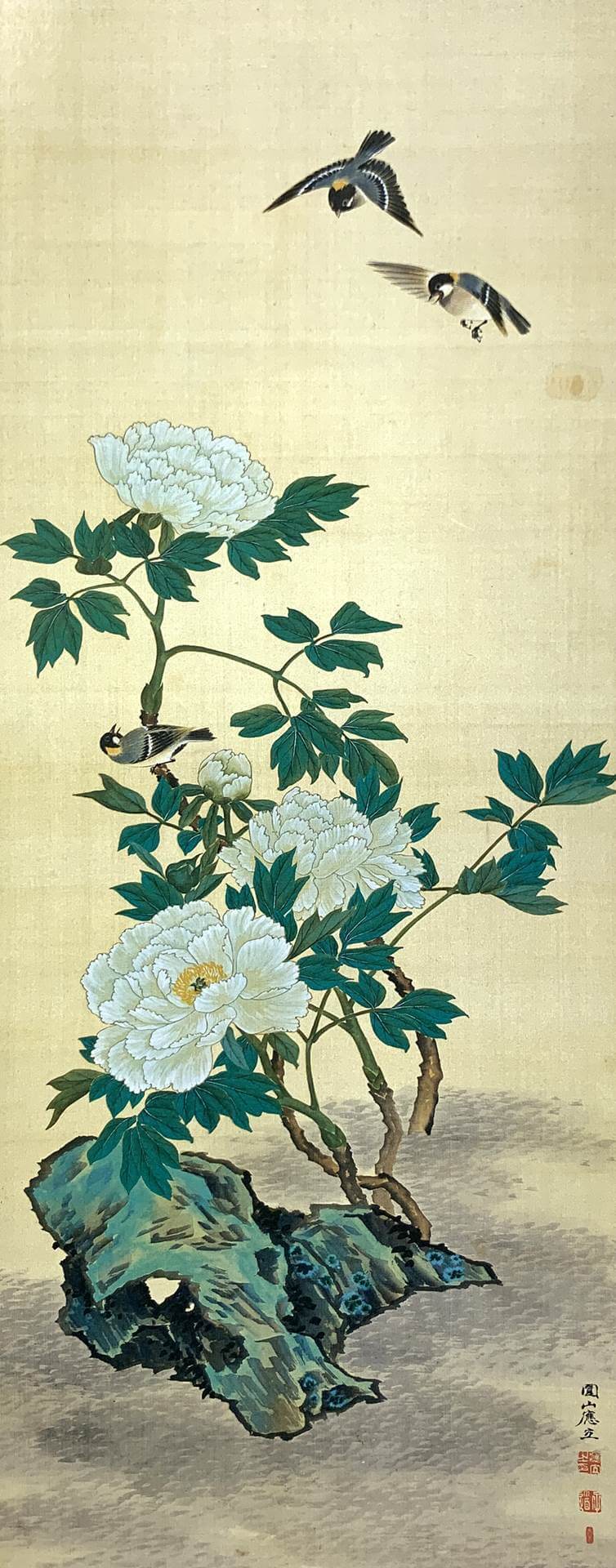
Botan ni Shōkin-zu (Peonies and Small Birds) by Maruyama Ōryū

Maruyama Ōryū (1817-1875) was born as a son of Terai Hisajirō who ran a Kyo-yūzen dyeing (traditional craft in Kyoto) business with his family. He was adopted by Maruyama Ōshin, the third generation of Maruyama school. He succeeded the Maruyama school and named himself the 4th generation.

It was around the time of third generation Ōshin that began to formally follow the Maruyama school painting method that Maruyama Ōkyo began. Since Ōryū was also adopted, he was not allowed to disarrange the painting method of his school, and you won’t be able to see the lively expressions that Ōkyo had in this painting. However, in part, the expression of the peony, which made full use of the sketching technique, seems to be refreshing. The rocks that look like Taihu stones placed at the base of the peony are used as the expression to break the atmosphere, and show that he was obedient to his school’s painting method.

The characteristic of the Maruyama school is that it is composed with a clear painting that can be understood even by girls and children, and the abstract dimension such as the spirituality of the author expressed in poetry of a literary painting is not emphasized. Ōkyo himself was aware that there was a dimension to express the spirituality of the author after being proficient in sketching, but at the elementary stage, he dared to ignore that part and emphasized sketching.

As a result, the successors who lost themselves in the social trend of the time, emphasized family traditions, and could not understand the goal that Ōkyo ultimately aimed for. They emphasized the rudimentary form, and that lead to the school’s decline.

Maruyama School

The 1st: Maruyama Ōkyo 円山応挙 (1733-1795)

The 2nd: Maruyama Ōzui 円山応瑞 (1766-1829)

The 3rd: Maruyama Ōshin 円山応震 (1790-1838)

The 4th: Maruyama Ōryū 円山応立 (1817-1875)

The 5th: Kunii Ōbun 国井応文 (1833-1887)

The 6th: Kunii Ōyō 国井応陽 (1868-1923)

The 7th: Maruyama Ōshō 円山応祥 (1904-1981)

The 8th: Maruyama Keishō 円山慶祥 (1947-)
Contact Us

Please fill out the form below and submit for your inquiry.

❈FirstName
❈LastName
Country
❈E-mail
(❈Confirm E-mail)
❈Inquiry category Question
Consultation
Impression
Request
Others
❈Comment

is the mark for required item.


Your privacy is important to us. We are committed to protecting your privacy.

(or press ESC or click the overlay)

CEO Message

Our Feelings For Kakejiku


 The Japanese people have long set a high value on aesthetic senses since ancient times. As a result, the
peculiar culture which is not seen in other countries blossomed and many aspects of the modern Japanese
culture come from it. Parts of Japanese culture has been introduced to people in other countries recently,
so the number of people from other countries who are interested in Japanese culture has been increasing.
However, the Japanese aesthetic senses, which are the bases of Japanese culture, have been nurtured
through a long history, intertwining various elements intricately, such as climate, geographical features,
religion, customs and so on. Therefore, they are very difficult to understand not only for people from other
countries, but even for the Japanese people. I think the best tool which conveys these difficult senses
understandably is a “kakejiku.”
 The kakejiku (a hanging scroll; a work of calligraphy or a painting which is mounted and hung in an
alcove or on a wall) is a traditional Japanese art. It's no exaggeration to say that paintings are what
express aesthetic senses at all times and places. The kakejiku is an art which expresses the Japanese
aesthetic senses. The kakejiku has long been used in traditional Japanese events, daily life and so on since
ancient times. As a result, there are various customs of kakejiku in Japan; kakejiku and the life of the
Japanese are closely related. We can see Japanese values through kakejiku.
 The kakejiku is a cultural tradition which the Japanese people should be proud of. However, many people
in other countries don't know much about it because it hasn't been showcased as much. This is why I
decided to try to introduce it. The kakejiku world is very interesting and beautiful. We want not only the
Japanese, but also many people from other countries to know and enjoy it. I hope that many people will
love kakejiku someday.

(or press ESC or click the overlay)
Company Profile
syaoku.jpg(120220 byte)

Name Art Nomura


President Tatsuji Nomura


Founded1973


Established1992


Address7-23 Babadori, Tarumi-ku, Kobe city,
Hyougo Prefecture, 655-0021, Japan


Capital10 million yen


URLhttp://nomurakakejiku.com


Our Business

 Art Nomura is an art dealer which produces kakejiku (hanging scrolls). We mount many paintings and calligraphic works in kakejiku in my factory. Kakejiku are our main product. We also remount and repair old or damaged kakejiku. We share the traditional Japanese art of kakejiku with people all over the world.


(or press ESC or click the overlay)
Access Map

Access Map


 The Japanese people have long set a high value on aesthetic senses since ancient times. As a result, the
peculiar culture which is not seen in other countries blossomed and many aspects of the modern Japanese
culture come from it. Parts of Japanese culture has been introduced to people in other countries recently,
so the number of people from other countries who are interested in Japanese culture has been increasing.
However, the Japanese aesthetic senses, which are the bases of Japanese culture, have been nurtured
through a long history, intertwining various elements intricately, such as climate, geographical features,
religion, customs and so on. Therefore, they are very difficult to understand not only for people from other
countries, but even for the Japanese people. I think the best tool which conveys these difficult senses
understandably is a “kakejiku.”
 The kakejiku (a hanging scroll; a work of calligraphy or a painting which is mounted and hung in an
alcove or on a wall) is a traditional Japanese art. It's no exaggeration to say that paintings are what
express aesthetic senses at all times and places. The kakejiku is an art which expresses the Japanese
aesthetic senses. The kakejiku has long been used in traditional Japanese events, daily life and so on since
ancient times. As a result, there are various customs of kakejiku in Japan; kakejiku and the life of the
Japanese are closely related. We can see Japanese values through kakejiku.
 The kakejiku is a cultural tradition which the Japanese people should be proud of. However, many people
in other countries don't know much about it because it hasn't been showcased as much. This is why I
decided to try to introduce it. The kakejiku world is very interesting and beautiful. We want not only the
Japanese, but also many people from other countries to know and enjoy it. I hope that many people will
love kakejiku someday.

(or press ESC or click the overlay)