
Saigō Kogetsu: One of the Big 4 Disciples of Hashimoto Gahō, a Little-Known Genius of Japanese Painting
Among the modern Japanese art circles from the Meiji period, Yokoyama Taikan, Hishida Shunsō, and Shimomura Kanzan had the artistic talent that everyone admits, and are known to many people even today for leading the art circles. However, it is not known that there was a person who was admired as one of the Big Four disciples of Hashimoto Gahō along with those three people at the time, and who had a promising life as an artist. That person is Saigō Kogetsu.
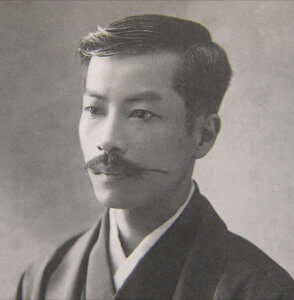
Saigō Kogetsu was the first graduate of the Tōkyō Bijutsu Gakkō (Tōkyō School of Fine Arts), the same as Yokoyama Taikan and Shimomura Kanzan, and his talent was recognized by those around him from that time. Kogetsu had Kanō school style as a base, and greedily adopted the techniques of Rinpa school style and Western painting, aiming to reform the modern Japanese painting.

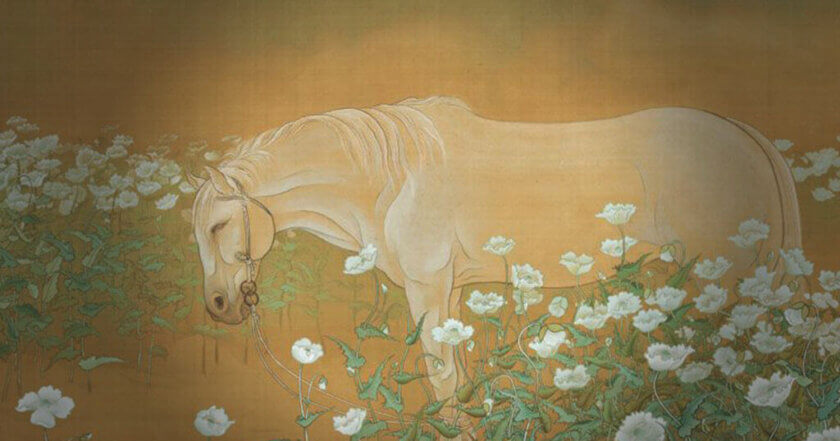
The masterpiece “Shundan [170.3 cm (height) x 271.8 cm(width)]”, which depicts a white horse looming in the white poppy flower field, has a mystical atmosphere and a charm that attracts viewers. This work, drawn in 1897, can be said to have been drawn at the time when Saigō Kogetsu had the most fulfilling painting skills. (Collection of Tokyo University of the Arts)
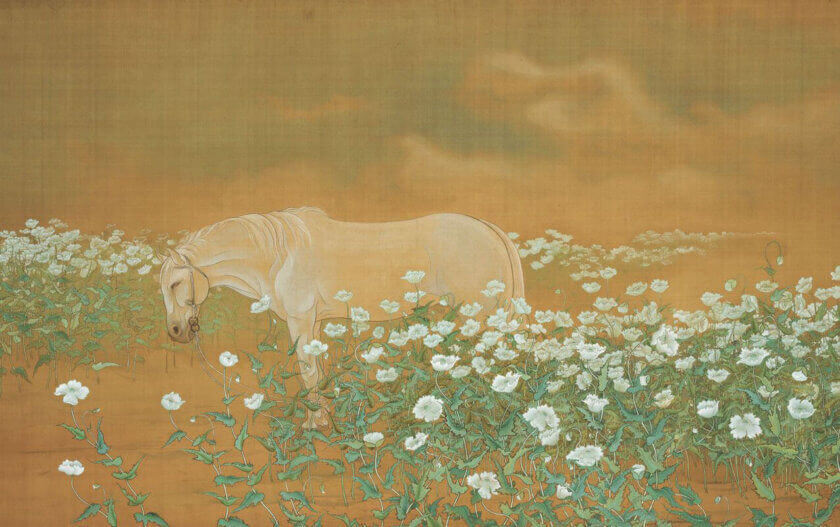
Shundan by Saigō Kogetsu

After the “School of Art Uproar” that occurred the year after “Shundan” was drawn, he worked with Okakura Tenshin and others to establish the Nihon Bijutsu-in (Japanese Art Institute) and was listed as a councilor. Hashimoto Gahō, a teacher since the time of the Tōkyō School of Fine Arts, highly evaluated Kogetsu’s talent and even allowed him to marry his daughter.

However, he fought with his teacher and his father-in-law, Hashimoto Gahō, when he was drinking and their relationship broke up. From that point, he started to drink and play daily, and that led to a divorce. Then, the life became disordered and that affected his painting ability. His appearance in the art world gradually disappeared.

Although Kogetsu was living a lonely life watching his peers Yokoyama Taikan, Hishida Shunsō, and Shimomura Kanzan succeed overseas, he restarts his career in 1911 due to the sudden death of his best friend, Hishida Shunsō. He travels to Taiwan and draws local scenery to seek a new life as an artist.  “Taiwanfukei (Taiwan Landscape)”, which skillfully uses a transparent and unique color sense and a perspective drawing, can be said to be an excellent work that makes you feel the Kogetsu of when he was called a genius.
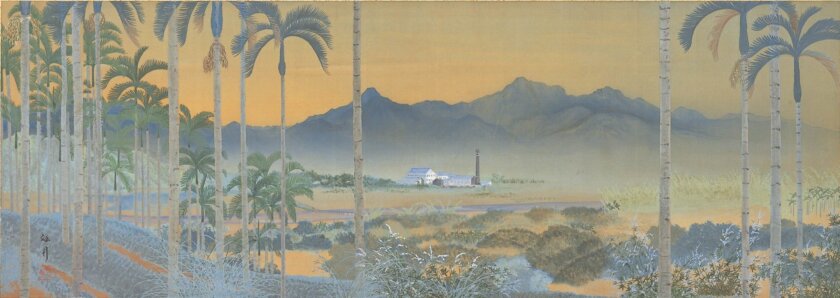
“Taiwanfukei (Taiwan Landscape)” by Saigō Kogetsu

Kogetsu aimed to restart his artist career in Taiwan, but he became ill in Taipei and lonely died in his house.

Saigō Kogetsu, a tragic painter who passed away at the young age of 38, attracting a lot of attention with his wonderful talent but never left his name in the art history mainstream. Re-evaluation of his remaining excellent works are now underway.
Contact Us

Please fill out the form below and submit for your inquiry.

❈FirstName
❈LastName
Country
❈E-mail
(❈Confirm E-mail)
❈Inquiry category Question
Consultation
Impression
Request
Others
❈Comment

is the mark for required item.


Your privacy is important to us. We are committed to protecting your privacy.

(or press ESC or click the overlay)

CEO Message

Our Feelings For Kakejiku


 The Japanese people have long set a high value on aesthetic senses since ancient times. As a result, the
peculiar culture which is not seen in other countries blossomed and many aspects of the modern Japanese
culture come from it. Parts of Japanese culture has been introduced to people in other countries recently,
so the number of people from other countries who are interested in Japanese culture has been increasing.
However, the Japanese aesthetic senses, which are the bases of Japanese culture, have been nurtured
through a long history, intertwining various elements intricately, such as climate, geographical features,
religion, customs and so on. Therefore, they are very difficult to understand not only for people from other
countries, but even for the Japanese people. I think the best tool which conveys these difficult senses
understandably is a “kakejiku.”
 The kakejiku (a hanging scroll; a work of calligraphy or a painting which is mounted and hung in an
alcove or on a wall) is a traditional Japanese art. It's no exaggeration to say that paintings are what
express aesthetic senses at all times and places. The kakejiku is an art which expresses the Japanese
aesthetic senses. The kakejiku has long been used in traditional Japanese events, daily life and so on since
ancient times. As a result, there are various customs of kakejiku in Japan; kakejiku and the life of the
Japanese are closely related. We can see Japanese values through kakejiku.
 The kakejiku is a cultural tradition which the Japanese people should be proud of. However, many people
in other countries don't know much about it because it hasn't been showcased as much. This is why I
decided to try to introduce it. The kakejiku world is very interesting and beautiful. We want not only the
Japanese, but also many people from other countries to know and enjoy it. I hope that many people will
love kakejiku someday.

(or press ESC or click the overlay)
Company Profile
syaoku.jpg(120220 byte)

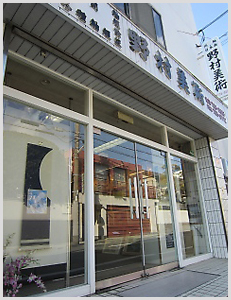
Name Art Nomura


President Tatsuji Nomura


Founded1973


Established1992


Address7-23 Babadori, Tarumi-ku, Kobe city,
Hyougo Prefecture, 655-0021, Japan


Capital10 million yen


URLhttp://nomurakakejiku.com


Our Business

 Art Nomura is an art dealer which produces kakejiku (hanging scrolls). We mount many paintings and calligraphic works in kakejiku in my factory. Kakejiku are our main product. We also remount and repair old or damaged kakejiku. We share the traditional Japanese art of kakejiku with people all over the world.


(or press ESC or click the overlay)
Access Map

Access Map


 The Japanese people have long set a high value on aesthetic senses since ancient times. As a result, the
peculiar culture which is not seen in other countries blossomed and many aspects of the modern Japanese
culture come from it. Parts of Japanese culture has been introduced to people in other countries recently,
so the number of people from other countries who are interested in Japanese culture has been increasing.
However, the Japanese aesthetic senses, which are the bases of Japanese culture, have been nurtured
through a long history, intertwining various elements intricately, such as climate, geographical features,
religion, customs and so on. Therefore, they are very difficult to understand not only for people from other
countries, but even for the Japanese people. I think the best tool which conveys these difficult senses
understandably is a “kakejiku.”
 The kakejiku (a hanging scroll; a work of calligraphy or a painting which is mounted and hung in an
alcove or on a wall) is a traditional Japanese art. It's no exaggeration to say that paintings are what
express aesthetic senses at all times and places. The kakejiku is an art which expresses the Japanese
aesthetic senses. The kakejiku has long been used in traditional Japanese events, daily life and so on since
ancient times. As a result, there are various customs of kakejiku in Japan; kakejiku and the life of the
Japanese are closely related. We can see Japanese values through kakejiku.
 The kakejiku is a cultural tradition which the Japanese people should be proud of. However, many people
in other countries don't know much about it because it hasn't been showcased as much. This is why I
decided to try to introduce it. The kakejiku world is very interesting and beautiful. We want not only the
Japanese, but also many people from other countries to know and enjoy it. I hope that many people will
love kakejiku someday.

(or press ESC or click the overlay)