
How Did Japan’s Largest Artist Collective, the Kanō School Survive the Threat of Extinction!?
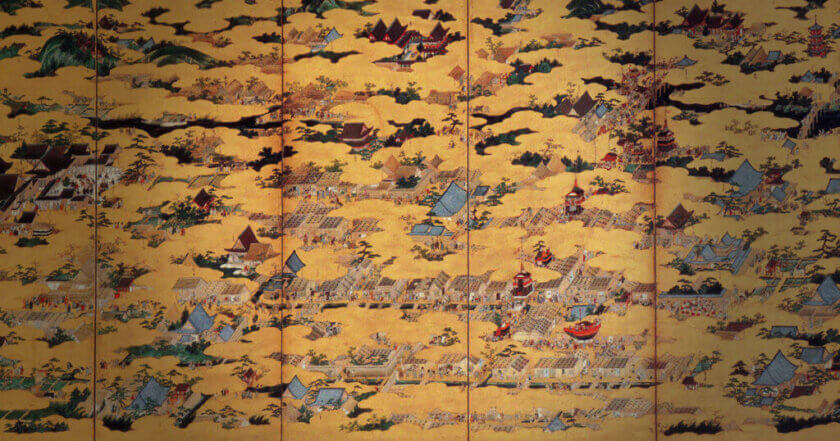
The Kanō School’s Biggest Crisis

From the end of the Muromachi period to the end of the Edo period, for around 400 years, was the strongest and largest artist collective that always ran in the center of the art world — the Kanō school.

The founder, Kanō Masanobu, played an active part as the official artist of the Muromachi Shogunate, and Kanō Motonobu, the second generation, had many apprentices and established a workshop system that could meet the demands of a wide range of customers. Additionally, Motonobu’s grandchild, Kanō Eitoku (狩野永徳), was favored by rulers such as Oda Nobunaga and Toyotomi Hideyoshi, making him a star of the times.
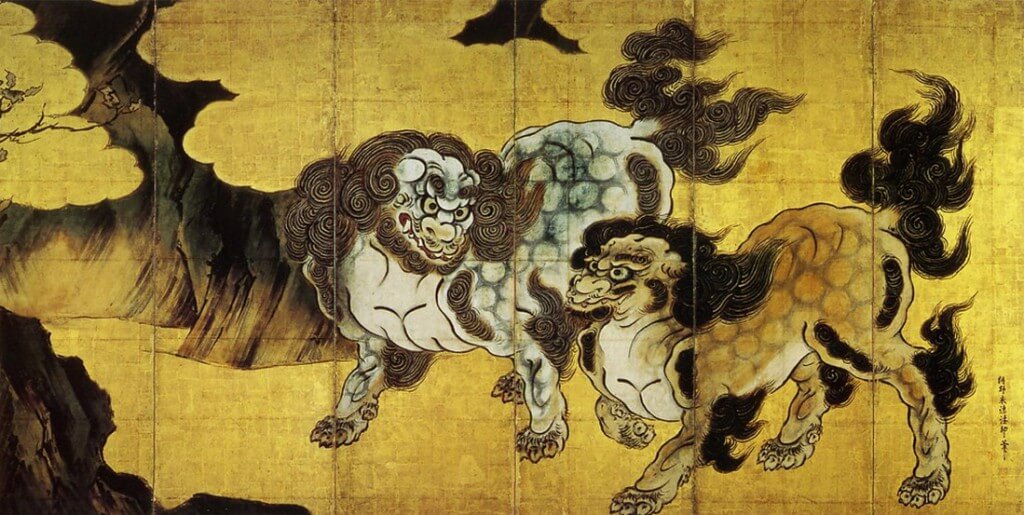
Eitoku Kanou / Chinese guardian lions (Karajishi) (Kanou School)
Eitoku Kanou / Chinese guardian lions (Karajishi)

However, tragedy fell upon what seemed to be the smooth sailing Kanō school. It was the sudden death of its master, Kanō Eitoku (狩野永徳). In the midst of troubled times when the future was uncertain, not only samurai, but artists also had to engage themselves in extremely fierce tactics for survival. Especially for the Kanō school, which had been closely involved with those in power, the turmoil caused by the death of the clan’s backbone, Eitoku, was enormous.

An incident occured, adding a further blow to the situation. The Kanō school, which received Toyotomi Hideyoshi’s generous patronage and was entrusted with most of the paintings, was robbed of their work from Hideyoshi by, of all people, their biggest rival, Hasegawa Tōhaku. Nothing could have been more humiliating for Eitoku’s eldest son, Kanō Mitsunobu, who had only just become the master.

It was the toughest time for the Kanō school, and a turbulent era as they had to determine who the ruler would be in the new era, for the sake of the clan’s survival. Now, what kind of secret methods did the Kanō school launch themselves into?

The Three Sides Strategy: the Kanō School’s Big Survival Tactic

With the Sekigahara battle as the turning point, the trends of society completely changed in the second half of the Momoyama period. The three-way struggle of power composed by the Toyotomi clan, the Tokugawa clan, and the Imperial Court also became the basis of the Kanō school’s survival tactics. It is the so-called ‘Three Sides Strategy.’

In other words, Kanō Eitoku’s apprentices, Kanō Sanraku and Kanō Naizen (both who were artists from families of samurai, whose talents were discovered by Hideyoshi,) served the Toyotomi clan, while Eitoku’s brother, Kanō Naganobu, who was 34 years Eitoku’s junior, served Tokugawa Ieyasu and Hidetada from the early stages, and later on, Kanō Tan-yū played a leading role in the Kanō clan achieving the title as the Edo Shogunate’s favorite artist. Kanō Takanobu was placed to serve the Imperial Court  he was a younger brother of Mitsunobu, and the father of three brothers, Kanō Tan-yū, Kanō Naonobu, and Kanō Eishin Yasunobu, who was well-trusted by the Emperor as an artist for the Imperial Court .
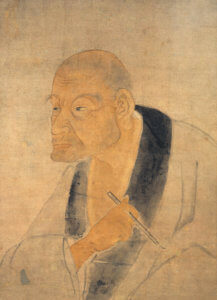
Kanō Tan-yū

Thus, in this period of political instability, the Kanō school established a system that could ensure their survival through any unforeseen circumstance, and this became the cornerstone of the Kanō school’s prosperity until the end of the Bakumatsu period (1853-1869). It can be said that this was a secret method unique to the Kanō school, who honored their lineage and had influential apprentices.
Contact Us

Please fill out the form below and submit for your inquiry.

❈FirstName
❈LastName
Country
❈E-mail
(❈Confirm E-mail)
❈Inquiry category Question
Consultation
Impression
Request
Others
❈Comment

is the mark for required item.


Your privacy is important to us. We are committed to protecting your privacy.

(or press ESC or click the overlay)

CEO Message

Our Feelings For Kakejiku


 The Japanese people have long set a high value on aesthetic senses since ancient times. As a result, the
peculiar culture which is not seen in other countries blossomed and many aspects of the modern Japanese
culture come from it. Parts of Japanese culture has been introduced to people in other countries recently,
so the number of people from other countries who are interested in Japanese culture has been increasing.
However, the Japanese aesthetic senses, which are the bases of Japanese culture, have been nurtured
through a long history, intertwining various elements intricately, such as climate, geographical features,
religion, customs and so on. Therefore, they are very difficult to understand not only for people from other
countries, but even for the Japanese people. I think the best tool which conveys these difficult senses
understandably is a “kakejiku.”
 The kakejiku (a hanging scroll; a work of calligraphy or a painting which is mounted and hung in an
alcove or on a wall) is a traditional Japanese art. It's no exaggeration to say that paintings are what
express aesthetic senses at all times and places. The kakejiku is an art which expresses the Japanese
aesthetic senses. The kakejiku has long been used in traditional Japanese events, daily life and so on since
ancient times. As a result, there are various customs of kakejiku in Japan; kakejiku and the life of the
Japanese are closely related. We can see Japanese values through kakejiku.
 The kakejiku is a cultural tradition which the Japanese people should be proud of. However, many people
in other countries don't know much about it because it hasn't been showcased as much. This is why I
decided to try to introduce it. The kakejiku world is very interesting and beautiful. We want not only the
Japanese, but also many people from other countries to know and enjoy it. I hope that many people will
love kakejiku someday.

(or press ESC or click the overlay)
Company Profile
syaoku.jpg(120220 byte)

Name Art Nomura


President Tatsuji Nomura


Founded1973


Established1992


Address7-23 Babadori, Tarumi-ku, Kobe city,
Hyougo Prefecture, 655-0021, Japan


Capital10 million yen


URLhttp://nomurakakejiku.com


Our Business

 Art Nomura is an art dealer which produces kakejiku (hanging scrolls). We mount many paintings and calligraphic works in kakejiku in my factory. Kakejiku are our main product. We also remount and repair old or damaged kakejiku. We share the traditional Japanese art of kakejiku with people all over the world.


(or press ESC or click the overlay)
Access Map

Access Map


 The Japanese people have long set a high value on aesthetic senses since ancient times. As a result, the
peculiar culture which is not seen in other countries blossomed and many aspects of the modern Japanese
culture come from it. Parts of Japanese culture has been introduced to people in other countries recently,
so the number of people from other countries who are interested in Japanese culture has been increasing.
However, the Japanese aesthetic senses, which are the bases of Japanese culture, have been nurtured
through a long history, intertwining various elements intricately, such as climate, geographical features,
religion, customs and so on. Therefore, they are very difficult to understand not only for people from other
countries, but even for the Japanese people. I think the best tool which conveys these difficult senses
understandably is a “kakejiku.”
 The kakejiku (a hanging scroll; a work of calligraphy or a painting which is mounted and hung in an
alcove or on a wall) is a traditional Japanese art. It's no exaggeration to say that paintings are what
express aesthetic senses at all times and places. The kakejiku is an art which expresses the Japanese
aesthetic senses. The kakejiku has long been used in traditional Japanese events, daily life and so on since
ancient times. As a result, there are various customs of kakejiku in Japan; kakejiku and the life of the
Japanese are closely related. We can see Japanese values through kakejiku.
 The kakejiku is a cultural tradition which the Japanese people should be proud of. However, many people
in other countries don't know much about it because it hasn't been showcased as much. This is why I
decided to try to introduce it. The kakejiku world is very interesting and beautiful. We want not only the
Japanese, but also many people from other countries to know and enjoy it. I hope that many people will
love kakejiku someday.

(or press ESC or click the overlay)