Changing the Mounting Style of a Kakejiku | Remounting from the Sandan Mounting Style to the Maru Mounting Style
Kakejiku mounting styles include the traditional Sandan Mounting Style, the simple Maru Mounting Style, and the Buddhist Mounting Style, which is commonly used for Buddhist hanging scrolls.
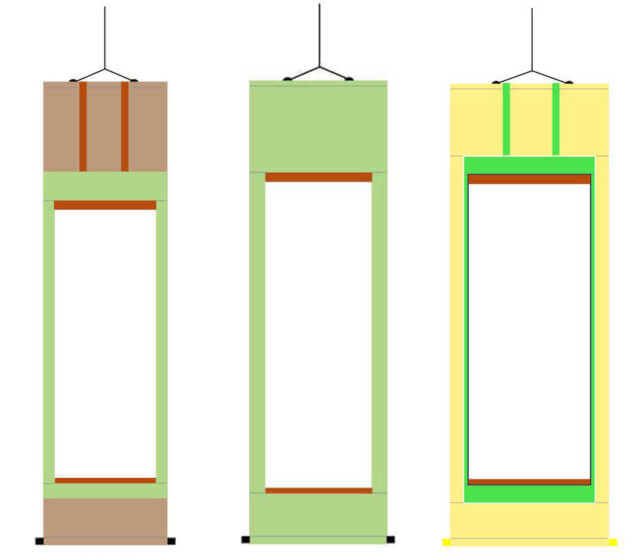
When remounting a kakejiku, we sometimes receive requests from customers who would like to change the existing mounting style to a different one.
In this article, we would like to introduce a project for a kakejiku depicting a black bird perched on a branch, entrusted to us by a customer in Australia, in which the mounting style was changed during the remounting process.
We hope this article will be helpful for those who are considering changing the mounting style when remounting an old kakejiku.
Consultation Details
This project was entrusted to us by a customer in Australia.
He is a returning customer who had previously asked us to restore another scroll, and this time as well, he entrusted us with the remounting of another important kakejiku.
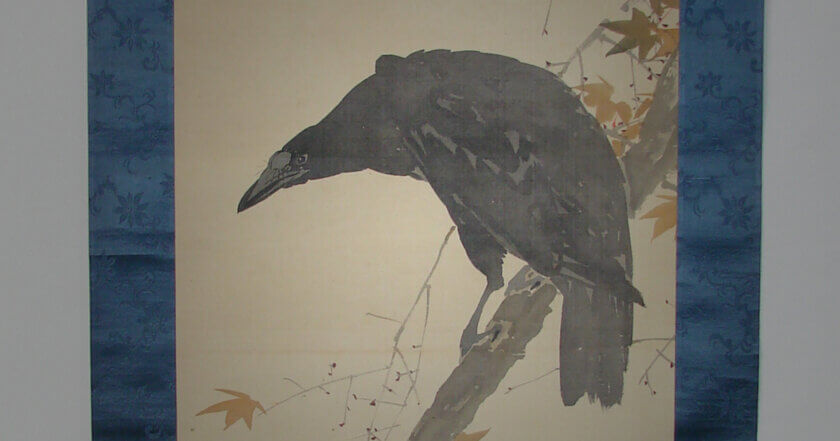
The work depicts a black bird perched on a branch with autumn leaves, creating a quiet and seasonal atmosphere.
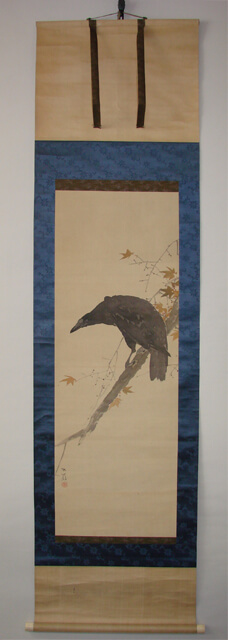
The customer consulted us not only about minor damage and surface stains on the artwork, but also expressed a wish to change the mounting style from the current Sandan Mounting Style to the Maru Mounting Style.
Requests to change the mounting style in this way are often made because customers would like to adjust the overall impression of the scroll to better suit their own taste.
In a case like this, changing from the Sandan Mounting Style to the Maru Mounting Style generally does not present a major problem.
However, changing in the opposite direction, from the Maru Mounting Style to the Sandan Mounting Style, requires more caution.
This is because the size of the honshi, meaning the main artwork area, in scrolls mounted in the Maru Mounting Style is often relatively long. If such a piece is remounted into the Sandan Mounting Style using the usual proportions of the mounting fabric, the total length of the finished scroll may become longer than before and may no longer fit properly in a tokonoma alcove.
For overseas customers, this may not matter as much, since many do not display kakejiku in a tokonoma. In Japan, however, this is something that should be considered carefully.
It is possible to reduce the overall length by shortening the usual proportions of the mounting fabric in the Sandan Mounting Style.
However, doing so can disturb the overall proportions of the mounting and result in an awkward appearance.
This is where changing the mounting style becomes difficult.
The customer also had a clear image in mind regarding the mounting fabric, wanting something calm and understated rather than overly decorative.
For this project, the key point was not simply to replace the old mounting with a new one, but to reshape the scroll into something that better suited the atmosphere of the artwork itself.
Condition Check | Stain and Damage to the Main Artwork
We first carefully examined the actual condition of the scroll.
Although there was no major damage severe enough to interfere with appreciation of the work as a whole, the customer was concerned about minor damage to the main artwork itself and slight surface staining.
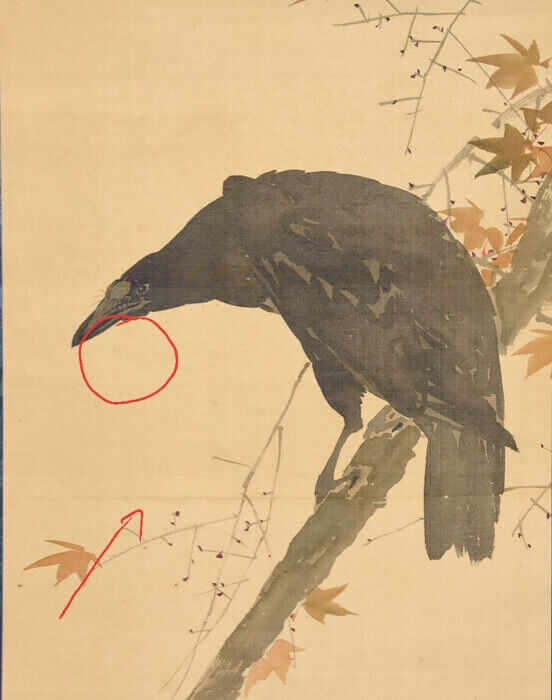
Damage that exists in the main artwork itself can be made less visually distracting through remounting, but it cannot be made to disappear completely.
On the other hand, the stains visible on the picture surface were in a condition where considerable improvement could be expected through cleaning and stain removal treatment.
In restoration work, it is important to clearly distinguish between what can be improved and what has its limits, and to explain that honestly to the customer.
Our Approach and Proposal
This work features a black bird and autumn leaves, creating a scene that evokes a quiet feeling somewhere between autumn and winter.
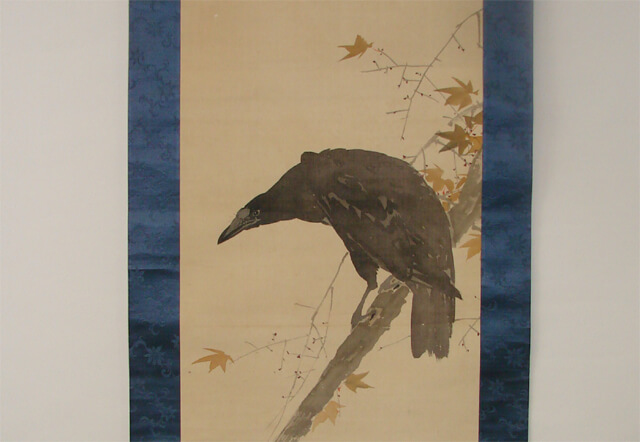
As for the mounting fabric, the customer preferred something more subdued rather than a bright floral pattern.
With this in mind, we searched for candidates that would not disturb the atmosphere of the artwork, while also avoiding a result that felt too plain, placing particular emphasis on the balance of texture and color.
In a project like this, it is important not only to listen to the customer’s preferences, but also to make proposals that take into account the motif of the work, its seasonal feeling, and how it will look when displayed.
The Process of Selecting the Mounting Fabric | Carefully Refining the Color Direction Until We Reached the Ideal Tone
The mounting fabric is one of the most important elements in determining the overall impression of a scroll.
In this case as well, the choice was not made immediately. We presented several options and gradually refined the direction through discussions with the customer.
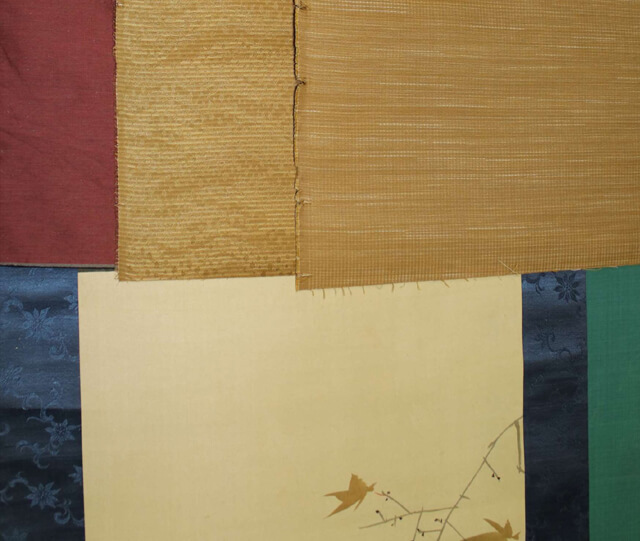
The customer imagined warm brown tones such as russet, dried persimmon brown, cinnamon, and nutmeg.
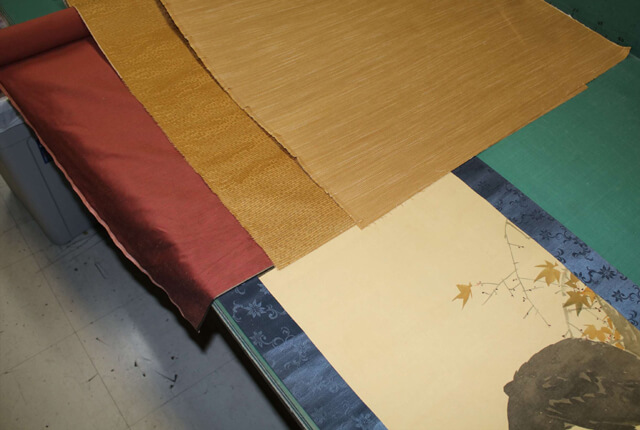
We also came to understand that he preferred fabrics without strong patterns, favoring either plain fabrics or those with beautiful texture.
Based on this exchange, the customer ultimately selected a calm brown-toned fabric.
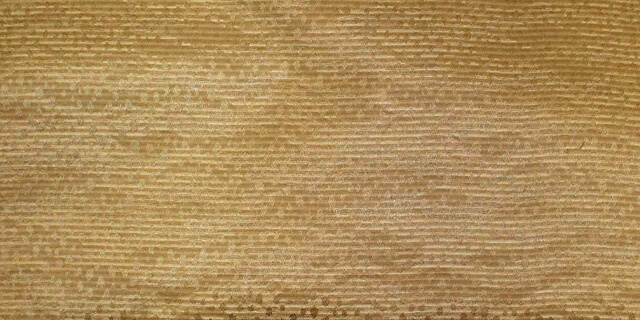
This fabric blended naturally with the colors of the autumn leaves and gave the entire work a soft warmth while also bringing out the black bird beautifully.
We also selected several understated ichimonji options while considering their harmony with the main mounting fabric.
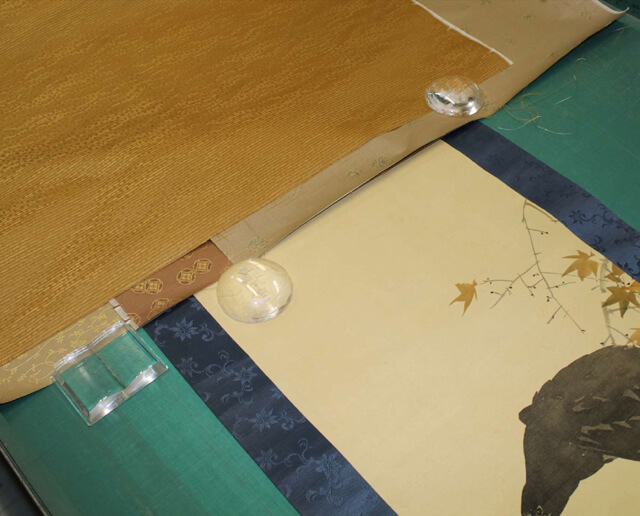
The ichimonji is a small part of the overall mounting, but choosing the right one can make a significant difference in the overall quality of the finished scroll.
This time, we also received a request to use the following roller ends in particular.
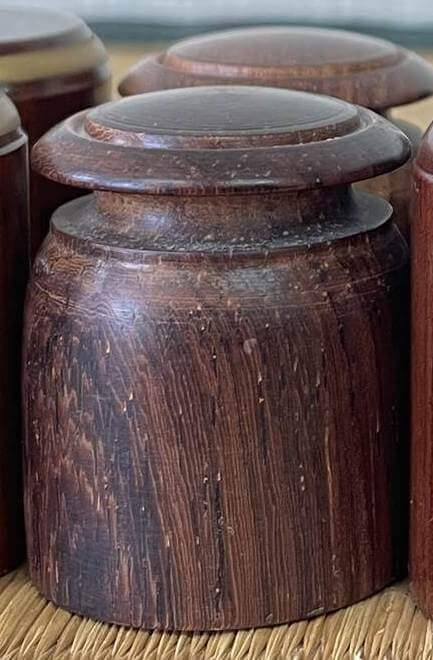
The Restoration and Remounting Process
This project was carried out in the following steps.
- Disassembly of the Scroll
We removed the old mounting fabric and roller rod from the existing kakejiku, taking great care not to place stress on the main artwork.- Removal of the Old Backing Paper
We removed the old backing paper from the reverse side of the scroll.- Cleaning and Stain Removal
We cleaned the work to remove dirt and, while carefully observing its condition, performed stain removal treatment as much as possible within a safe range.- Remounting
Using the mounting fabric selected by the customer, we remounted the work as a new kakejiku.
The Most Challenging Part
The most difficult part of this project was the damaged areas that had also concerned the customer.
Damage means that those areas are more fragile than the rest of the work, so it was necessary to exercise the utmost care to avoid widening or worsening them during treatment.
Although the damage itself could not be erased, we relied on our past experience to apply the most appropriate treatment so that it would become as inconspicuous as possible.
The Finished Impression | A Calm Scroll Suited to the Quiet Mood of the Artwork
Here is the kakejiku after the remounting was completed.
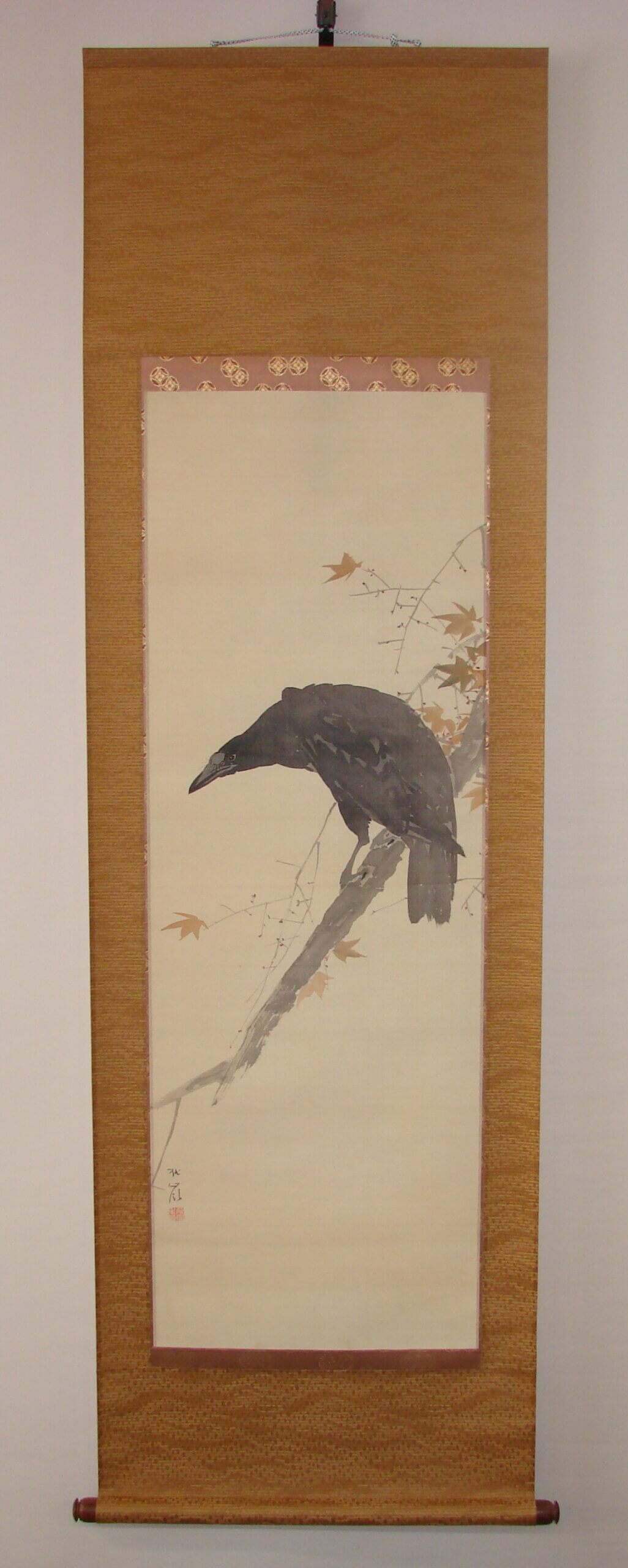
The finished result has a very calm impression, combining a warm brown-toned mounting fabric with a restrained ichimonji.
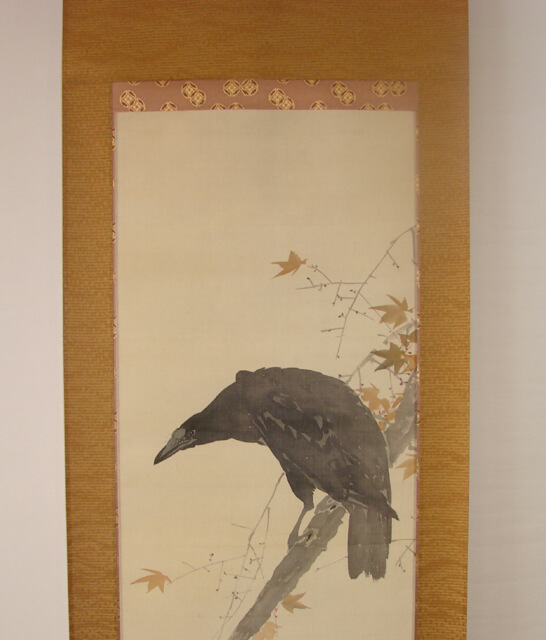
We feel that the new mounting preserves the quiet tension and seasonal atmosphere that the work originally had, while making it more harmonious in an interior space and more refined in appearance than before.
The black bird now appears more striking, and the colors of the autumn leaves in the background have also come to life more naturally.
By changing the mounting to the Maru Mounting Style, the scroll did not become dramatically transformed in a flashy way. Rather, it feels as though the charm of the work has been brought out again in a very natural manner.
When remounting an old kakejiku, the goal is not simply to make it look new. What matters is how to preserve the character of the work while restoring it into a better state.
We feel that this project turned out to be a very good example of that balance.
The Customer’s Response | Safely Displayed in Australia and Received with Delight
After completion, the kakejiku was shipped to our customer in Australia, and we later received word that it had arrived safely.
The customer also kindly gave us the following feedback regarding the result:
The results of all your efforts are excellent as always.
We were very pleased to receive such warm words.
In addition, he sent us a photograph of the scroll displayed in his home.
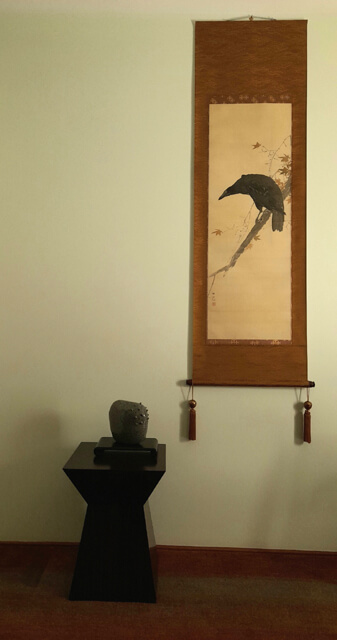
Of course, we are happy when a project is completed in our workshop, but seeing the scroll beautifully displayed in its actual setting reminds us once again of the meaning of this work.
A kakejiku is not truly complete simply because it has been made. It comes back to life when it is displayed.
It was a great pleasure for us to see that this scroll had found a new role within a home overseas.
Conclusion | We Also Accept Kakejiku Repairs and Changes in Mounting Style
In this project, the mounting style was adjusted according to the customer’s wishes so that it would better suit the atmosphere of the artwork.
In the process of selecting the mounting fabric as well, we carefully listened to the customer’s preferences and worked together to find the most natural and suitable direction for the piece.
If you would like to restore a kakejiku whose mounting has deteriorated, remount a scroll in a style that better suits your taste, or discuss mounting fabrics that best complement your artwork, we would be very happy to hear from you.
At ART NOMURA, we make our proposals while considering not only the condition of the work itself, but also the atmosphere it carries and the space in which it will be displayed.