
Custom Nichiren Mandala Kakejiku Commission From the Philippines
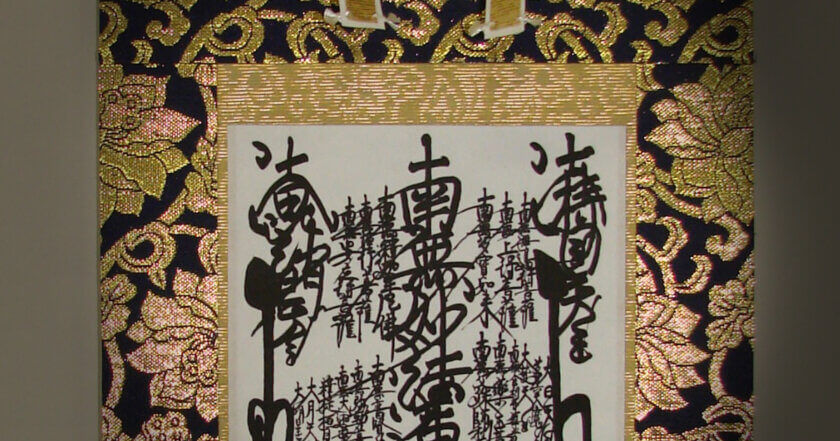
We have produced many Nichiren Mandala kakejiku for overseas customers over the years.

Through these commissions, we also came to realize that there are various types of Nichiren Mandala, and that there is real interest in them.

In this article, we would like to share an episode in which we custom-made a Nichiren Mandala kakejiku for a customer living in the Philippines.

Inquiry And Request

The customer contacted us with an image of a Nichiren Mandala kakejiku that we had previously produced and posted on our website, and asked us to create a Nichiren Mandala kakejiku with a similar atmosphere.
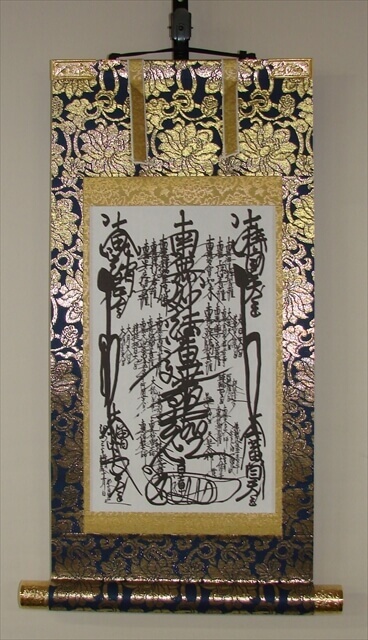
The customer also requested a finished size of 20 cm (width) × 37 cm (height).

This is quite a small size.

Simply scaling down a previously made kakejiku at the same ratio would not achieve the requested dimensions, and we needed to redesign the layout so that the artwork area would be as large as possible.

To avoid any mismatch such as “this feels different from what we imagined,” it is important to share the finished image at the planning stage, before production begins.

Sharing The Finished Image To Avoid Any Misunderstanding

What we most want to avoid in a custom commission from overseas is a mismatch in expectations—“It looks different from what we imagined once it is finished.”

Therefore, after confirming that 20 cm × 37 cm referred to the overall finished size of the kakejiku, we prepared a mock-up image so the customer could review the expected final appearance.

Here is the mock-up image we shared.
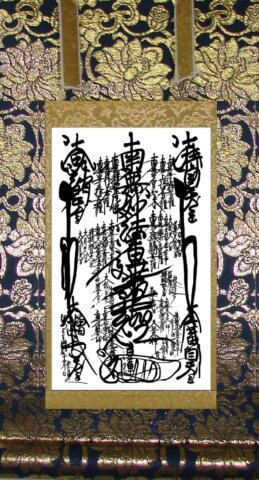
By aligning the overall layout in advance, the impression of the final piece becomes much more consistent, and it makes a big difference to customer satisfaction.

After reviewing the mock-up, the customer confirmed that both the dimensions and the overall layout were fine, and asked us to proceed with this plan.

In this way, by confirming the final image once before production, even overseas customers can place a custom order with confidence.

Completion of the Nichiren Mandala Kakejiku

The commissioned kakejiku is now complete.
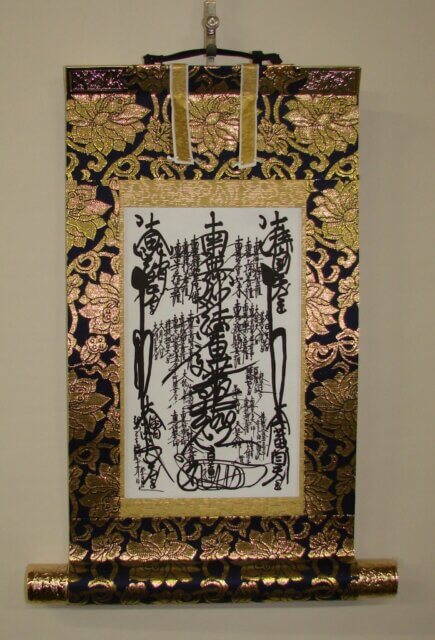
Although it is small in size, it has been finished with a proper sense of solemnity.

Customer Feedback: Message After Delivery And Google Review

After the kakejiku arrived, the customer kindly wrote to us:

It’s so beautifully made. Wonderful! Thank you very much for your help throughout this process.

We were very happy to receive such a wonderful message.

The customer also posted the following warm review on Google regarding the finished piece and our support:

I recently commissioned a custom hanging scroll from ART NOMURA and could not be more pleased with the result. The craftsmanship is truly exceptional—the piece is beautifully made and exactly what I had hoped for. Mr. Nomura provided wonderful support throughout the entire process, making the experience smooth and professional. Highly recommended for anyone looking for high-quality traditional Japanese mounting.

Feedback like this is the greatest encouragement for us, and it is also a valuable asset that helps us connect with new customers in the future.

Conclusion: Custom Nichiren Mandala Commissions Are Welcome

We accept custom Nichiren Mandala commissions like this.

By sharing a mock-up and confirming the finished image before production—just as we did in this case—even overseas customers can proceed with a custom commission with confidence.

Please feel free to contact us anytime.
 

    NameRequired

    SexRequired

    MaleFemale

    CountryRequired

    e-mailRequired

    CommentRequired

    Attached File
    ※Up to 3 MB for each file.


    ← ← "MUST CHECK" / Please confirm the above contents again and check this button.


    Contact Us

    Please fill out the form below and submit for your inquiry.

    ❈FirstName
    ❈LastName
    Country
    ❈E-mail
    (❈Confirm E-mail)
    ❈Inquiry category Question
    Consultation
    Impression
    Request
    Others
    ❈Comment

    is the mark for required item.


    Your privacy is important to us. We are committed to protecting your privacy.

    (or press ESC or click the overlay)

    CEO Message

    Our Feelings For Kakejiku


     The Japanese people have long set a high value on aesthetic senses since ancient times. As a result, the
    peculiar culture which is not seen in other countries blossomed and many aspects of the modern Japanese
    culture come from it. Parts of Japanese culture has been introduced to people in other countries recently,
    so the number of people from other countries who are interested in Japanese culture has been increasing.
    However, the Japanese aesthetic senses, which are the bases of Japanese culture, have been nurtured
    through a long history, intertwining various elements intricately, such as climate, geographical features,
    religion, customs and so on. Therefore, they are very difficult to understand not only for people from other
    countries, but even for the Japanese people. I think the best tool which conveys these difficult senses
    understandably is a “kakejiku.”
     The kakejiku (a hanging scroll; a work of calligraphy or a painting which is mounted and hung in an
    alcove or on a wall) is a traditional Japanese art. It's no exaggeration to say that paintings are what
    express aesthetic senses at all times and places. The kakejiku is an art which expresses the Japanese
    aesthetic senses. The kakejiku has long been used in traditional Japanese events, daily life and so on since
    ancient times. As a result, there are various customs of kakejiku in Japan; kakejiku and the life of the
    Japanese are closely related. We can see Japanese values through kakejiku.
     The kakejiku is a cultural tradition which the Japanese people should be proud of. However, many people
    in other countries don't know much about it because it hasn't been showcased as much. This is why I
    decided to try to introduce it. The kakejiku world is very interesting and beautiful. We want not only the
    Japanese, but also many people from other countries to know and enjoy it. I hope that many people will
    love kakejiku someday.

    (or press ESC or click the overlay)
    Company Profile
    syaoku.jpg(120220 byte)

    Name Art Nomura


    President Tatsuji Nomura


    Founded1973


    Established1992


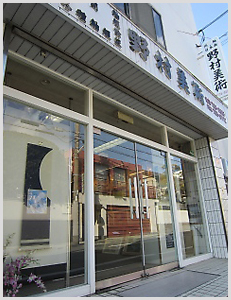
    Address7-23 Babadori, Tarumi-ku, Kobe city,
    Hyougo Prefecture, 655-0021, Japan


    Capital10 million yen


    URLhttp://nomurakakejiku.com


    Our Business

     Art Nomura is an art dealer which produces kakejiku (hanging scrolls). We mount many paintings and calligraphic works in kakejiku in my factory. Kakejiku are our main product. We also remount and repair old or damaged kakejiku. We share the traditional Japanese art of kakejiku with people all over the world.


    (or press ESC or click the overlay)
    Access Map

    Access Map


     The Japanese people have long set a high value on aesthetic senses since ancient times. As a result, the
    peculiar culture which is not seen in other countries blossomed and many aspects of the modern Japanese
    culture come from it. Parts of Japanese culture has been introduced to people in other countries recently,
    so the number of people from other countries who are interested in Japanese culture has been increasing.
    However, the Japanese aesthetic senses, which are the bases of Japanese culture, have been nurtured
    through a long history, intertwining various elements intricately, such as climate, geographical features,
    religion, customs and so on. Therefore, they are very difficult to understand not only for people from other
    countries, but even for the Japanese people. I think the best tool which conveys these difficult senses
    understandably is a “kakejiku.”
     The kakejiku (a hanging scroll; a work of calligraphy or a painting which is mounted and hung in an
    alcove or on a wall) is a traditional Japanese art. It's no exaggeration to say that paintings are what
    express aesthetic senses at all times and places. The kakejiku is an art which expresses the Japanese
    aesthetic senses. The kakejiku has long been used in traditional Japanese events, daily life and so on since
    ancient times. As a result, there are various customs of kakejiku in Japan; kakejiku and the life of the
    Japanese are closely related. We can see Japanese values through kakejiku.
     The kakejiku is a cultural tradition which the Japanese people should be proud of. However, many people
    in other countries don't know much about it because it hasn't been showcased as much. This is why I
    decided to try to introduce it. The kakejiku world is very interesting and beautiful. We want not only the
    Japanese, but also many people from other countries to know and enjoy it. I hope that many people will
    love kakejiku someday.

    (or press ESC or click the overlay)