Completing a Four-Season Kakejiku Collection: A Customer Visit From Switzerland
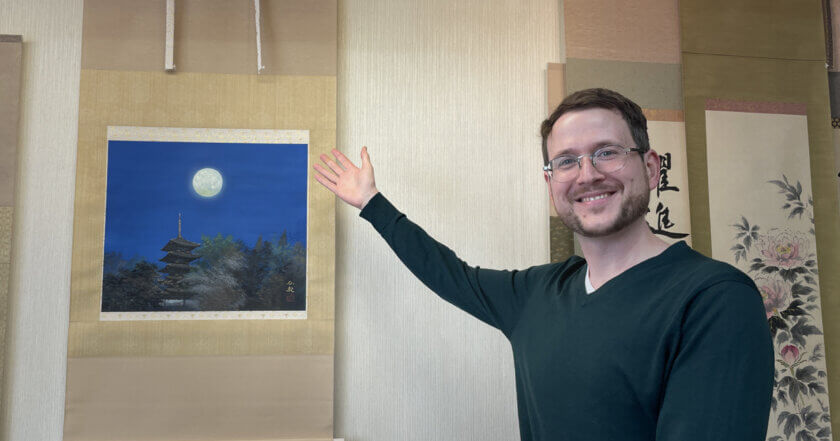
A Visit From Switzerland: Completing an All-Season Kakejiku Collection
In this article, we would like to share an episode of a customer from Switzerland who already owned a spring kakejiku and visited us to complete a four-season collection by selecting summer, autumn, and winter scrolls.
How It Started: Reconnecting After an Earlier Inquiry
This customer had contacted us about kakejiku in the past.
After that, his work assignment changed from Asia (mainly Japan) to Europe, and he had fewer opportunities to visit Japan, so his plan was put on hold for a while.
Later, he began covering both Europe and Asia again and started traveling to Japan more frequently, which led to this visit.
It is completely natural for circumstances to change, but we were truly happy that he reached out again and said he wanted to choose in person, by seeing the pieces in real life.
Preparing Before the Visit: Confirming Candidates and Re-Discussing Winter
Before his visit, his goal was clear.
He already owned a spring kakejiku, and he wanted to add three more pieces for summer, autumn, and winter.
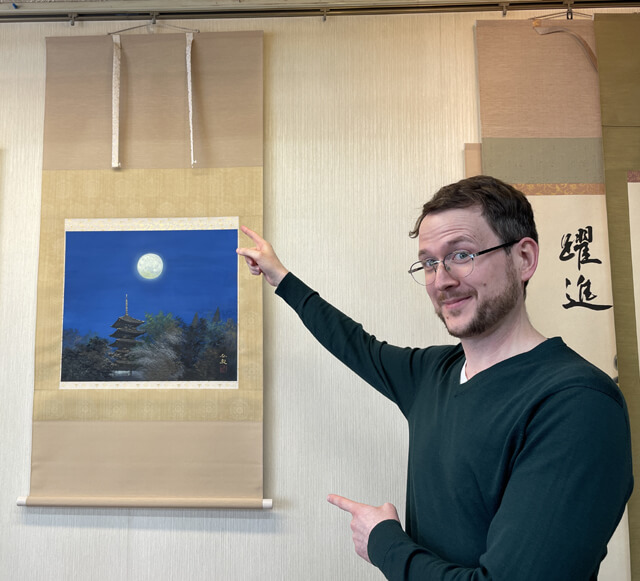
In addition, he planned to add one more scroll, “Moonlight,” not as a seasonal piece but as a scroll to display on holidays and festive occasions.
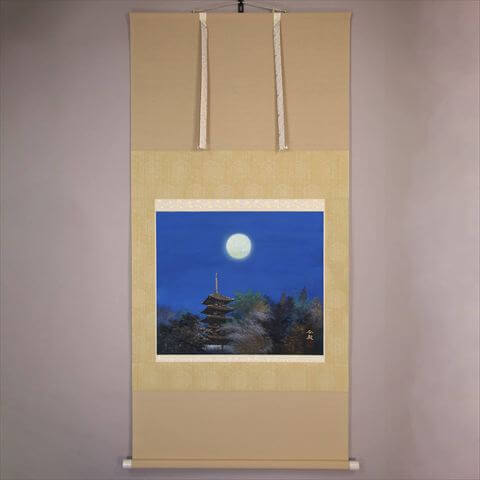
He shared several candidates from our website, and we checked our stock and prepared accordingly. However, one of the winter candidates he had selected was already sold and no longer available.
For that reason, we asked about his preferences for winter again and suggested several alternative winter options.
He was very pleased with the proposals and decided to view two winter pieces in our shop on the day.
With that, our preparations for his visit were in place.
The Visit: From Travel Talk to Kakejiku Naturally
On the day, our conversation started in a very friendly way right away.
Just before the appointment, we happened to see a visitor from Europe or North America near our shop, which is not something we often see in this neighborhood.
At that moment we could not be sure, but we did wonder if he might be our customer.
When the appointment time arrived, it turned out to be him.

When we mentioned it, he said he had arrived a bit early and had stopped by a convenience store to buy a drink before coming. From there, he told us he had stayed in Osaka the night before, and that after our meeting he planned to visit Himeji Castle.
The conversation naturally warmed up, and then we moved into the main purpose of his visit: selecting summer, autumn, and winter seasonal scrolls, plus “Moonlight.”
Why He Looked So Closely at Every Detail
He works in IT, involved with technologies such as barcode, text, and object recognition.
His background is engineering, and he mentioned that he now spends more time speaking directly with customers.
Perhaps because of that, he examined each kakejiku with great care, not only the overall impression but also the finer details, materials, and the information you can only truly understand in person.
He also noted that people in Switzerland and other German-speaking countries often appreciate Japanese art and culture, and he suggested that a shared respect for precision and accuracy may be one reason.
Summer: Imagining the Scroll in His Home
While looking at the summer options, he described his home very clearly.
His house is on a slight hill, and in his living room there is a large white wall. From the window, he can look down over Lake Zurich.
Among the summer candidates, one scroll depicted a lake scene, and he felt it would harmonize beautifully with the view and atmosphere of his home.
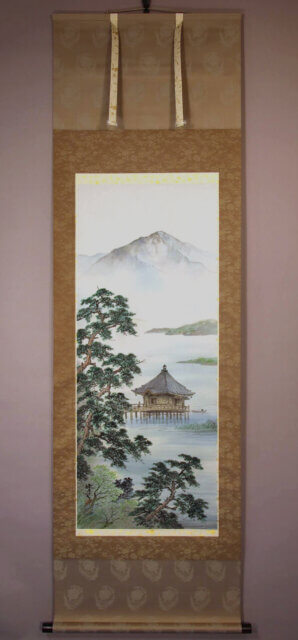
It was impressive to see how he was not only choosing a beautiful painting, but also envisioning how it would live in the space where he would display it.
Autumn: The Turning Point Was His Memory of Mt. Fuji
When we moved to the autumn options, he found it difficult to decide because both pieces were strongly appealing.
Although the photos are already beautiful, the real works revealed more depth in layering and gradation, and it was clear he felt they were even more impressive in person.
At that point, the conversation suddenly became especially lively when he spoke about Mt. Fuji.
He told us that in the past, his office in Shibuya was on a high floor, and he could see Mt. Fuji from there. Seeing Mt. Fuji every day left a strong impression on him, and he said it remains a memorable view.
In that moment, we could feel how special Mt. Fuji is to him.
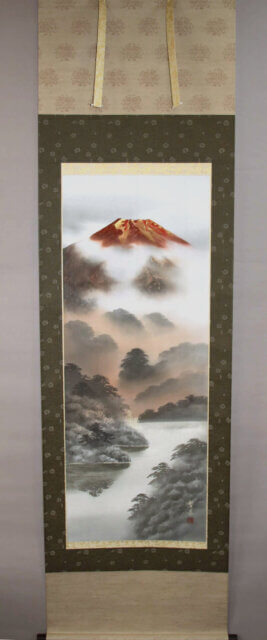
Sometimes, the final decision is not made only by knowledge or information, but by a personal memory that carries real weight. This was exactly such a moment.
Because he asked about the best season to display Red Mt. Fuji, we explained that in Japan it is often displayed as an auspicious scroll for New Year’s and other celebratory occasions, and at the same time it is also appropriate as an autumn scroll, since the motif is associated with late summer through early autumn.
Winter: From a Sold Piece to New Suggestions Through Preference
For winter, one of his initial candidates was already sold, so we started by asking again what kind of winter scene he truly wanted.
He said he was most drawn to winter landscapes that convey the crisp atmosphere of Japan in snow, such as snowy mountains and valleys.
Based on that direction, we suggested several winter options and compared them together in person.
One piece that captured his attention was a “Kinkaku-ji Temple in Snow” kakejiku.
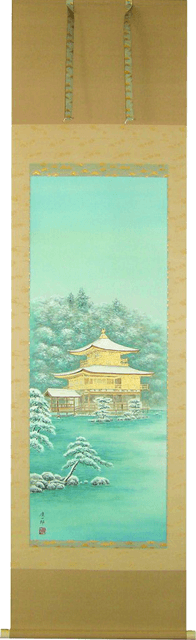
Interestingly, the sold-out winter piece he had asked about before his visit was also a Kinkaku-ji snow scene, so he was delighted to find another work with the same theme.
His interest went beyond the visual impression into history as well.
He asked whether Kinkaku-ji was originally built as a residence or palace-like structure and later became a temple.
We replied that it was originally built as a villa of Ashikaga Yoshimitsu, the third shōgun of the Muromachi shogunate, and after his death it became a temple.
It was a warm and enjoyable moment of sharing Japanese history together.
He also gave a very careful impression of the work, noting how the snow on the roof makes the gold stand out even more, and how the blues and touches of green and gold create a sense of warmth rather than a cold feeling, despite being a winter scene.
“Moonlight”: Not Seasonal, but for Festive Days
Regarding “Moonlight,” his view was consistent from beginning to end.
Rather than a seasonal scroll, he saw the full moon and the temple scenery as something suitable for holidays and festive days, and he wanted it as a special-occasion scroll.
We also shared a cultural note that moon motifs are often displayed in autumn in Japan, as autumn is traditionally considered the best season to appreciate the moon. In the end, we agreed that the most important thing is the owner’s own sensibility and how they wish to enjoy the piece.
Shipping Timed to His Return Home
He told us he would remain in Japan for a while longer and that his work schedule would continue during his stay.
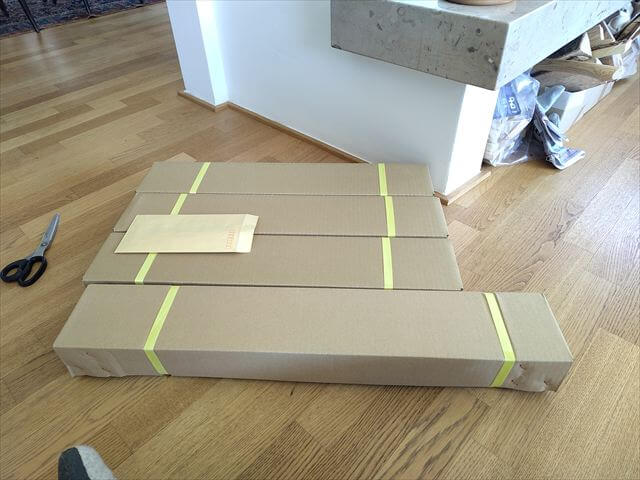
For that reason, we arranged the shipment to match the timing of his return home, so that receiving the parcel and handling customs would be easier for him.
Later, he contacted us to say the shipment arrived safely and everything was in perfect condition, which brought us great relief as well.
Customer Review
Below is the customer’s review.
Great shop for anyone interested in Kakejiku – Japanese hanging scrolls.
Nomura-san offers a wide selection on his online shop with high resolution pictures as well as good descriptions.
He is very knowledgeable about this topic and was great in advising me for a pre-selection via email and in English before I came to the store for my final selection of pieces.
I was warmly welcomed to his store, he showed me the different pieces we had previously selected and also suggested additional alternatives on the spot when I was unsure.
I made my selection over a delicious cup of green tea and further benefiting from Nomura-san’s knowledge and expertise.
Since I had planned to have the Kakejiku shipped, I was impressed by his statement that I should take a day or two to consider which pieces I finally want, so that I am 100% happy with them. Very considerate and it shows his aim to satisfy his customers.
While I finished my trip in Japan, he expertly packed all the pieces and shipped them with DHL so they arrived easily a few days after I was back. Customs was also a breeze thanks to a clear invoice and using DHL.
Last but not least, Nomura-san was also so generous as to use his expertise in the field of Kakejiku to identify the artist of a Kakejiku I had bought at an antique store in the past.
I highly appreciate you helping me with this.
All in all – whether you come in person or order online – you can trust that you will receive great customer service, advisory and high quality Kakejiku.
どうもありがとう
Enjoying Kakejiku With the Seasons
Changing a kakejiku with the seasons can make the very same room feel completely different.
At ART NOMURA, we do our best to support customers both in person and from overseas as carefully as possible.
Whether you are purchasing your first kakejiku or hoping to build an all-season collection, please feel free to contact us anytime.