Shikoku Pilgrimage Temple: No. 24 Hotsumisaki-ji
The Place Associated with Kōbō Daishi’s Name, “Kūkai.”
- Name: Muroto-zan Myōjō-in Hotsumisaki-ji
- Main Deity: Kokūzō Bosatsu (Ākāśagarbha)
- Goeika (Pilgrimage Song):
- To the eastern temple where the morning star rises
- how could any dark delusions remain?
Access From Temple No. 23, Yakuō-ji:
- On foot: Walk steadily along National Route 55. Approx. 75 km, 24 hours.
- By Car: Same route as walking. Approx. 2 hours.
- Public Transport: From Hiwasa Station, take the JR Mugi Line (approx. 40 min) and get off at Kaifu Station. Take the Asa Kaigan Railway DMV (Dual Mode Vehicle) for 15 min and get off at Umi-no-Eki Tōyō-chō. Transfer to the Kōchi Tōbu Kōtsū Bus Muroto Line (55 min) and get off at Muroto Eigyōsho. Transfer to the same company’s bus bound for Muroto Global Geopark (6 min) and get off at Murotomisaki.
The Beginning of the “Dōjō of Ascetic Practice” in Tosa Province
Standing on a mountain overlooking the sea near the tip of Cape Muroto, which juts out into the Pacific Ocean, is Hotsumisaki-ji. From this temple, the pilgrimage through Tosa Province—known as the “Dōjō of Ascetic Practice” (Shugyō no Dōjō)—begins. The journey from Temple 23 Yakuō-ji to this 24th temple is about 75 km, taking around three days on foot, with the majority of the route following the national highway. However, walking silently for three days with the sole focus of reaching the next sacred site seems fitting for the beginning of the “Dōjō of Ascetic Practice.”
The Place Where the Young Kōbō Daishi Practiced Asceticism
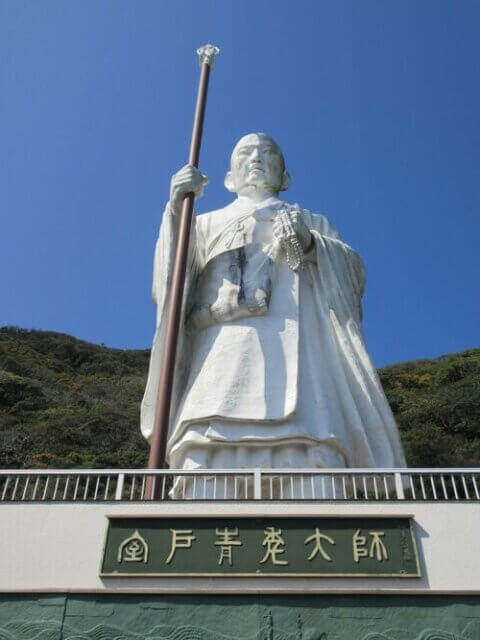
Cape Muroto, where Hotsumisaki-ji is built, is the place where Kōbō Daishi repeatedly underwent rigorous ascetic practices in his youth. On a hill near the coast stands the Muroto Seinen Daishi Statue, depicting the Daishi as a young man. It is a giant statue standing 16 meters tall, said to be the tallest statue of Kōbō Daishi in Japan.
There are many other highlights conveying episodes of the Daishi’s miraculous efficacy, such as Kanjōgahama, where he is said to have performed esoteric Buddhist rituals; the “Eye-Washing Pond” (Mearai no Ike), which gushes fresh water despite being on the coast and is said to be miraculously effective for eye diseases; and the “Child-Granting Rock” (Kozukari-iwa), where throwing a pebble is said to bless one with children. A walking trail is provided to visit these sites.
The Cave That Conveys the Name “Kūkai”
Among the scattered historic sites associated with the Daishi, the one you must visit is the Mikurodo cave.
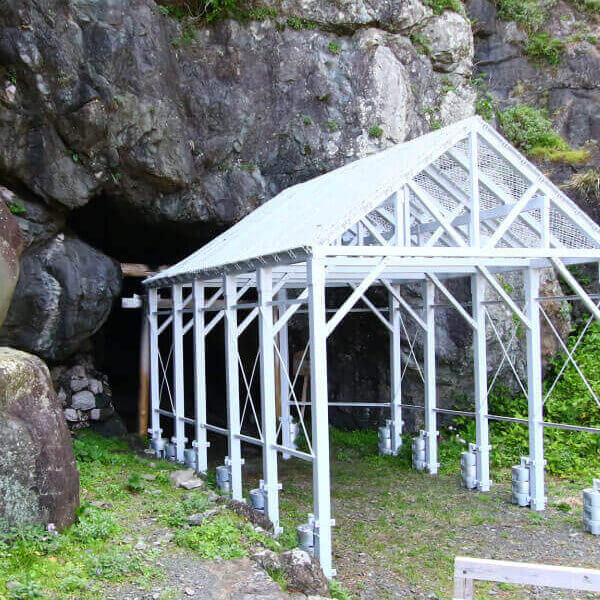
This is the cave where the young Kōbō Daishi lived while practicing asceticism, and where he is said to have attained enlightenment after his rigorous training. The interior is spacious, measuring about 20 meters deep and up to 5 meters to the ceiling. Looking out toward the entrance from the pitch-dark interior, the only thing that jumps into view is the distant horizon. It is said that the Daishi obtained the name “Kūkai” (Sky and Sea) from his experience in this cave, where nothing but the sky and the sea could be seen.
Founded by the Daishi After Returning from Tang China
Kōbō Daishi later crossed over to Tang China, underwent further training, and returned to Japan. Upon his return, he visited Cape Muroto again and founded Hotsumisaki-ji by the imperial prayer of Emperor Saga. It is said that he carved the statue of Kokūzō Bosatsu himself and enshrined it as the principal image. Since then, the temple prospered as an imperial prayer place for successive emperors, and in the Nanboku-chō period, it became Tosa Ankokuji to protect Tosa Province. In the Edo period, it received generous protection from the Yamauchi clan, the lords of the Tosa domain, and its shichidō garan (complete set of seven temple buildings) was arranged. However, it fell into ruin due to the separation of Shinto and Buddhism in the Meiji period. Though it was completely desolate for a time, it was restored in Taishō 3 (1914). The current hondō (main hall) was rebuilt in Taishō 13 (1924).
Tracing the Historic Sites Associated with the Daishi
The official approach to Hotsumisaki-ji is climbing the mountain trail from just beyond the Mikurodo cave on the coast. The guide sign for the Cape Muroto Lighthouse serves as a landmark. Dotted along this mountain path are sites such as the “Twisted Rock” (Nejiri-iwa)—where the Daishi is said to have sheltered his mother on a stormy day, and the rock allegedly twisted when he sealed the storm inside it—and the “Cave Built in One Night” (Ichiya Konryū no Iwaya), which the Daishi is said to have constructed in a single night. Eventually, you will reach the magnificent Niō-mon Gate. Proceeding left before the gate leads to the Cape Muroto Lighthouse. If you are driving, take the slope to the right from the parking lot instead of climbing the stone steps. If you climb the stone steps, you will suddenly emerge right at the hondō.
Precincts with a Tropical Mood
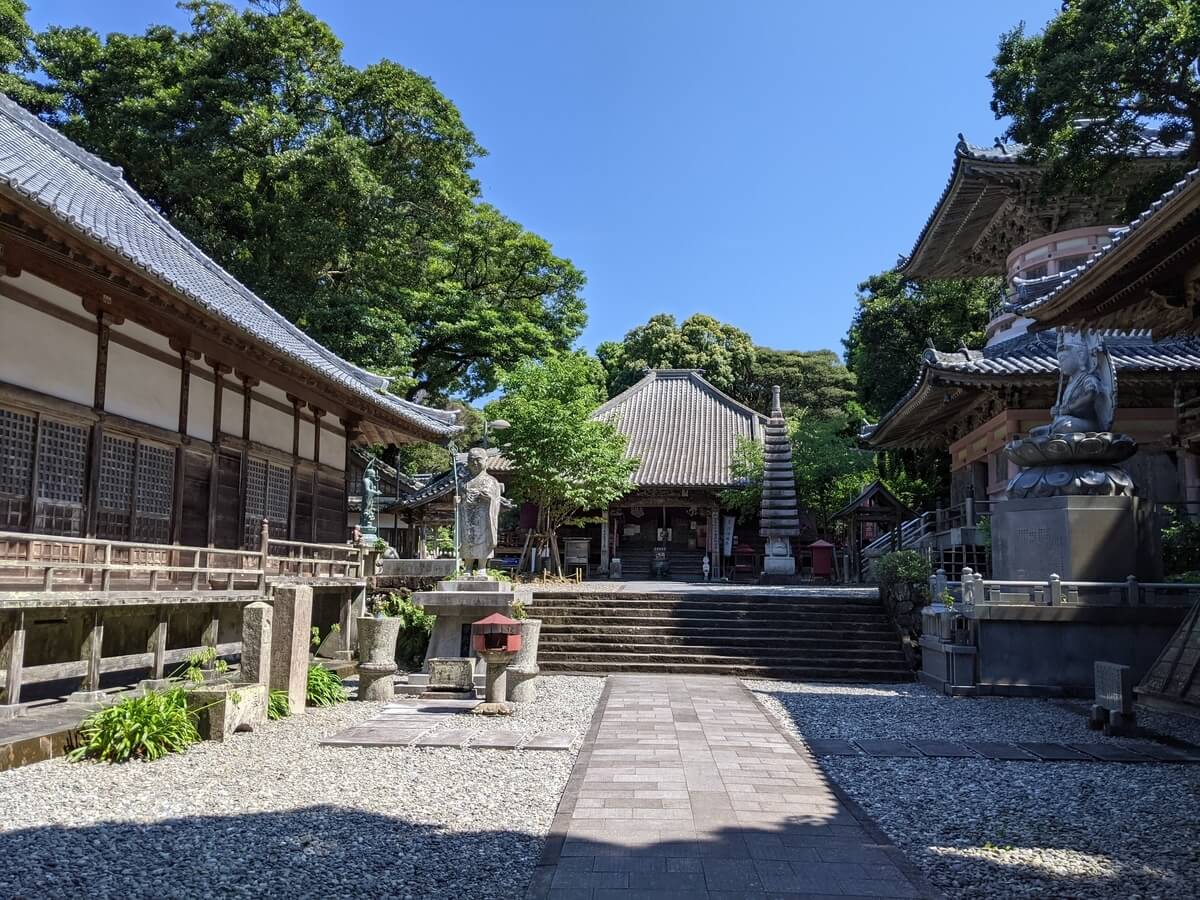
Pass through the Niō-mon Gate into the temple precincts. The area is thick with subtropical plants such as akō (fig trees), birō (fan palms), and ubamegashi (ubame oaks). Compared to the sacred sites in Tokushima Prefecture where cedar groves are prominent, this temple has a rich tropical atmosphere. The colonies of yakkosō plants are particularly rare. Surrounded by these subtropical trees, temple buildings such as the Shōrō-dō (Bell Tower Hall), Daishi-dō, Tahō-tō (Two-storied Pagoda), Kangiten-dō, Goma-dō, and the hondō stand side by side. Behind the hondō is the Treasure House (Hōmotsuden). Although not usually open to the public, it houses many temple treasures. The statue of Yakushi Nyorai, the standing statue of Gakkō Bosatsu, and the half-lotus posture statue of Nyoirin Kannon—said to have been brought back from Tang China by the Daishi—are designated as National Important Cultural Properties. Beside the Daishi-dō, what catches the eye is the “Bell Stone” (Kane-ishi). It is a rock with several hollows on top; when you strike it with a small stone placed in the hollows, a clear, metallic “clink” sound echoes. It is said that this is the sound of a bell echoing all the way to the Pure Land of Ultimate Bliss (Gokuraku Jōdo). Going further past the hondō brings you to the temple lodging (shukubō), the “Hotsumisaki-ji Henro Center.” There is also a shop selling pilgrimage supplies and a dining hall.
DATA
Address: 4058-1 Murotomisaki-chō, Muroto City, Kōchi Prefecture, Japan
Phone: 0887-23-0024
Access: From Nahari Station on the Tosa Kuroshio Railway Gomen-Nahari Line, take the Kōchi Tōbu Kōtsū Bus bound for Murotomisaki (50 min), get off at Murotomisaki, then walk 35 min.
Parking: Available (Free for standard cars)
Lodging: The “Hotsumisaki-ji Henro Center” is available. You can also enjoy local Tosa flavors such as seared bonito (katsuo no tataki). Reservation required.
Your Pilgrimage, Your Art
Completing the Shikoku Pilgrimage is a once-in-a-lifetime journey—but what if you could preserve it in a form that lasts forever?
Many pilgrims collect red stamps and calligraphy from each temple on a special silk scroll called a nōkyōjiku.
This sacred record of your path can be transformed into a kakejiku—a traditional Japanese hanging scroll—not only preserving the memories, but turning them into a work of cultural and spiritual art.
It’s more than a souvenir—it’s a way to honor your journey, your prayers, and your growth.
To learn more about how a nōkyōjiku becomes a kakejiku, and what makes this transformation so meaningful, please refer the below link.