Shikoku Pilgrimage Temple: No. 23 Yakuō-ji
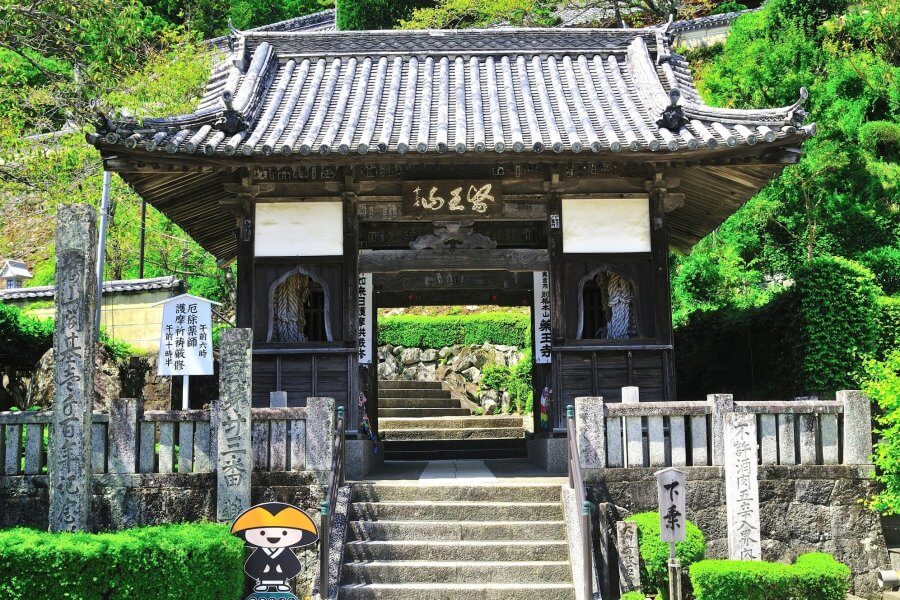
Known As a Famous Temple for Warding off Evil (Yaku-yoke)
- Name: Iō-zan Muryōju-in Yakuō-ji
- Main Deity: Yaku-yoke Yakushi Nyorai (Bhaiṣajyaguru)
- Goeika (Pilgrimage Song):
- For everyone in their years of illness or calamity
- Yakuō-ji grants the healing medicine of Lapis Lazuli.
Access From Temple No. 22, Byōdō-ji:
- On foot: Follow National Route 55 and the pilgrimage path parallel to it. Approx. 21 km, 7 hours.
- By Car: Via National Route 55. Approx. 23 km, 30 minutes.
- Public Transport: Return to Aratano Station, take the JR Mugi Line (30 min) and get off at Hiwasa Station.
A Prayer Temple for Warding Off Misfortune, Revered by the Imperial Family
Standing midway up the mountain and overlooking the Hiwasa Coast—famous for sea turtle nesting—Yakuō-ji is one of the region’s best-known attractions and draws many visitors.
The temple traces its origins to the Nara period and is said to have been founded by Gyōki as an imperial prayer temple for Emperor Shōmu. In the Heian period, by order of Emperor Heizei, Kōbō Daishi established it as a fundamental prayer center for warding off misfortune, and Emperors Saga, Junna and Toba later sent imperial envoys to pray for protection. The temple has long been revered by the Imperial Family; for example, when it was devastated by fire, Emperor Go-Daigo supported its revival. Because of this history, Yakuō-ji has also been worshipped by the common people as a temple for yaku-yoke. It is visited not only by pilgrims but also by many general worshippers, with annual visitors said to reach around one million.
Various Places for Warding Off Misfortune Within the Precincts
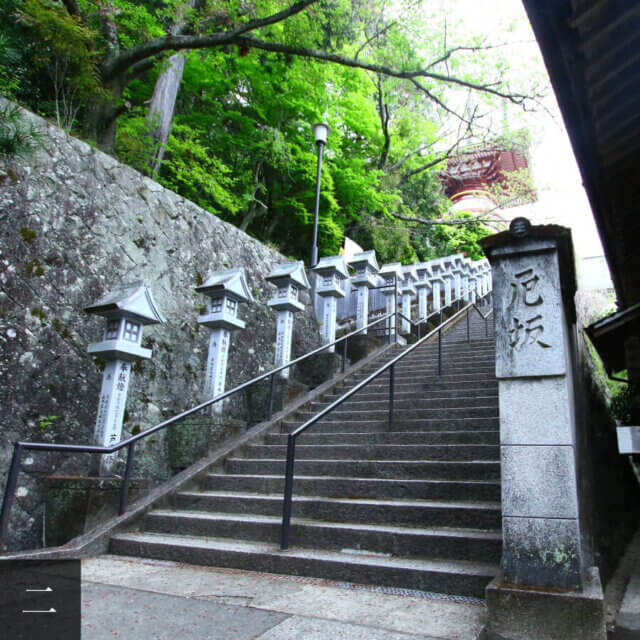
The bridge over the small waterway in front of the Sanmon (Mountain Gate) is known as the “Yaku-yoke Bridge.” Crossing it, passing through the Niō-mon Gate, and proceeding along the approach with the Shōrō (Bell Tower) on the right, you first reach the 33 stone steps of the Onna-Yakuzaka (Women’s Calamity Slope). At the top is the Ema Hall, and from there the Otoko-Yakuzaka (Men’s Calamity Slope) continues with 42 stone steps. It is customary for those in yakudoshi (critical years) to place small coins on each step as they ascend, praying to cast off misfortune.
The steps leading up to the Yugi-tō (Yugi Tower) at the back right of the Hondō (Main Hall) form the Kanreki-Yakuzaka (Sixtieth-Year Calamity Slope), with 61 steps shared by both men and women. There are many other yaku-yoke spots within the grounds. In the Ema Hall between the Women’s and Men’s Slopes is a yaku-yoke mortar (usu). Near the Hondō, beside the Gyoran Kannon (Fish-Basket Kannon), is the Zuigu Bell for warding off misfortune. Such sacred sites are scattered throughout the precincts. Both the mortar and the unpan (cloud-shaped gong) are struck with a pestle or wooden mallet the same number of times as one’s age, as a yaku-yoke prayer.
The Backward-Facing Yakushi
Two Yakushi statues are enshrined as the principal image (hidden Buddhas). Legend says that when a fire broke out in Bunji 4 (1188), the principal Yakushi emitted light, flew away, and took refuge at Mt. Tamazushi in the Oku-no-in (Inner Sanctuary). Later, when Emperor Saga rebuilt the temple complex and consecrated a new Yakushi statue, the original principal image returned, emitting light again, and entered the Hondō backward. This is the origin of the “Backward-Facing Yakushi,” meaning that the two statues are enshrined back-to-back. For this reason, the Hondō can be worshipped from both the front and the rear.
Yugi Tower (Yugi-tō)
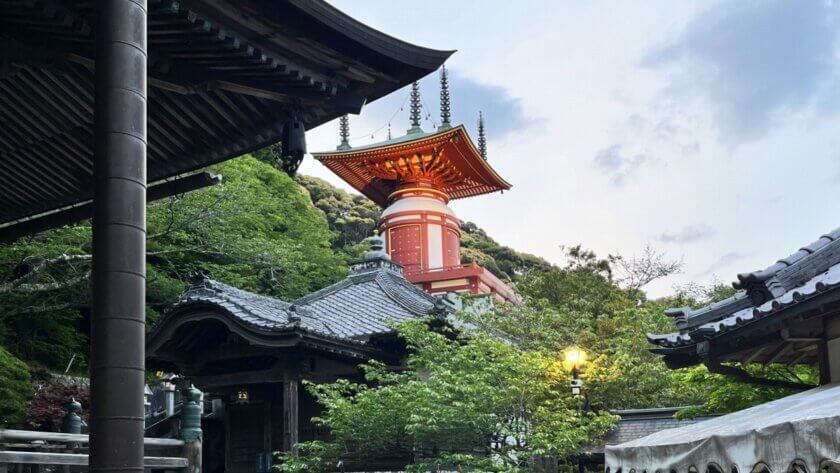
A symbolic feature of the precinct’s scenery, visible even from the Sanmon, is the Yugi Tower. This vermilion hōtō-style pagoda (treasure pagoda) stands 29 meters tall. Unlike typical hōtō, it has sōrin (spires) not only at the center of the roof but also at the four corners, for a total of five. Based on the teachings of the Yugi-kyō, which speaks of the harmony of heaven and earth, this is said to signify peace and happiness. Inside, the first floor enshrines the Gochi Nyorai (Five Wisdom Buddhas) centered on Dainichi Nyorai. The basement features a kaidan-meguri (underground circuit), and the second floor is an observation deck. As viewing periods are limited (such as during the New Year holidays), those wishing to enter should check in advance.
Precincts Overlooking the Sea
From the high ground, the view is superb, offering a panoramic vista of the town of Hiwasa and the Pacific Ocean. At this temple, Tokushima Prefecture’s “Dōjō of Awakening Faith” (Hasshin no Dōjō) comes to an end, and from here begins Kōchi Prefecture’s “Dōjō of Ascetic Practice” (Shugyō no Dōjō).
DATA
Address: Teramae 285-1, Okugawachi, Minami-chō, Kaifu-gun, Tokushima Prefecture, Japan
Phone: 0884-77-0023
Access: 10 min walk from JR Hiwasa Station (Mugi Line)
Parking: Available (Free)
Lodging: None
*Entrance fee for Yugi Tower kaidan-meguri: 100 yen
Your Pilgrimage, Your Art
Completing the Shikoku Pilgrimage is a once-in-a-lifetime journey—but what if you could preserve it in a form that lasts forever?
Many pilgrims collect red stamps and calligraphy from each temple on a special silk scroll called a nōkyōjiku.
This sacred record of your path can be transformed into a kakejiku—a traditional Japanese hanging scroll—not only preserving the memories, but turning them into a work of cultural and spiritual art.
It’s more than a souvenir—it’s a way to honor your journey, your prayers, and your growth.
To learn more about how a nōkyōjiku becomes a kakejiku, and what makes this transformation so meaningful, please refer the below link.