Remounting and Repair of a Handscroll with Creases and Areas of Separation
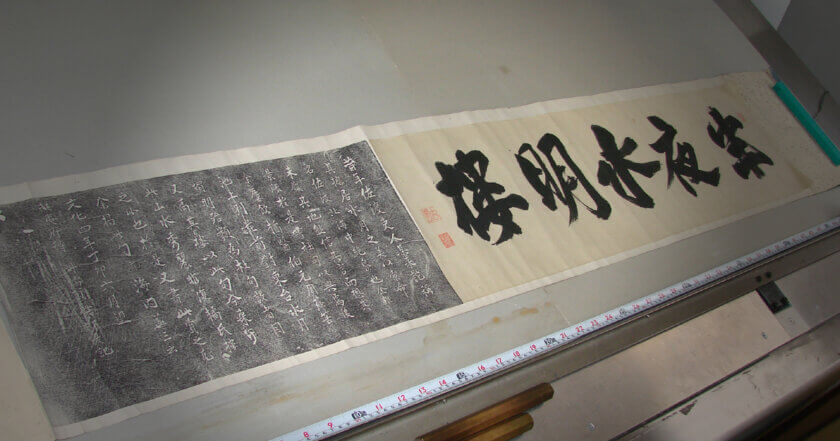
Old handscrolls often carry not only artistic value, but also the history and memories of a family.

This time, we received a request from a customer living in Toyooka City, Hyōgo Prefecture, to repair and remount an important handscroll connected to their ancestors.

This customer had previously entrusted us with the restoration of a kakejiku as well, and we are truly grateful that they chose to contact us again.

Consultation Regarding an Important Handscroll Connected to the Customer’s Ancestors

The item brought to us this time was a work related to the customer’s ancestors, who had run a traditional Japanese restaurant in Tajima.
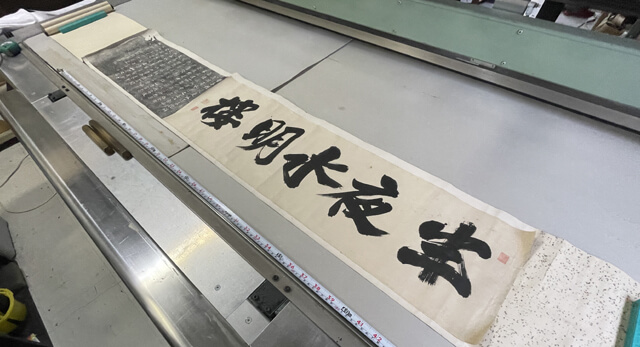
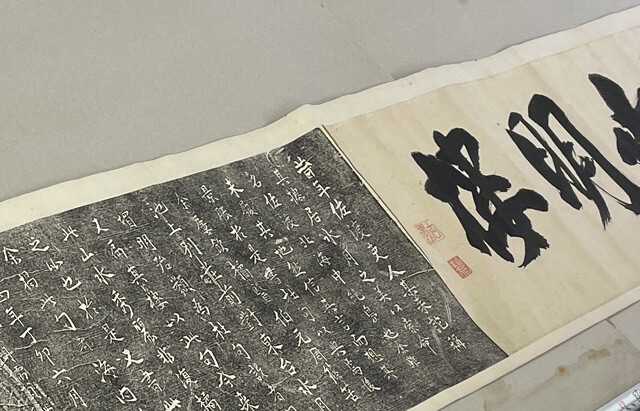
It was a rare handscroll made by combining calligraphy with a rubbing, and for the customer it was a special piece closely connected to their own roots.
After receiving their inquiry, visited the customer’s home and discussed the condition of the work in person.

Items so deeply tied to a family’s history carry a significance quite different from that of an ordinary antique work of art.

For that reason, it is important not only to consider how the piece should be repaired, but also to carefully listen to how the customer wishes to preserve it and what it means to them.

Condition of the Handscroll: Tears, Separation, and Creases

When we examined the handscroll, there were no noticeable stains or major dirt.

However, creases and distortions had developed throughout the scroll, showing the effects of long-term storage.

In addition, the joined sections of the work had begun to tear, and there were also several areas where the work had started to separate from the backing paper.
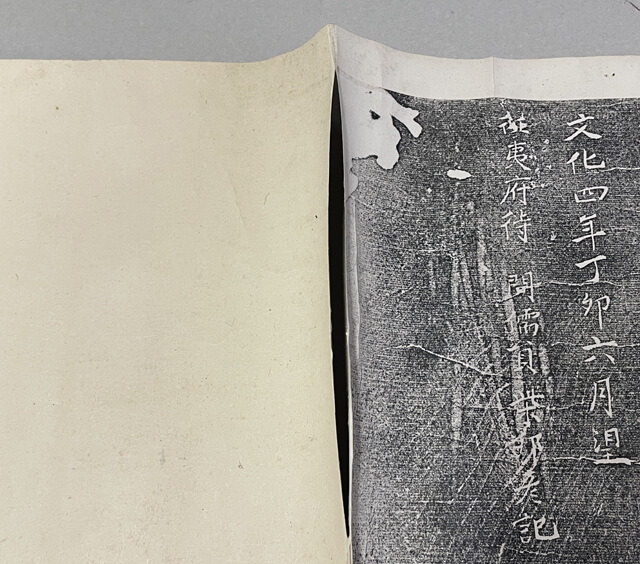
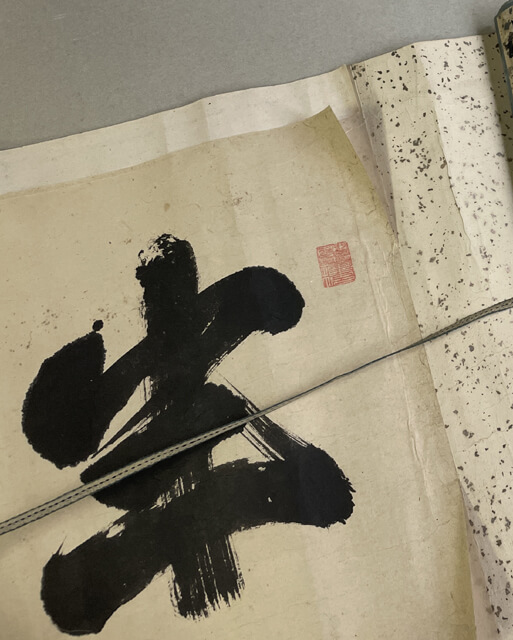
Preserving the Natural Appearance of a Handscroll Combining Calligraphy and Rubbing

One of the defining features of this handscroll was its composition, combining calligraphy and a rubbing.

Based on our policy of preserving the atmosphere of the work, we decided to carry out the remounting while reinforcing the joined sections so that the handscroll could continue to be used and preserved in the future.

The Remounting of the Handscroll Has Been Completed

After the remounting, the creases that had appeared throughout the handscroll were removed, and the handscroll regained a cleaner and more refined overall appearance.

The combination of the calligraphy and the rubbing could also be viewed more naturally, and we believe the original charm of the work was brought back more clearly.
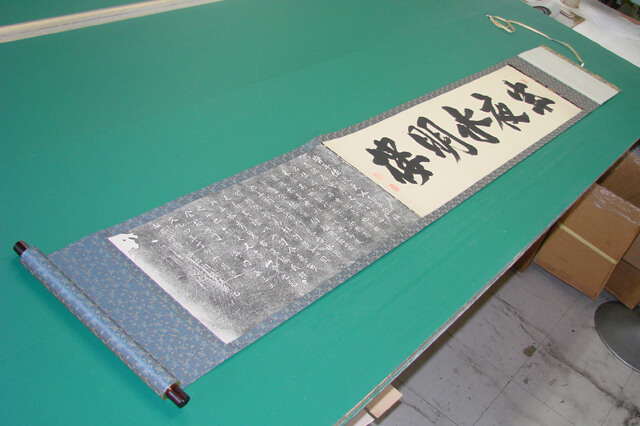
The joined sections were also reinforced to help prevent the tears from recurring.
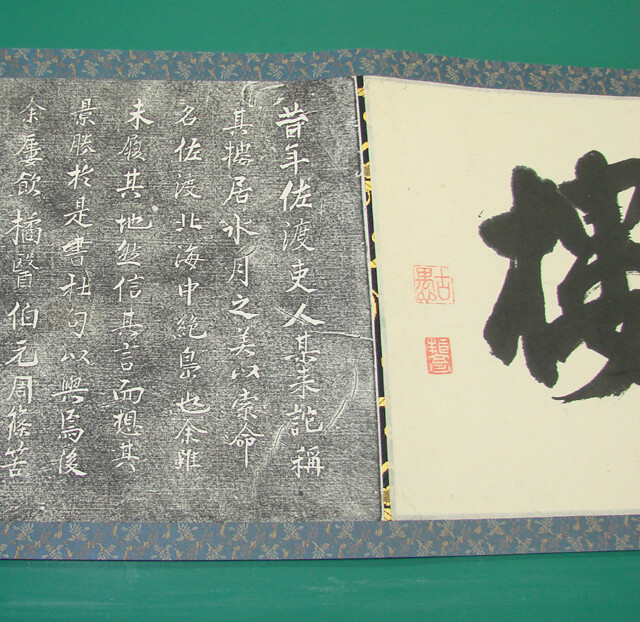
The Accompanying Paulownia Wood Box Was Also Repaired

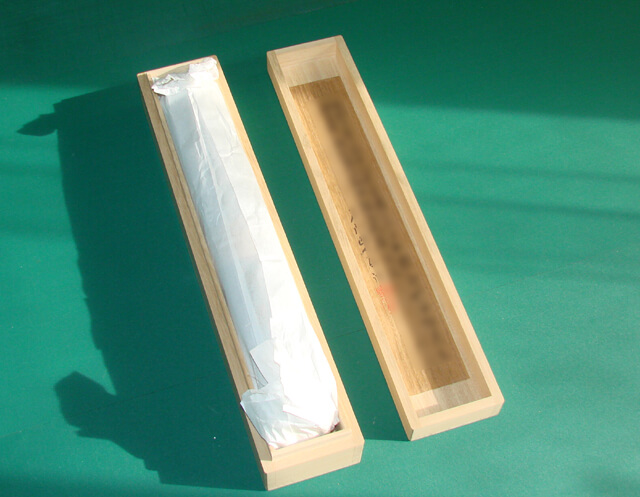
In this case, we were consulted not only about the handscroll itself, but also about its accompanying paulownia wood box.

The box itself was in quite poor condition, but the customer wished to preserve the inscription on the lid, so we responded by salvaging only that part and transferring it to a new paulownia wood box.
The Customer Was Also Very Pleased

After the remounting was completed, we visited the customer’s home again for delivery, and we were very pleased that the customer was highly satisfied with the result.

Because this handscroll was such an important item connected to their ancestors, we believe they felt reassured not only that it had become beautiful again, but also that it had been restored to a condition in which it could be safely preserved for years to come.

Such items are not simply old objects. They are things that connect a family to its history and memories.

We take that value seriously and approach each piece with the care it deserves.

Please Contact Us if You Are Considering Repair Work for an Ancestral Handscroll or an Old Handscroll

Handscrolls have a structure quite different from that of kakejiku, and they are prone to unique issues such as creases, distortions, and damage to the mounting.

We carefully examine the condition of each work and propose repair and remounting methods that will allow it to be preserved and passed down for many years to come.

If you are considering repair work for an ancestral handscroll or an old handscroll filled with family history, please feel free to contact us.
    NameRequired

    SexRequired

    MaleFemale

    CountryRequired

    e-mailRequired

    CommentRequired

    Attached File
    ※Up to 3 MB for each file.


    ← ← "MUST CHECK" / Please confirm the above contents again and check this button.


    Contact Us

    Please fill out the form below and submit for your inquiry.

    ❈FirstName
    ❈LastName
    Country
    ❈E-mail
    (❈Confirm E-mail)
    ❈Inquiry category Question
    Consultation
    Impression
    Request
    Others
    ❈Comment

    is the mark for required item.


    Your privacy is important to us. We are committed to protecting your privacy.

    (or press ESC or click the overlay)

    CEO Message

    Our Feelings For Kakejiku


     The Japanese people have long set a high value on aesthetic senses since ancient times. As a result, the
    peculiar culture which is not seen in other countries blossomed and many aspects of the modern Japanese
    culture come from it. Parts of Japanese culture has been introduced to people in other countries recently,
    so the number of people from other countries who are interested in Japanese culture has been increasing.
    However, the Japanese aesthetic senses, which are the bases of Japanese culture, have been nurtured
    through a long history, intertwining various elements intricately, such as climate, geographical features,
    religion, customs and so on. Therefore, they are very difficult to understand not only for people from other
    countries, but even for the Japanese people. I think the best tool which conveys these difficult senses
    understandably is a “kakejiku.”
     The kakejiku (a hanging scroll; a work of calligraphy or a painting which is mounted and hung in an
    alcove or on a wall) is a traditional Japanese art. It's no exaggeration to say that paintings are what
    express aesthetic senses at all times and places. The kakejiku is an art which expresses the Japanese
    aesthetic senses. The kakejiku has long been used in traditional Japanese events, daily life and so on since
    ancient times. As a result, there are various customs of kakejiku in Japan; kakejiku and the life of the
    Japanese are closely related. We can see Japanese values through kakejiku.
     The kakejiku is a cultural tradition which the Japanese people should be proud of. However, many people
    in other countries don't know much about it because it hasn't been showcased as much. This is why I
    decided to try to introduce it. The kakejiku world is very interesting and beautiful. We want not only the
    Japanese, but also many people from other countries to know and enjoy it. I hope that many people will
    love kakejiku someday.

    (or press ESC or click the overlay)
    Company Profile
    syaoku.jpg(120220 byte)

    Name Art Nomura


    President Tatsuji Nomura


    Founded1973


    Established1992


    Address7-23 Babadori, Tarumi-ku, Kobe city,
    Hyougo Prefecture, 655-0021, Japan


    Capital10 million yen


    URLhttp://nomurakakejiku.com


    Our Business

     Art Nomura is an art dealer which produces kakejiku (hanging scrolls). We mount many paintings and calligraphic works in kakejiku in my factory. Kakejiku are our main product. We also remount and repair old or damaged kakejiku. We share the traditional Japanese art of kakejiku with people all over the world.


    (or press ESC or click the overlay)
    Access Map

    Access Map


     The Japanese people have long set a high value on aesthetic senses since ancient times. As a result, the
    peculiar culture which is not seen in other countries blossomed and many aspects of the modern Japanese
    culture come from it. Parts of Japanese culture has been introduced to people in other countries recently,
    so the number of people from other countries who are interested in Japanese culture has been increasing.
    However, the Japanese aesthetic senses, which are the bases of Japanese culture, have been nurtured
    through a long history, intertwining various elements intricately, such as climate, geographical features,
    religion, customs and so on. Therefore, they are very difficult to understand not only for people from other
    countries, but even for the Japanese people. I think the best tool which conveys these difficult senses
    understandably is a “kakejiku.”
     The kakejiku (a hanging scroll; a work of calligraphy or a painting which is mounted and hung in an
    alcove or on a wall) is a traditional Japanese art. It's no exaggeration to say that paintings are what
    express aesthetic senses at all times and places. The kakejiku is an art which expresses the Japanese
    aesthetic senses. The kakejiku has long been used in traditional Japanese events, daily life and so on since
    ancient times. As a result, there are various customs of kakejiku in Japan; kakejiku and the life of the
    Japanese are closely related. We can see Japanese values through kakejiku.
     The kakejiku is a cultural tradition which the Japanese people should be proud of. However, many people
    in other countries don't know much about it because it hasn't been showcased as much. This is why I
    decided to try to introduce it. The kakejiku world is very interesting and beautiful. We want not only the
    Japanese, but also many people from other countries to know and enjoy it. I hope that many people will
    love kakejiku someday.

    (or press ESC or click the overlay)