Mounting a Chichibu 34 Kannon Pilgrimage Nōkyō-jiku as a Kakejiku
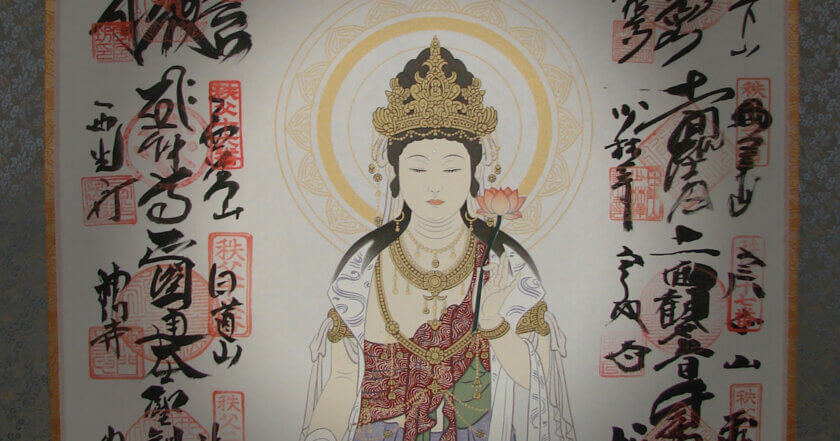
The Chichibu 34 Kannon Pilgrimage (Chichibu Sanjūyon Kannon Reijō) is one of the most representative Kannon pilgrimage routes in the Kantō region, consisting of thirty-four sacred temples scattered across the Chichibu area of Saitama Prefecture.

The total route is generally said to be around 100 km, and thanks to its convenient access from the greater Tokyo area, it is often introduced as an “ideal pilgrimage for beginners” that can be completed in a relatively short period of time.

A nōkyō-jiku is a scroll that records a Japanese temple pilgrimage with vermilion seals (shuin) and calligraphy collected at each temple. It is often mounted as a kakejiku after the pilgrimage so it can be displayed and preserved.

In this case, we received a request from a customer living in Tokyo who wished to have their nōkyō-jiku from the Chichibu 34 Kannon Pilgrimage professionally mounted as a kakejiku.

Consultation Details

The customer had completed the pilgrimage and wanted to transform the finished nōkyō-jiku as a format that could be properly hung and displayed.
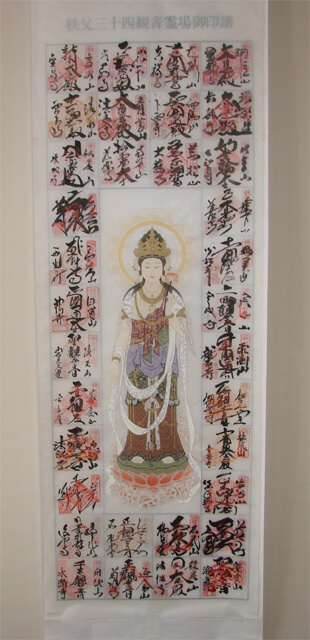
The customer also noted that there was a small area with a few ink splatters and asked whether it would be a concern.
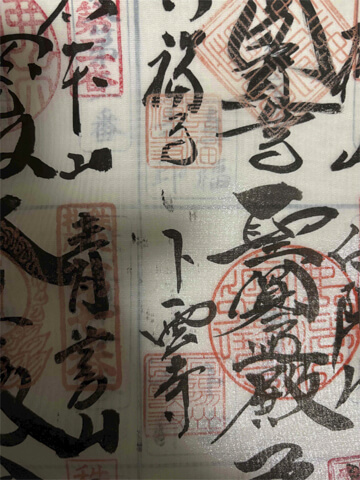
Based on the photos we received, the ink splatters appeared minor.

We explained that, in our professional view, they would likely become much less noticeable once the piece was mounted as a full kakejiku, and that proceeding with the mounting in its current condition should not be a problem.

The customer agreed and sent the nōkyō-jiku to our shop.

Discussing the Mounting Specifications and the Production Process

After the nōkyō-jiku arrived, we confirmed the mounting specifications with the customer.

For this project, the customer asked us to select the mounting fabrics on their behalf. Drawing on our experience, we chose a combination of fabrics that would best complement the work and create a calm, dignified overall impression.

The mounting process generally proceeds as follows.

First, we apply a fixing treatment to help prevent the ink and vermilion seals from bleeding.

We then reinforce the work with backing papers to ensure the strength and stability required for a hanging scroll.

Next, we plan the fabric layout, cut the textiles, and assemble each section in sequence to shape the final composition.

Finally, we attach the roller rod and the hanging cord to complete the kakejiku.

Condition After Completion: A Calm, Dignified Kakejiku

This is the completed kakejiku mounted from the customer’s Chichibu nōkyō-jiku.

Once finished as a hanging scroll, the small ink splatters the customer had been concerned about became barely noticeable within the overall composition.
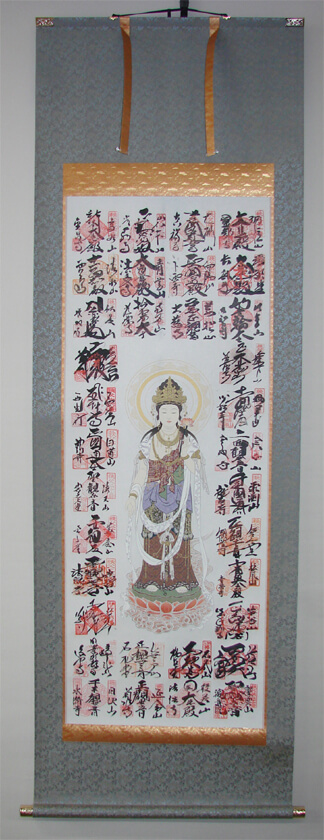
After we shared photos of the finished piece, the customer kindly told us. “The result is chic and luxurious, and the colors match the Kannon’s robe beautifully.”

Customer Feedback: “Impressive Weight and Presence, More Beautiful Than I Imagined”

After the scroll arrived safely, the customer also shared the following comment. “The actual scroll has a sense of weight and presence, and the result was more beautiful than I imagined.”

The customer further mentioned that, in the future, he would like to consult us again after completing other pilgrimages such as Saigoku, Bandō, or Shikoku.

We consider it a great honor to help our customers preserve their pilgrimage milestones by mounting these precious records as kakejiku that can be displayed with pride in everyday life.

Summary: Please Feel Free to Consult Us About Mounting Your Nōkyō-jiku as a Kakejiku

We accept inquiries from customers who live far away as well. If you would like to have a nōkyō-jiku mounted as a kakejiku, we will confirm the condition and your preferences and then propose the most suitable mounting specifications. Please feel free to contact us anytime.
    NameRequired

    SexRequired

    MaleFemale

    CountryRequired

    e-mailRequired

    CommentRequired

    Attached File
    ※Up to 3 MB for each file.


    ← ← "MUST CHECK" / Please confirm the above contents again and check this button.


    Contact Us

    Please fill out the form below and submit for your inquiry.

    ❈FirstName
    ❈LastName
    Country
    ❈E-mail
    (❈Confirm E-mail)
    ❈Inquiry category Question
    Consultation
    Impression
    Request
    Others
    ❈Comment

    is the mark for required item.


    Your privacy is important to us. We are committed to protecting your privacy.

    (or press ESC or click the overlay)

    CEO Message

    Our Feelings For Kakejiku


     The Japanese people have long set a high value on aesthetic senses since ancient times. As a result, the
    peculiar culture which is not seen in other countries blossomed and many aspects of the modern Japanese
    culture come from it. Parts of Japanese culture has been introduced to people in other countries recently,
    so the number of people from other countries who are interested in Japanese culture has been increasing.
    However, the Japanese aesthetic senses, which are the bases of Japanese culture, have been nurtured
    through a long history, intertwining various elements intricately, such as climate, geographical features,
    religion, customs and so on. Therefore, they are very difficult to understand not only for people from other
    countries, but even for the Japanese people. I think the best tool which conveys these difficult senses
    understandably is a “kakejiku.”
     The kakejiku (a hanging scroll; a work of calligraphy or a painting which is mounted and hung in an
    alcove or on a wall) is a traditional Japanese art. It's no exaggeration to say that paintings are what
    express aesthetic senses at all times and places. The kakejiku is an art which expresses the Japanese
    aesthetic senses. The kakejiku has long been used in traditional Japanese events, daily life and so on since
    ancient times. As a result, there are various customs of kakejiku in Japan; kakejiku and the life of the
    Japanese are closely related. We can see Japanese values through kakejiku.
     The kakejiku is a cultural tradition which the Japanese people should be proud of. However, many people
    in other countries don't know much about it because it hasn't been showcased as much. This is why I
    decided to try to introduce it. The kakejiku world is very interesting and beautiful. We want not only the
    Japanese, but also many people from other countries to know and enjoy it. I hope that many people will
    love kakejiku someday.

    (or press ESC or click the overlay)
    Company Profile
    syaoku.jpg(120220 byte)

    Name Art Nomura


    President Tatsuji Nomura


    Founded1973


    Established1992


    Address7-23 Babadori, Tarumi-ku, Kobe city,
    Hyougo Prefecture, 655-0021, Japan


    Capital10 million yen


    URLhttp://nomurakakejiku.com


    Our Business

     Art Nomura is an art dealer which produces kakejiku (hanging scrolls). We mount many paintings and calligraphic works in kakejiku in my factory. Kakejiku are our main product. We also remount and repair old or damaged kakejiku. We share the traditional Japanese art of kakejiku with people all over the world.


    (or press ESC or click the overlay)
    Access Map

    Access Map


     The Japanese people have long set a high value on aesthetic senses since ancient times. As a result, the
    peculiar culture which is not seen in other countries blossomed and many aspects of the modern Japanese
    culture come from it. Parts of Japanese culture has been introduced to people in other countries recently,
    so the number of people from other countries who are interested in Japanese culture has been increasing.
    However, the Japanese aesthetic senses, which are the bases of Japanese culture, have been nurtured
    through a long history, intertwining various elements intricately, such as climate, geographical features,
    religion, customs and so on. Therefore, they are very difficult to understand not only for people from other
    countries, but even for the Japanese people. I think the best tool which conveys these difficult senses
    understandably is a “kakejiku.”
     The kakejiku (a hanging scroll; a work of calligraphy or a painting which is mounted and hung in an
    alcove or on a wall) is a traditional Japanese art. It's no exaggeration to say that paintings are what
    express aesthetic senses at all times and places. The kakejiku is an art which expresses the Japanese
    aesthetic senses. The kakejiku has long been used in traditional Japanese events, daily life and so on since
    ancient times. As a result, there are various customs of kakejiku in Japan; kakejiku and the life of the
    Japanese are closely related. We can see Japanese values through kakejiku.
     The kakejiku is a cultural tradition which the Japanese people should be proud of. However, many people
    in other countries don't know much about it because it hasn't been showcased as much. This is why I
    decided to try to introduce it. The kakejiku world is very interesting and beautiful. We want not only the
    Japanese, but also many people from other countries to know and enjoy it. I hope that many people will
    love kakejiku someday.

    (or press ESC or click the overlay)