Mounting a Saigoku 33 Kannon Pilgrimage Nōkyōjiku As a Kakejiku for a Customer in France
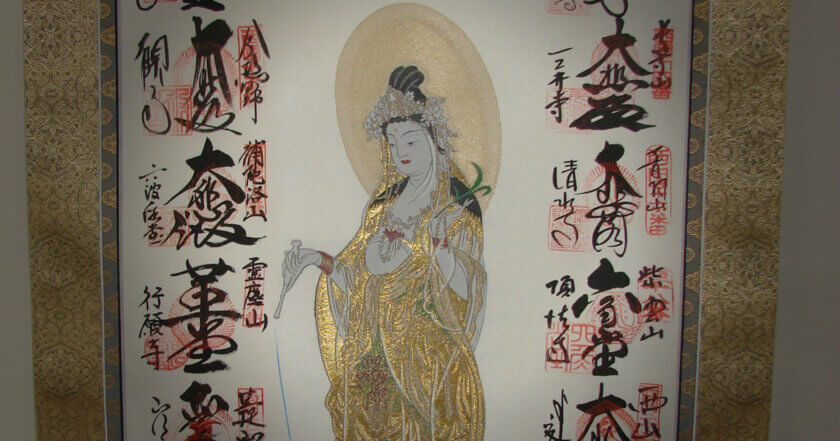
The Key Challenge in Nōkyōjiku Mounting Is Fabric Selection
A nōkyōjiku (a pilgrimage stamp scroll) completed for the Saigoku 33 Kannon pilgrimage is a precious record of the journey itself.
Many people feel, “I want to have my stamp-filled pilgrimage scroll properly mounted as a kakejiku (a mounted hanging scroll).”
However, when it comes time to proceed, the point that most often causes hesitation is fabric selection.
In this article, we introduce a real mounting project we handled for a customer living in France, along with the key points for choosing kinran brocade (gold brocade) that harmonizes with gold-thread embroidery.
A Calm, Gold-Centered Mounting That Blends Into Any Room
Our customer lives in Paris, France, and completed the Saigoku 33 Kannon pilgrimage last year.
He contacted us because he wanted to have his nōkyōjiku mounted as a kakejiku and displayed properly at home.
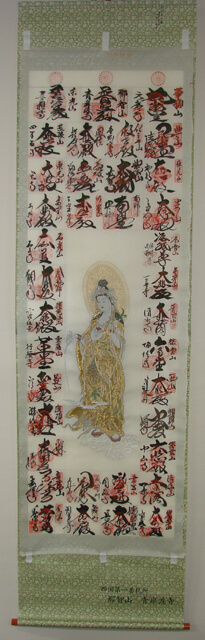
His preferences were very clear. The scroll itself is silk, featuring Kannon embroidery in gold thread, and it carries a solemn, gold-toned atmosphere throughout.
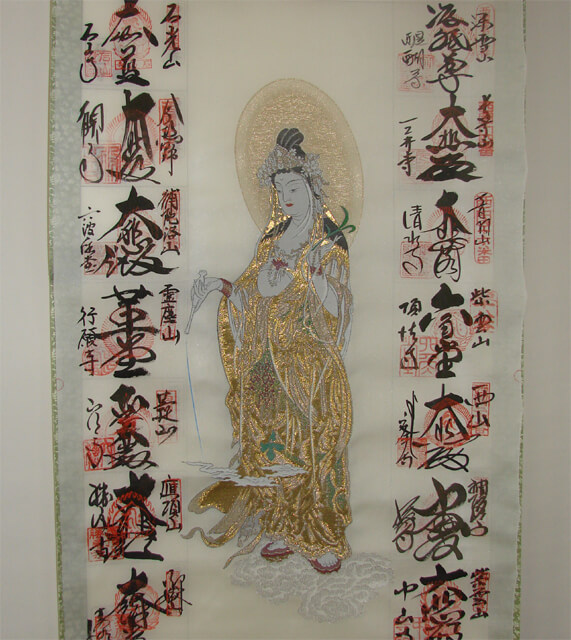
For that reason, he wished to keep that character intact and make gold the dominant color of the mounting.
At the same time, he did not want something overly flashy. His goal was to limit the number of colors so the finished scroll would blend naturally into any room in his home.
As an accent, he preferred a subdued green, closer to moss green than a bright green. Among the fabrics shown on our website, he felt that our Reiga course matched his image particularly well.
He had also looked at one of our previous overseas case studies (a nōkyōjiku mounting) and told us, “I would like something close to that atmosphere,” so he already had a clear image of the direction he wanted.
He also mentioned that, while gold and bronze would be the main tone, white might also be an option depending on the overall balance.
In addition, he told us he was not familiar with the meaning and use of colors in Buddhist contexts, and he wanted to hear our thoughts and recommendations for an appropriate selection for a Kannon-related scroll.
In response, we first explained our basic approach. Because the gold-thread embroidery is the focal point, we recommended setting the overall color scheme in gold tones so the mounting would harmonize with the artwork.
In Japan, Buddhist kakejiku are often mounted with kinran (gold brocade), and selecting a brocade that matches the dignity and atmosphere of the gold embroidery helps the entire design come together with a convincing sense of harmony.
Since he mentioned white as a possible option, we also explained that white-toned brocades are relatively more common in Shintō contexts in Japan, and they are less often chosen as the main fabric for Buddhist mountings. This does not mean white is impossible. However, for this particular scroll, we felt that centering the design on kinran would best preserve the solemn character of the piece.
We also explained that we would finalize the fabric selection only after the scroll arrived, once we could confirm the exact feel of the gold embroidery and the overall atmosphere in person, and compare the fabric directly against the scroll.
Arrival and Condition Check
After the scroll arrived at our workshop, we inspected it and found it to be in good condition. There were no major issues that would prevent us from proceeding with the mounting.
At this in-person inspection stage, the direction for the fabric selection also became much clearer.
Our Proposal: Selecting Kinran That “Resonates” With Gold-Thread Embroidery
The key to this project was fabric selection. Even within the category of kinran, there are many variations in weave, tone, and luster.
Because he wanted a restrained palette that would fit naturally into any room, while also incorporating a subtle accent color, we reviewed multiple fabric combinations.
In the end, we concluded that our Reiga course was the best match and proposed it.
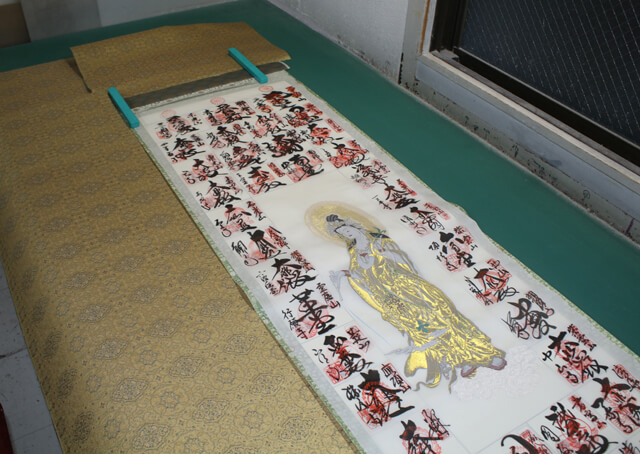
Reiga has the richness expected of kinran, yet the gold threads have a slightly muted, aged luster rather than a sharp shine. In addition, the moss-green inner section aligns beautifully with his preference.
When we placed the scroll next to the fabric and compared them side by side, the solemn presence of the kinran blended surprisingly naturally with Kannon’s gold-thread embroidery. The harmony of the overall design became even more apparent, and we felt confident that this was the right direction.
He was pleased with the proposal, and we began the mounting process.
Workflow Overview
Below is a simplified overview of the process.
1. Color-Fixing
Because mounting work involves significant use of water, we apply color-fixing to help prevent ink or red seals from bleeding.2. First Backing (Hada-Urauchi)
We apply backing paper to the reverse side.3. Fabric Preparation and Cutting
We cut the Reiga fabrics to the required dimensions for each part.4. Assembling the Fabric Sections (Tsukemawashi)
We join the prepared fabric pieces with paste in sequence, using an edge overlap of about 3 mm at each joint.5. Middle Backing (Naka-Urauchi)
Second backing.6. Edge Folding (Mimi-Ori)
We fold and adhere the left and right edges on the back to create appropriate thickness and stability.7. Final Backing (Sō-Urauchi)
Third backing.8. Final Finishing
We attach the roller rod and fittings, as well as the hanging cord and tying cord, and complete the final adjustments.
Completion: Solemn, Yet Not Overly Flashy—A Finish That Fits the Home
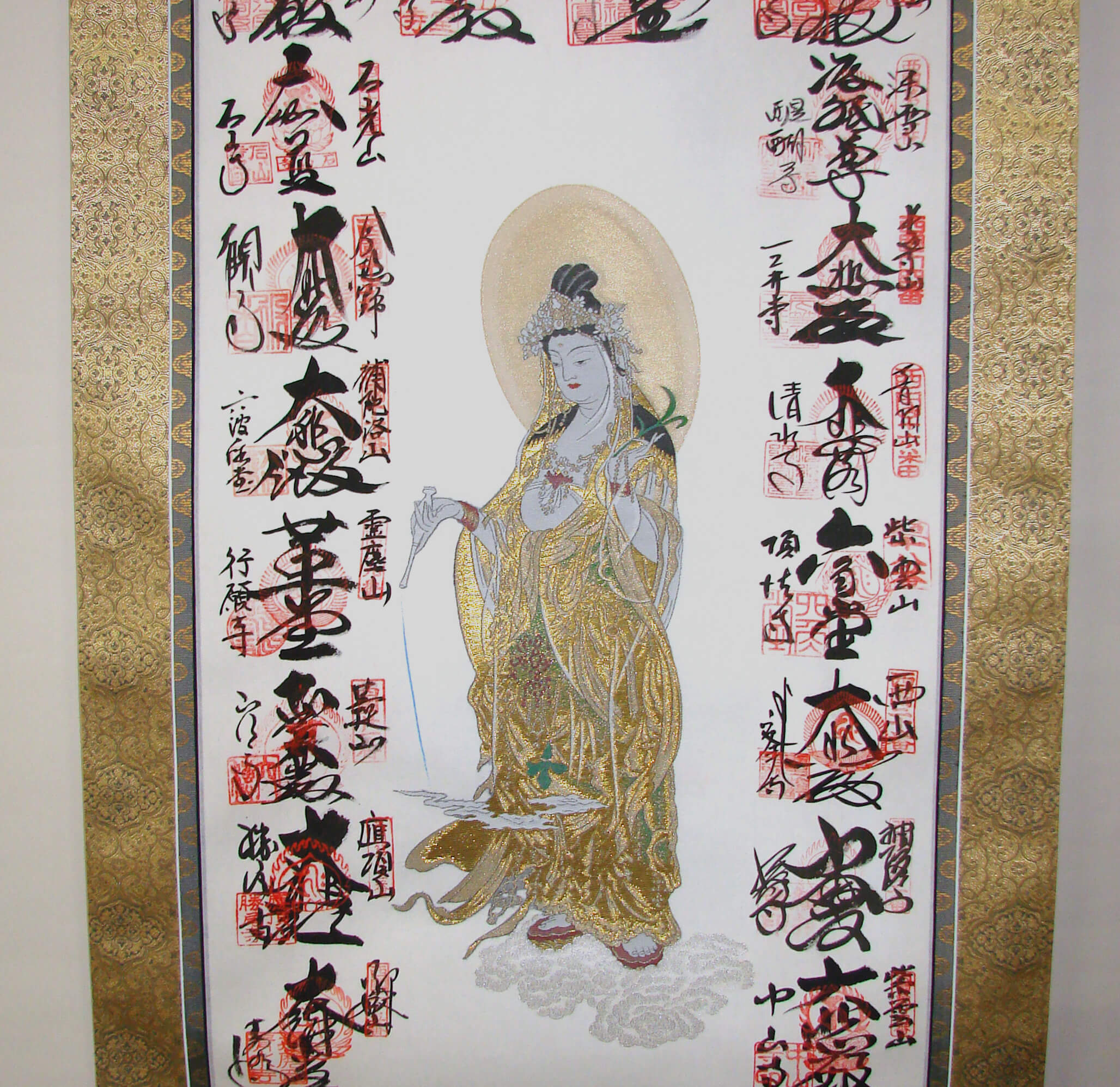
Once completed, Kannon’s gold-thread embroidery stands out as the main focus, while the kinran supports and enhances its dignity. The finished scroll carries the weight and memory of the pilgrimage in a calm, balanced way.
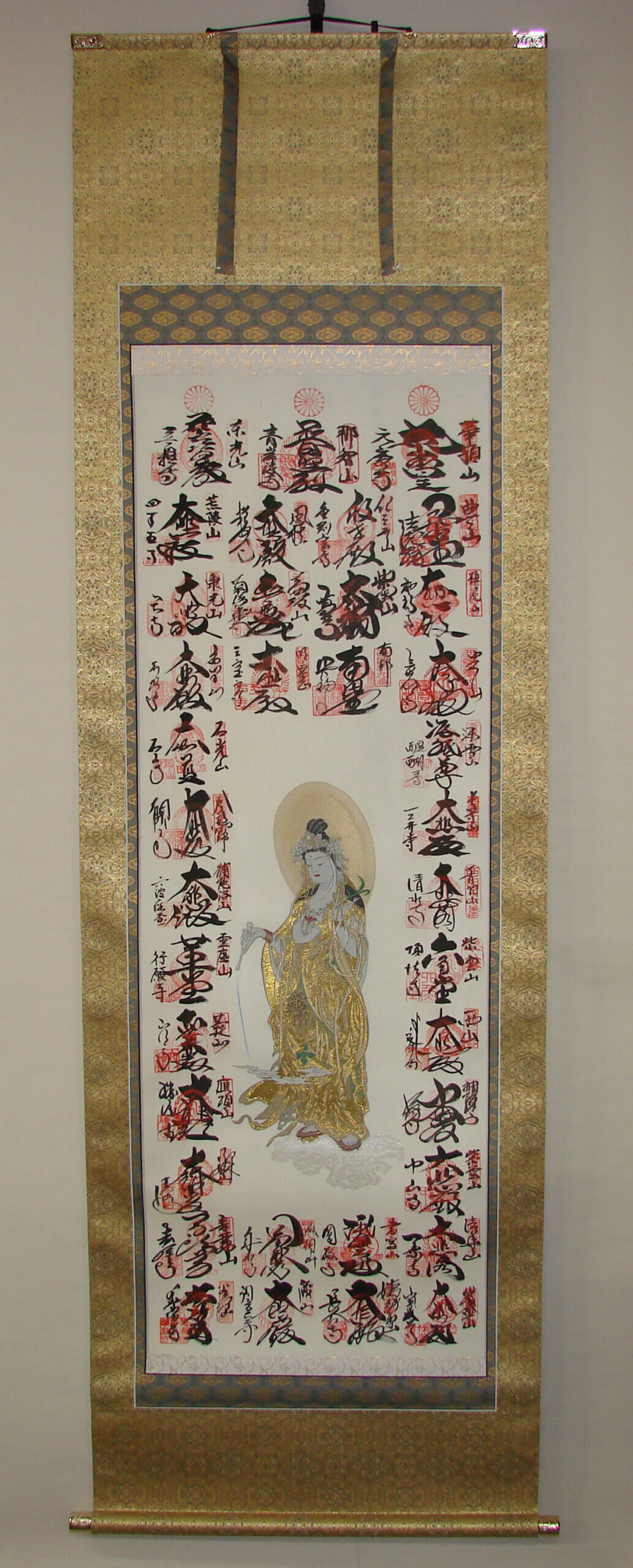
The result also aligns with his wish to keep gold as the base while limiting colors so the scroll would harmonize with any room. It is solemn, refined, and quietly present.
Customer Response
After we sent photos of the finished work, he immediately responded:
“This is great news, the final state looks already amazing.”
The scroll then arrived safely in France. If the mounting continues to quietly support his pilgrimage memories as a piece that can be enjoyed in everyday life, nothing would make us happier.
Summary: Key Checkpoints When Choosing Fabrics for Nōkyōjiku Mounting
Mounting a nōkyōjiku is not simply a matter of choosing a favorite color.
True harmony comes from considering the dignity and atmosphere of the scroll itself, the customer’s desired image, and whether the final piece will blend naturally into the home.
We inspect each scroll in person, then compare fabrics directly against the artwork while discussing preferences with the customer, to find the single best combination where the customer’s taste and the scroll’s character meet most beautifully.
If you are considering mounting a Saigoku 33 Kannon nōkyōjiku, please feel free to contact us.