
Shikoku Pilgrimage Temple: No. 22 Byōdō-ji
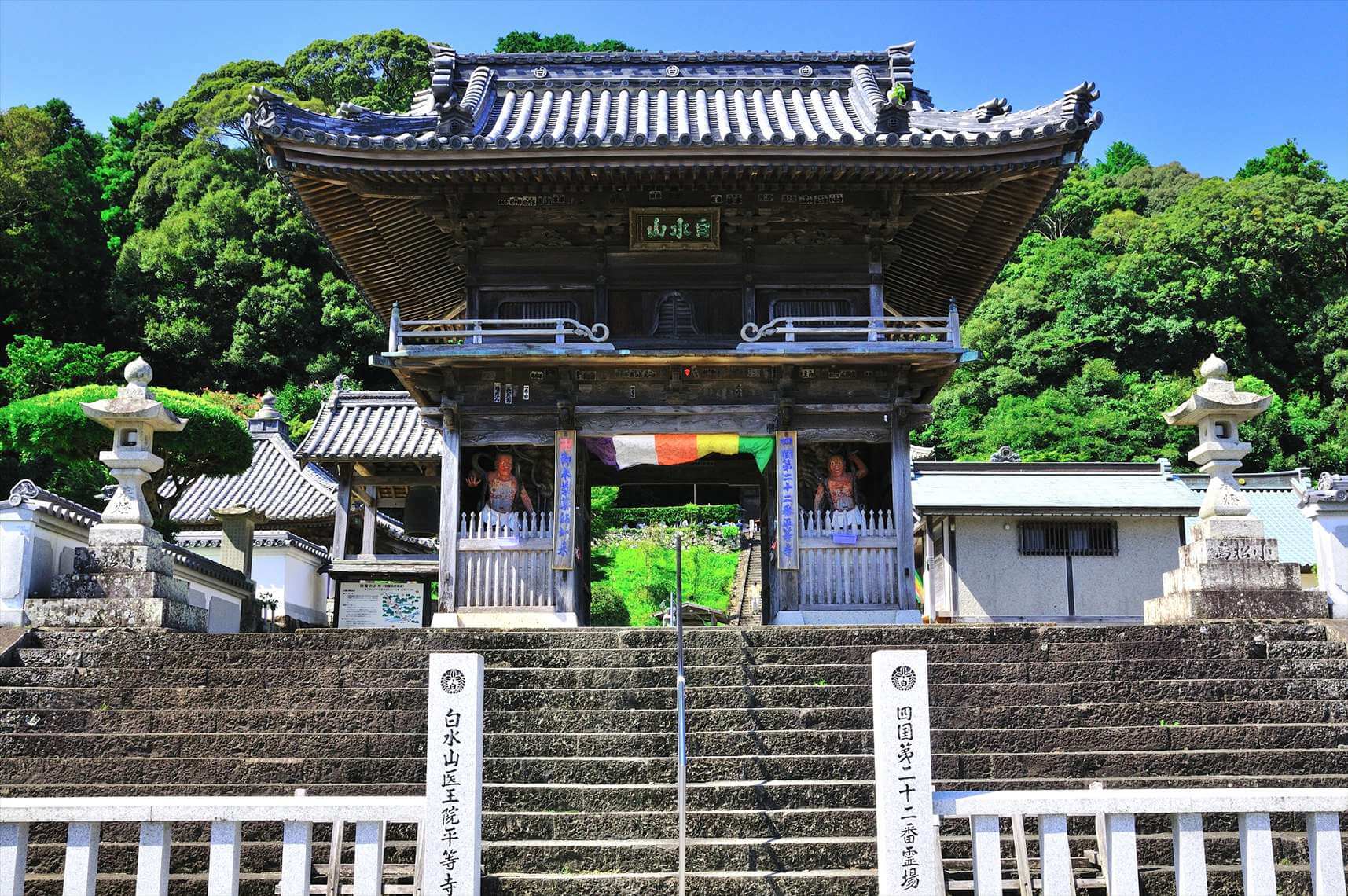
Byōdō-ji

Where Sacred Water Associated with Kōbō Daishi Springs Forth.

  • Name: Hakusui-zan Iō-in Byōdō-ji
  • Main Deity: Yakushi Nyorai (Bhaiṣajyaguru)
  • Goeika (Pilgrimage Song):
  • When I hear that the Buddha is impartial
  • how reassuring he is.

Access From Temple No. 21, Tairyū-ji:

  • On foot: Descend the steep slope from the Tairyū-ji parking lot. Reach National Route 195 from the village at the foot of the mountain, then return to the mountain path and cross a small pass. Approx. 11.5 km, 3 hours 30 minutes.
  •  
  • By Car: Via Prefectural Road 19 and National Route 195. Approx. 12 km, 40 minutes.
  •  
  • Public Transport: From the Ropeway Sanroku Station (base station), go to Wajiki-Higashi Bus Stop. Take the Tokushima Bus Nanbu bound for Tokushima Station (20 min) and get off at Kuwano-Kami. Walk 5 min to JR Kuwano Station. Then take the Mugi Line (6 min) to Aratano Station.

The Spring Dug by the Kōbō Daishi Is the Origin of the Mountain Name

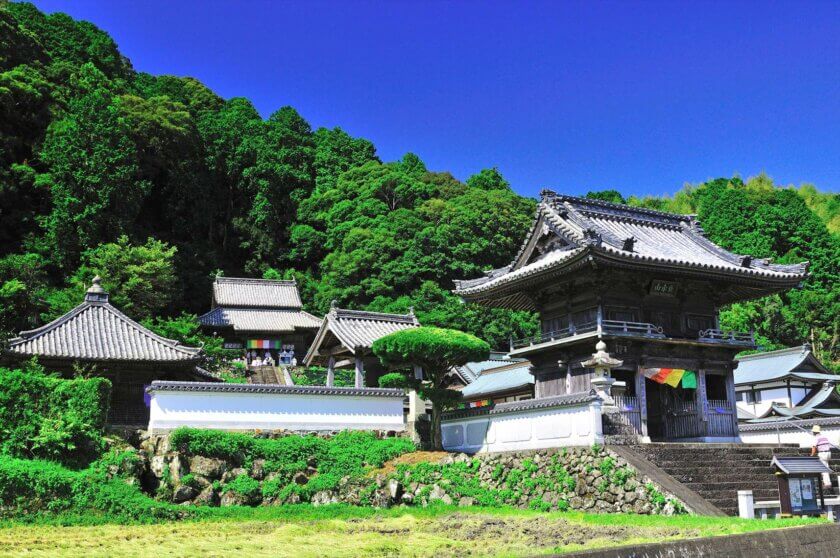
Leaving Aratano Station on the Mugi Line, passing through the town of Aratano, and crossing the Kuwano River, a magnificent rōmon (tower gate) comes into view on a small hill. This is the sanmon (temple gate) of Byōdō-ji, where vermilion-lacquered Kongō Rikishi (Niō) statues welcome pilgrims.

Passing through the sanmon, the shōrō (bell tower) is on the left, followed by the Daishi-dō (Daishi Hall) and a small Kannon-dō (Kannon Hall). A little distance from the Kannon-dō, sacred water associated with Kōbō Daishi wells up. It is said that when the Daishi performed a prayer to ward off evil here, he felt the spiritual efficacy of Yakushi Nyorai, and when he dug the ground with his shakujō (staff), this sacred water sprang forth. The Daishi bathed in this water and then used it for prayers. This sacred water became the origin of the temple’s sangō, “Hakusui-zan” (White Water Mountain). If you peek through the katōmado (cusped window) at the base of the small hall, you can see that the sacred water is still welling up today. It is said to be effective for all illnesses, and many pilgrims receive the water to share in its blessings.
Miraculous Efficacy for Strong Legs (Kenkyaku)

Ascending the stone steps in front of the sacred water leads to the hondō (main hall). There are two routes: the “Men’s Evil-Warding Slope,” which goes straight up to the hondō, and the “Women’s Evil-Warding Slope,” which winds upward.

Ascending the stone steps leads to the hondō. The principal image is Yakushi Nyorai (a hidden Buddha). It is said that Kōbō Daishi appeared here while praying for his mother, Tamayori-gozen.

Yakushi Nyorai is the Buddha who saves people from the suffering of illness and grants the joy of health. In particular, the Yakushi here is said to be especially efficacious for strong legs, and inside the hondō, crutches offered by people with impaired legs are enshrined.

A box cart (hakoguruma) is kept in the hondō. It is said that long ago, a person with a leg disability made the Shikoku Pilgrimage on this cart, was able to stand and walk after coming here, and then dedicated it to the temple. Here one can feel the wish of those who longed to complete the pilgrimage even without being able to stand, and the joy of becoming able to walk on one’s own feet.

DATA

Address: 177 Akiyama, Aratano-chō, Anan City, Tokushima Prefecture, Japan
Phone: 0884-36-3522
Access: 25 min walk from JR Aratano Station (Mugi Line)
Parking: Available (Free)
Lodging: Currently closed

Your Pilgrimage, Your Art

Completing the Shikoku Pilgrimage is a once-in-a-lifetime journey—but what if you could preserve it in a form that lasts forever?

Many pilgrims collect red stamps and calligraphy from each temple on a special silk scroll called a nōkyōjiku.

This sacred record of your path can be transformed into a kakejiku—a traditional Japanese hanging scroll—not only preserving the memories, but turning them into a work of cultural and spiritual art.

It’s more than a souvenir—it’s a way to honor your journey, your prayers, and your growth.

To learn more about how a nōkyōjiku becomes a kakejiku, and what makes this transformation so meaningful, please refer the below link.


Contact Us

Please fill out the form below and submit for your inquiry.

❈FirstName
❈LastName
Country
❈E-mail
(❈Confirm E-mail)
❈Inquiry category Question
Consultation
Impression
Request
Others
❈Comment

is the mark for required item.


Your privacy is important to us. We are committed to protecting your privacy.

(or press ESC or click the overlay)

CEO Message

Our Feelings For Kakejiku


 The Japanese people have long set a high value on aesthetic senses since ancient times. As a result, the
peculiar culture which is not seen in other countries blossomed and many aspects of the modern Japanese
culture come from it. Parts of Japanese culture has been introduced to people in other countries recently,
so the number of people from other countries who are interested in Japanese culture has been increasing.
However, the Japanese aesthetic senses, which are the bases of Japanese culture, have been nurtured
through a long history, intertwining various elements intricately, such as climate, geographical features,
religion, customs and so on. Therefore, they are very difficult to understand not only for people from other
countries, but even for the Japanese people. I think the best tool which conveys these difficult senses
understandably is a “kakejiku.”
 The kakejiku (a hanging scroll; a work of calligraphy or a painting which is mounted and hung in an
alcove or on a wall) is a traditional Japanese art. It's no exaggeration to say that paintings are what
express aesthetic senses at all times and places. The kakejiku is an art which expresses the Japanese
aesthetic senses. The kakejiku has long been used in traditional Japanese events, daily life and so on since
ancient times. As a result, there are various customs of kakejiku in Japan; kakejiku and the life of the
Japanese are closely related. We can see Japanese values through kakejiku.
 The kakejiku is a cultural tradition which the Japanese people should be proud of. However, many people
in other countries don't know much about it because it hasn't been showcased as much. This is why I
decided to try to introduce it. The kakejiku world is very interesting and beautiful. We want not only the
Japanese, but also many people from other countries to know and enjoy it. I hope that many people will
love kakejiku someday.

(or press ESC or click the overlay)
Company Profile
syaoku.jpg(120220 byte)

Name Art Nomura


President Tatsuji Nomura


Founded1973


Established1992


Address7-23 Babadori, Tarumi-ku, Kobe city,
Hyougo Prefecture, 655-0021, Japan


Capital10 million yen


URLhttp://nomurakakejiku.com


Our Business

 Art Nomura is an art dealer which produces kakejiku (hanging scrolls). We mount many paintings and calligraphic works in kakejiku in my factory. Kakejiku are our main product. We also remount and repair old or damaged kakejiku. We share the traditional Japanese art of kakejiku with people all over the world.


(or press ESC or click the overlay)
Access Map

Access Map


 The Japanese people have long set a high value on aesthetic senses since ancient times. As a result, the
peculiar culture which is not seen in other countries blossomed and many aspects of the modern Japanese
culture come from it. Parts of Japanese culture has been introduced to people in other countries recently,
so the number of people from other countries who are interested in Japanese culture has been increasing.
However, the Japanese aesthetic senses, which are the bases of Japanese culture, have been nurtured
through a long history, intertwining various elements intricately, such as climate, geographical features,
religion, customs and so on. Therefore, they are very difficult to understand not only for people from other
countries, but even for the Japanese people. I think the best tool which conveys these difficult senses
understandably is a “kakejiku.”
 The kakejiku (a hanging scroll; a work of calligraphy or a painting which is mounted and hung in an
alcove or on a wall) is a traditional Japanese art. It's no exaggeration to say that paintings are what
express aesthetic senses at all times and places. The kakejiku is an art which expresses the Japanese
aesthetic senses. The kakejiku has long been used in traditional Japanese events, daily life and so on since
ancient times. As a result, there are various customs of kakejiku in Japan; kakejiku and the life of the
Japanese are closely related. We can see Japanese values through kakejiku.
 The kakejiku is a cultural tradition which the Japanese people should be proud of. However, many people
in other countries don't know much about it because it hasn't been showcased as much. This is why I
decided to try to introduce it. The kakejiku world is very interesting and beautiful. We want not only the
Japanese, but also many people from other countries to know and enjoy it. I hope that many people will
love kakejiku someday.

(or press ESC or click the overlay)