Shikoku Pilgrimage Temple: No. 21 Tairyū-ji
An Ancient Mountain Temple Known as the “Kōyasan of the West.”
- Name: Shashinzan Jōjū-in Tairyū-ji
- Main Deity: Kokūzō Bosatsu (Akasagarbha Bodhisattva)
- Goeika (Pilgrimage Song):
- In the cavern where the Great Dragon forever dwells
- the practice of Gumonji memory retention is for the sake of protection.
Access From Temple No. 20, Kakurin-ji:
- On foot: The descent from Kakurin-ji is a slope so steep that if you lose focus, you might tumble down. You cross a paved road once along the way, and after about 30 minutes, you emerge onto a paved road again. Crossing the Naka River past Shinkō Hongū leads to the ascent to Tairyū-ji. It is a gentle forest road for a while, but eventually becomes a steep slope and merges with the path from the Tairyū-ji parking lot. Approx. 6.5 km, 3 hours.
- By Car: Use the prefectural road from the Kakurin-ji parking lot. To drive up to the halfway point, take Prefectural Road 28 on the east side. Approx. 15 km, 30 minutes. From the halfway parking lot to the Niō-mon Gate is a 30-minute walk. If using the ropeway, go via Prefectural Road 19. Approx. 11.5 km, 30 minutes.
- Public Transport: Walk down the trail to Shinkō Hongū, then walk along Prefectural Road 19 to the Tairyū-ji Ropeway boarding area. Approx. 8.7 km, 2 hours 30 minutes.
A Pilgrimage Route that Makes Pilgrims Cry: Difficult Spots Continue from the Previous Temple
Tairyū-ji is located deep in the mountains at an elevation of 600 meters. Since the previous temple, Kakurin-ji, is also known as a “Henro-korogashi” (a place where pilgrims tumble/fall due to steepness), this section involves two consecutive difficult spots. For this reason, Tairyū-ji has long been considered one of the toughest locations in Awa (Tokushima). Even by car, one must walk over 1 km up a steep mountain path from the upper parking lot to the Niō-mon Gate.
However, Tairyū-ga-take (Mt. Tairyū), where Tairyū-ji is situated, is the place where the young Kōbō Daishi underwent 100 days of severe training. This training, called “Kokūzō Gumonji-hō,” is a secret ritual of Shingon Esoteric Buddhism said to heighten memory to its peak—enabling one to remember everything seen or heard once. Perhaps a rugged approach is fitting for such a rugged place.
Tairyū-ji Ropeway
Because there is a significant distance from the halfway parking lot to the temple grounds, many pilgrims visiting by car use the Tairyū-ji Ropeway. If you take the ropeway, the temple grounds are right there when you get off at the Sanchō (Summit) Station. This ropeway is also a grateful existence for walking pilgrims.
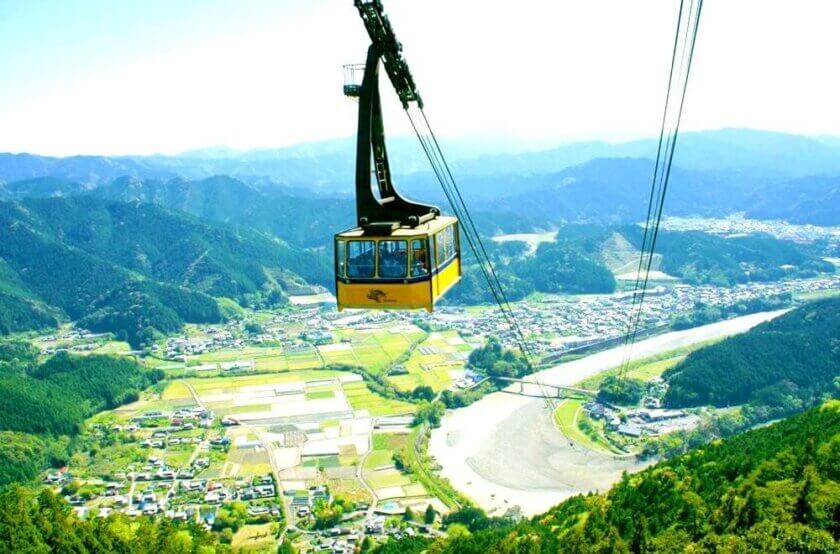
The ropeway is 2,775 meters long, the longest in western Japan, crossing one river and two mountains. You can enjoy an aerial walk for over 10 minutes while gazing at a large-scale panoramic view.
The “Kōyasan of the West”
When you get off at the Ropeway Sanchō Station, 117 stone steps stretch out right in front of you. Climbing these leads to the Main Hall, which is surrounded by cedar trees. The Main Hall was rebuilt in the 5th year of Kaei (1852) by Hachisuka Narihiro, the Lord of the Tokushima Domain. The hall enshrines the main deity, Kokūzō Bosatsu, said to have been carved by Kōbō Daishi. It is a “Hibutsu” (hidden Buddha), but the doors are opened only on January 12th each year. Next to the Main Hall is the Gumonji-dō Hall.
A pilgrim path continues to the right from the Main Hall. Going a little further, there are stone steps leading up to the left, and atop these steps stands the Tahōtō (Pagoda). This was built in the 1st year of Bunkyū (1861), and its sculptures are truly magnificent.
Proceeding further from the Tahōtō and turning left leads to the Daishi-dō Hall. It stands surrounded by cedar trees, and the sculptures on the building, depicting Chinese myths, folklore, and historical events, are impressive. The Daishi-dō has a Kōbō Daishi Mausoleum at the rear and consists of two halls: the Haiden (Worship Hall) and the Okuden (Inner Hall), which is rare for Shikoku pilgrimage temples. This is the same layout as the Okunoin at Kōyasan. Come to think of it, the arrangement of Tairyū-ji’s Main Hall, Tahōtō, and Daishi-dō is reminiscent of the arrangement of the Kondō, Daitō, and Miedō at Kōyasan’s Danjō Garan. Because of these similarities, this temple is also called the “Kōyasan of the West.”
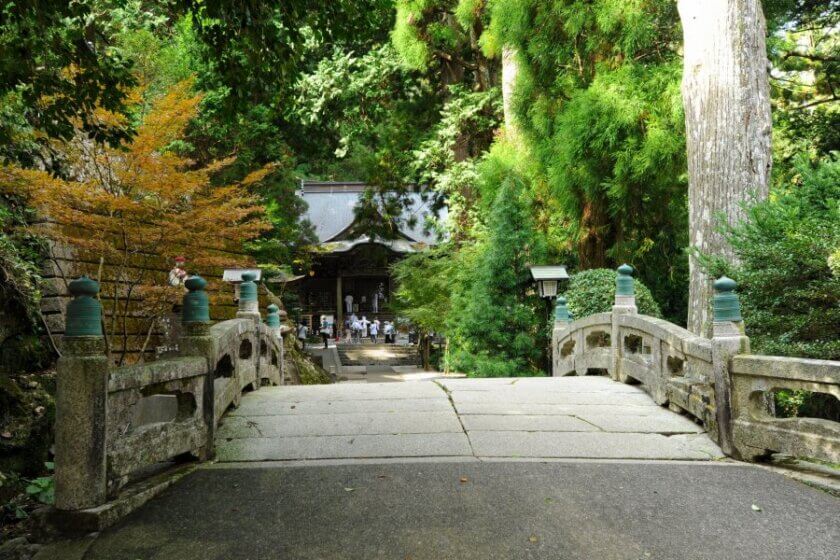
Halls Scattered on the Mountaintop
Proceeding on the path in front of the Daishi-dō, there is a statue of the Ascetic Daishi. Descending 73 stone steps from there leads to the dignified Shōrō-mon (Bell Tower Gate). Descending further stone steps towards the Honbō (Head Priest’s Quarters), where the stamp office is located, you will find the Jibutsu-dō, Goma-dō, and Hexagonal Sutra Depository standing alongside the Honbō.
In the grand corridor of the Jibutsu-dō, there is a ceiling painting of a dragon. This ceiling painting was drawn in the 34th year of Meiji (1901) by Takemura Shōrei, a painter from Aki City, Kōchi Prefecture. It depicts the Great Dragon (Tairyū) said to have protected the Daishi during his training.
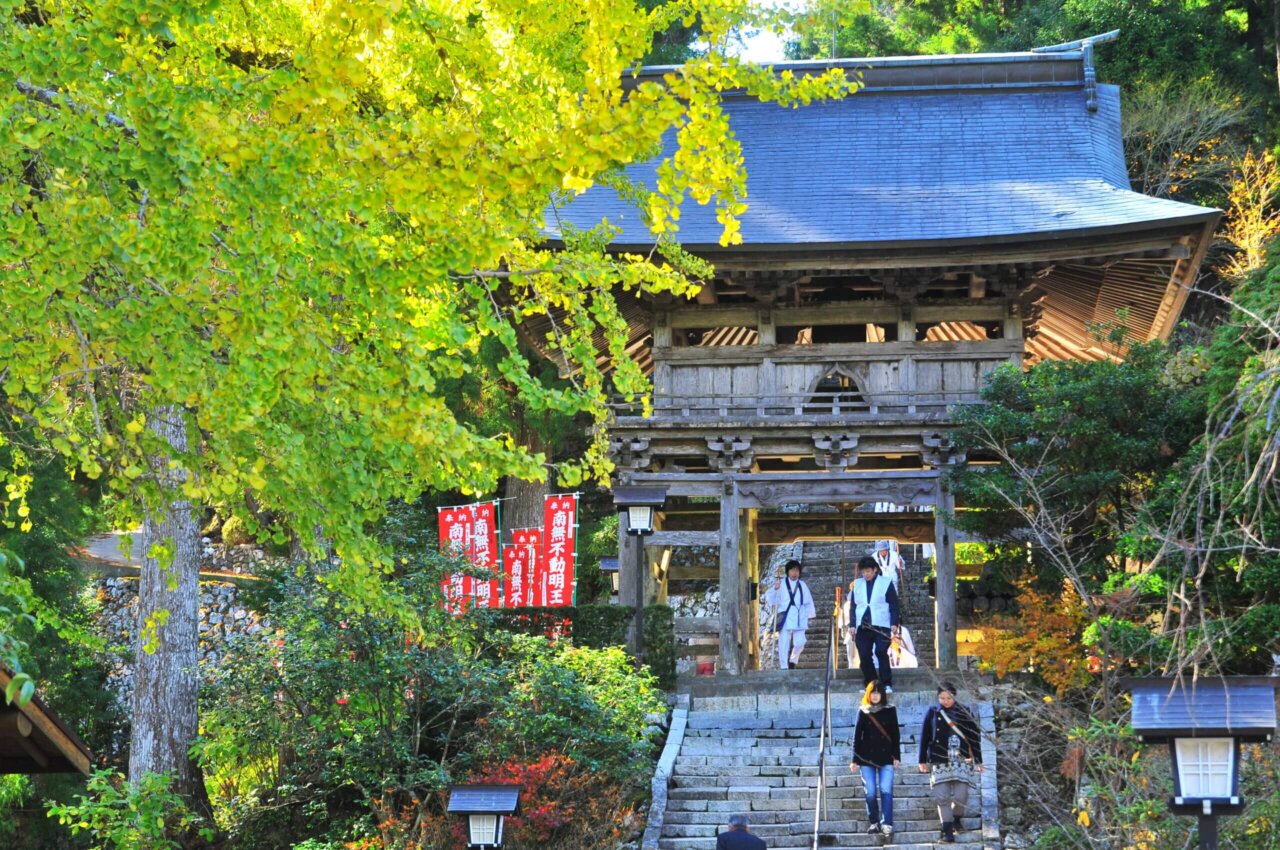
From here, you would typically return to the front of the Honbō and head back to the ropeway station, but if you proceed further, you will come to the Niō-mon Gate, which is the original entrance to this temple. Walking pilgrims who have gasped their way up the steep slopes are welcomed by huge Kongōrikishi statues at this Niō-mon before entering the grounds. This gate is said to have been built in the Kamakura period, and it houses Niō statues that are among the largest and oldest in Shikoku.
History of Ruin and Revival
Tairyū-ji was founded in the Enryaku era (782–806) by the imperial order of Emperor Kanmu. Since then, it has gone through repeated cycles of ruin and reconstruction. In the Edo period, it flourished under the protection of the Hachisuka family, lords of the Tokushima Domain.
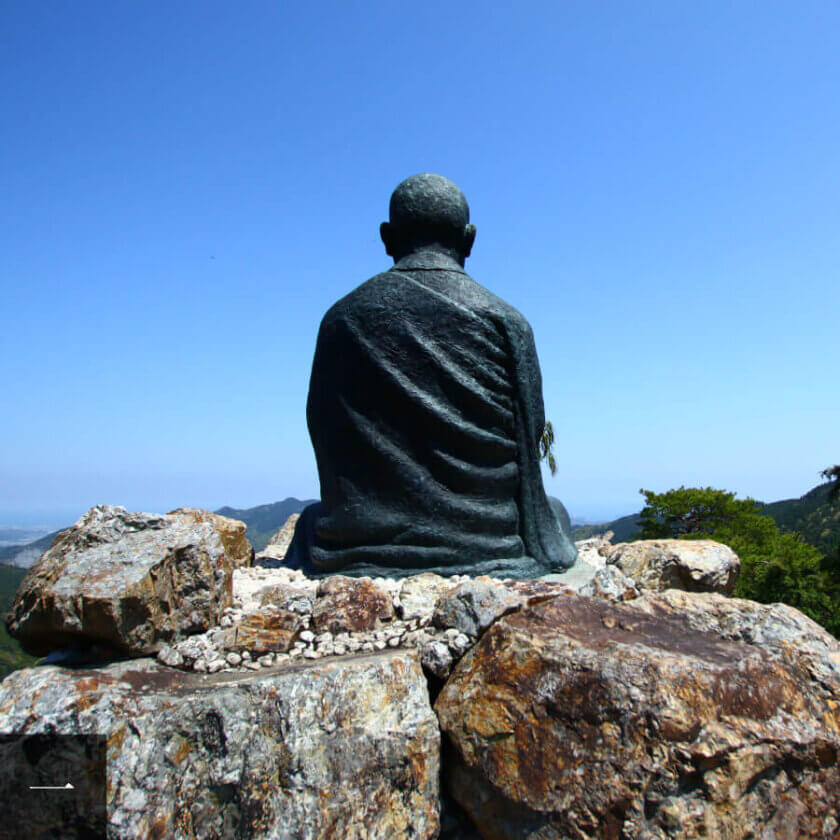
The place where the young Kōbō Daishi is said to have trained is a rocky mountain called Shashin-ga-take (Mt. Tairyū), located about 700 meters south of the temple grounds. On the way from the foot of the mountain to the summit by ropeway, you can see this Shashin-ga-take in the mountains below to the right. Although viewed from a distance, you can see a seated statue of Kōbō Daishi atop a sheer cliff. “Shashin” (holding the mind/dwelling of the mind) connects to “Shashin” (abandoning the body/self-sacrifice). The thoughts of the Daishi who trained in this harsh land are conveyed to the viewer.
To get to Shashingatake, you walk for about 20 minutes on a steep mountain path from the Ropeway Sanchō Station. Eventually, the figure of Kōbō Daishi sitting in meditation on a cliff overlooking a deep valley comes into view. You climb up to the vicinity of the Daishi statue using chains (kusari-ba), but there is also a walking route that bypasses the chains. Although it is a short distance, it is a quite dangerous path, so please proceed with extreme caution.
Depending on the weather, the area around the Daishi statue may be enveloped in fog. The scene is mysterious, as if inviting you into a world of subtle profundity.
DATA
Address: 2 Ryūzan, Kamo-chō, Anan City, Tokushima Prefecture
Phone: 0884-62-2021
Access: From JR Mugi Line Kuwano Station, take the Tokushima Bus bound for Kawaguchi for 1 hour 34 minutes, get off at Wajiki-Higashi, and walk 10 minutes to the Tairyū-ji Ropeway Sanroku (Base) Station. Take the ropeway for 10 minutes and get off at the Sanchō (Summit) Station immediately.
Parking: Available (paid)
Lodging: None
Your Pilgrimage, Your Art
Completing the Shikoku Pilgrimage is a once-in-a-lifetime journey—but what if you could preserve it in a form that lasts forever?
Many pilgrims collect red stamps and calligraphy from each temple on a special silk scroll called a nōkyōjiku.
This sacred record of your path can be transformed into a kakejiku—a traditional Japanese hanging scroll—not only preserving the memories, but turning them into a work of cultural and spiritual art.
It’s more than a souvenir—it’s a way to honor your journey, your prayers, and your growth.
To learn more about how a nōkyōjiku becomes a kakejiku, and what makes this transformation so meaningful, please refer the below link.