A Gift of Two Kakejiku for Middle Eastern Royalty
Kakejiku (Japanese hanging scrolls) have become increasingly popular as gifts and souvenirs for people overseas.
In this article, we share an urgent request—one truly “against the clock”—and how we were able to deliver two kakejiku intended as a gift for a young lady from Middle Eastern royalty.
An Urgent Inquiry
This inquiry came from someone working at a company in Japan, and the message was as follows:
A young lady from Middle Eastern royalty is seriously practicing jujutsu, and we are looking for a kakejiku with words that could inspire and uplift her spirit.
As long as it is calligraphy, we are open to any suggestions—would it be possible for you to help us find something suitable?
However, we have very limited time. We have exactly one week, as we must present it to her by next Monday.
We would like to purchase it today or tomorrow, have it shipped the same day, receive it in Tokyo tomorrow or the day after, and then send it to the Middle East by DHL.
Would it be possible to consult with you about this?
Thank you very much in advance.
It was an extremely urgent request, and we could clearly feel how much they needed help. We decided to do everything we could and immediately began selecting suitable scrolls.
Our Three Recommendations
Within the limited time available, we considered what kind of calligraphy would best match the request and selected the following three scrolls.
All three are calligraphy works by Zen monk Kobayashi Taigen, the head priest of Ōbai-in (a sub-temple of Daitoku-ji, Rinzai Zen Buddhism), highly regarded both in Japan and internationally.
His calligraphy is known for being powerful while deeply spiritual, and is especially popular among those who pursue martial arts and those who value spiritual discipline.
We believed these pieces would be appropriate for a young lady devoted to jujutsu, as a gift that supports both her growth and her future path.
Dream
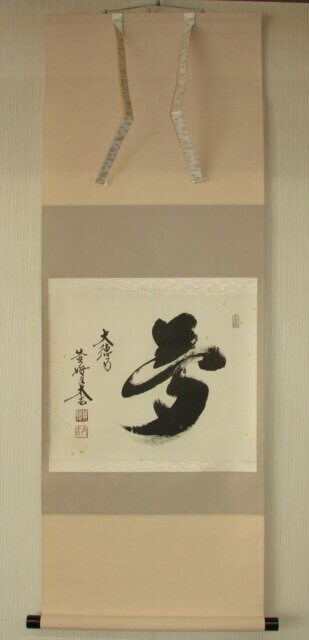
“Dream” is a single character, yet it carries great strength. For someone walking the path of jujutsu—believing in her goals and training day after day—this word can become a symbol of hope and determination. It is a scroll that encourages one not to lose sight of the ideal held in the heart, and to continue forward with courage.
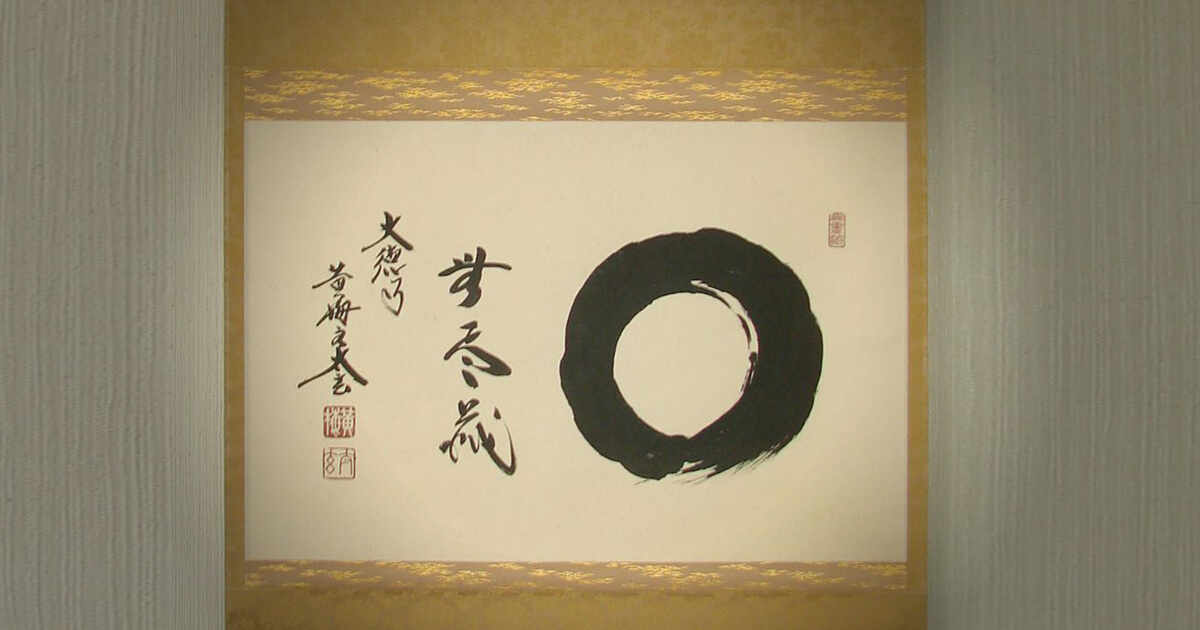
Ensō: Mujinzō (Circle – Boundless)
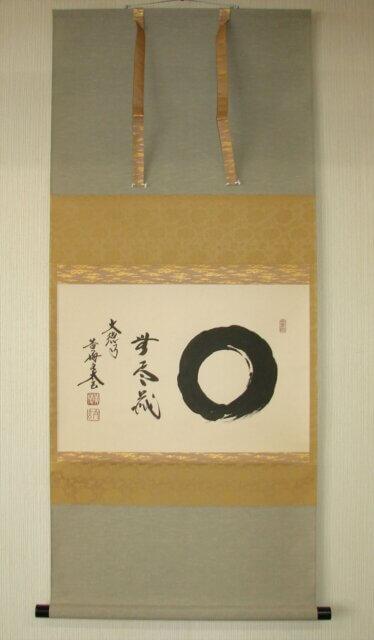
An ensō is a Zen circle drawn in one brushstroke, symbolizing emptiness, no-mind, and enlightenment.
“Ensō” is a symbol with special meaning in Zen, representing a state of enlightenment. This “enlightenment” is a tranquil world of “nothingness,” where one casts off all attachments and delusions. It is said that upon reaching such a state, a person gains limitless energy and potential.
With the words “Mujinzō” (Boundless) added, this work symbolizes precisely that infinite power.
We felt it would be especially suitable for jujutsu—supporting mental focus, inner growth, and calmness of mind.
By viewing this scroll before practice, one may be able to center the mind and face training with a clear, undistracted spirit.
“Every Day Is a Good Day” (Nichinichi Kore Kōjitsu)
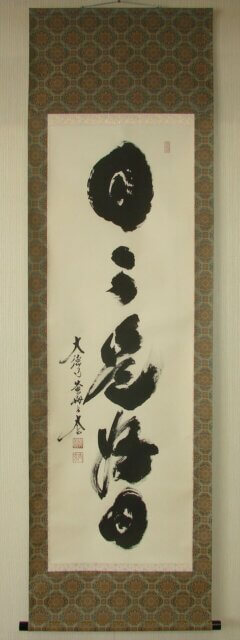
“Every Day Is a Good Day” is a well-loved phrase in Zen.
Even on days when things do not go as planned, the teaching reminds us that—depending on one’s state of mind—any day can be received as a good day. This is also an important attitude in learning martial arts.
Jujutsu training includes not only the joy of improvement, but also times of struggle and obstacles.
This scroll supports a calm yet strong heart—one that can accept such days positively and continue forward with gratitude.
Summary of Our Proposal
All three recommendations resonate with the path of jujutsu, each with a distinct theme:
- Dream: Encourages forward progress with clear goals.
- Ensō: Mujinzō: Promotes mental focus and awareness of limitless potential.
- Every Day Is a Good Day: Cultivates the ability to face each day positively.
We made these recommendations in the hope that they would support the young lady’s passion for jujutsu and her journey ahead.
In addition, since the gift was for Middle Eastern royalty, there was a strong possibility the recipient might be a Muslima (a Muslim woman). With that in mind, and as a precaution for cultural and religious sensitivities—such as avoiding figurative or idol-like motifs—we also confirmed that the mounting fabric patterns would not conflict with such considerations before making our recommendations.
The Two Selected Scrolls
After consulting with their head office within the limited time, the client decided to purchase the following two scrolls:
- Ensō: Mujinzō
- Every Day Is a Good Day
A Race Against Time: Shipment
Once the items were decided and payment was completed, we proceeded with urgent shipment under the client’s instructions. There were some unexpected adjustments along the way, but we were ultimately able to complete the shipment successfully.
Later, we received the following feedback:
Yesterday, we safely received the two kakejiku on the Dubai side.
Thank you very much for everything.
Because it was such a sudden request, we searched with doubts and found ART NOMURA, and thanks to your help, we were able to meet the request.
If we have another opportunity, we would be grateful for your continued support.
Hearing this, our entire team felt a great sense of relief.
Conclusion
This was a very urgent request, and we are truly glad we were able to help. We hope the recipient also enjoys the scrolls.
At ART NOMURA, we will do our best to support urgent requests whenever possible. If you are considering a kakejiku as a gift—and if cultural or religious sensitivities may be a concern—we can also take such factors into account when recommending suitable pieces.
If you are considering a kakejiku as a gift, please feel free to contact us. Even under time constraints, we will continue to support each request carefully so that your sentiment is conveyed properly.