
Shikoku Pilgrimage Temple: No. 19 Tatsue-ji

Tatsue-ji

Tatsue-ji: A Glimpse of the Temple Precincts Appears Beyond the Houses of the Temple Town.

  • Name: Kyōchi-zan Mani-in, Tatsue-ji
  • Main Deity: Enmei Jizō Bosatsu (Life-Prolonging Jizō Bodhisattva)
  • Goeika (Pilgrimage Song):
  • One day, surely, to my Tatsue—my dwelling in the Western Land
  • —may we board the boat of the great vow (guzēi) and arrive there.

Access From Temple No. 18, Onzan-ji:

  • On foot: Before the temple-front inn Minshuku Chiba, turn onto an unpaved path through a bamboo grove. This route is said to be the road along which Minamoto no Yoshitsune advanced his troops on the way to the Battle of Yashima. After joining a paved road, continue straight along the gentle, rolling hillside. Passing Okyō-zuka, an extra temple site (bangai fudasho), you will reach the settlement near Tatsue-ji. 4.1 km / about 1 hour
  •  
  • By Car: Return to Onzan-ji-mae bus stop, then follow the bus road. About 4.2 km / about 10 minutes.
  •  
  • Public Transport: From Onzan-ji-mae bus stop, take a Tokushima Bus for 7 minutes and get off at Tatsue Elementary School-mae. Then walk 3 minutes.

“Sekisho-dera” — The Checkpoint Temple of Awa

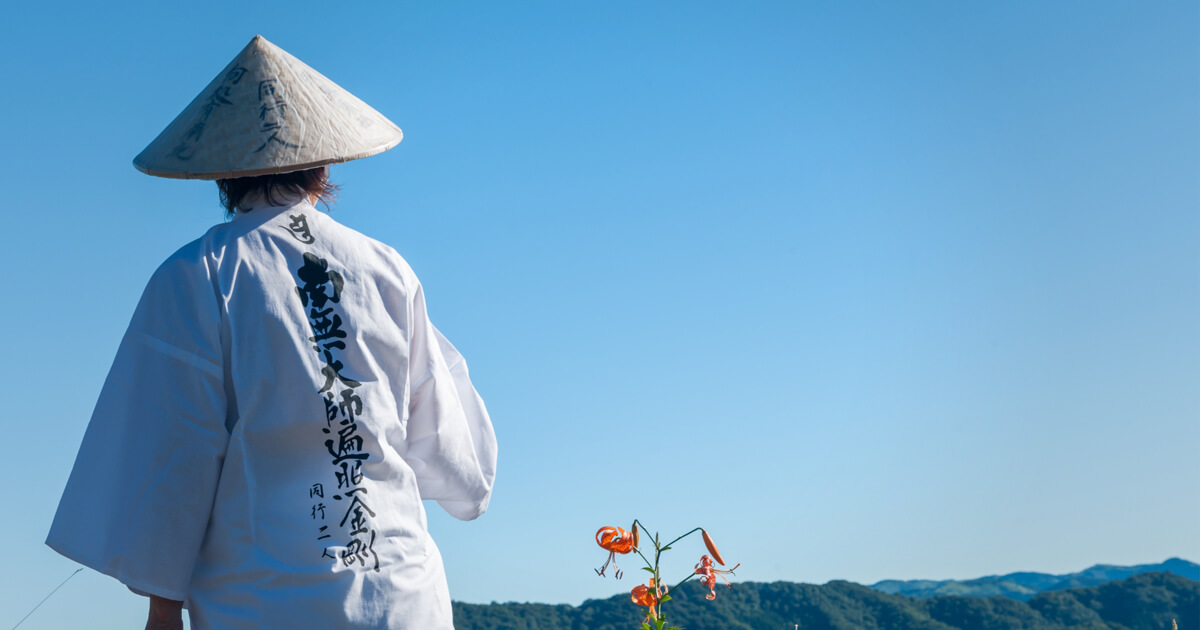
Tatsue-ji is known as Awa no Sekisho-dera (“Awa’s checkpoint temple”). There are four such “checkpoint temples” among the Shikoku 88-temple pilgrimage. Tradition says that those who carry deceitful intentions or behave improperly will be admonished by Kōbō Daishi, and will be unable to proceed beyond that temple. In other words, it is a place where pilgrims pause to reflect on their own conduct and repent.

As a checkpoint-temple legend, Tatsue-ji preserves the story of Okyō, “the wife-killer.” Okyō conspired with her illicit lover to murder her husband, then set out on the Shikoku pilgrimage believing that, as a pilgrim, she would face only mild questioning. However, when she reached Tatsue-ji, her hair became entangled around the cord of the waniguchi (a large bronze gong hung at the front of the hall). It would not come free, and in the end her hair—and even her scalp—were torn away. After losing her hair, Okyō built a small hut near the temple, devoted herself to Buddhist practice, and lived out her life there. The Okyō-zuka encountered on the way from Onzan-ji is associated with this tradition.

Within the grounds stands the Kurokami-dō (Black Hair Hall), where black hair said to be Okyō’s is enshrined.

A Grand Temple Atmosphere with Many Halls

For a temple located in an urban area, Tatsue-ji is notably spacious. Passing through its large main gate, you will find the Main Hall on the left, connected to the Kannon Hall. Further back stands the Goma Hall. On the right are buildings such as the Bishamon Hall, a Tahōtō Pagoda, and the Daishi Hall, creating an impressive, large-temple atmosphere. The temple was originally founded west of its current location as an imperial prayer temple commissioned by Emperor Shōmu. During the Sengoku period it was destroyed by fire in warfare involving the Chōsokabe forces. In the Edo period, it was rebuilt on its present site by the Tokushima domain’s Hachisuka clan. The current Main Hall was rebuilt after a fire in Shōwa 49 (1974). The principal image is a Jizō Bodhisattva said to have been carved by Emperor Shōmu to pray for the safe childbirth of his consort, Empress Kōmyō. Having survived multiple fires, it is revered as Enmei Koyasu Jizō (Life-Prolonging, Safe-Childbirth Jizō) and has long attracted deep devotion.

DATA

Address: 13 Wakamatsu, Tatsue-chō, Komatsushima City, Tokushima Prefecture, Japan
Phone: 0885-37-1019
Access: About 5 minutes on foot from Tatsue Station (JR Mugi Line)
Parking: Available (paid)
Lodging: 15 guest rooms; accommodates up to 200 people. As the pilgrimage continues to Temple 20 Kakurin-ji and Temple 21 Tairyū-ji—a mountainous stretch known as the “henro korogashi” (a notoriously difficult section)—this lodging has long been valued as a place to rest and recover. Meals are handmade shōjin ryōri (Buddhist vegetarian cuisine).
From JPY 7,000 with two meals; also offers room-only stays. Reservations should be made by the day before whenever possible.

Your Pilgrimage, Your Art

Completing the Shikoku Pilgrimage is a once-in-a-lifetime journey—but what if you could preserve it in a form that lasts forever?

Many pilgrims collect red stamps and calligraphy from each temple on a special silk scroll called a nōkyōjiku.

This sacred record of your path can be transformed into a kakejiku—a traditional Japanese hanging scroll—not only preserving the memories, but turning them into a work of cultural and spiritual art.

It’s more than a souvenir—it’s a way to honor your journey, your prayers, and your growth.

To learn more about how a nōkyōjiku becomes a kakejiku, and what makes this transformation so meaningful, please refer the below link.


Contact Us

Please fill out the form below and submit for your inquiry.

❈FirstName
❈LastName
Country
❈E-mail
(❈Confirm E-mail)
❈Inquiry category Question
Consultation
Impression
Request
Others
❈Comment

is the mark for required item.


Your privacy is important to us. We are committed to protecting your privacy.

(or press ESC or click the overlay)

CEO Message

Our Feelings For Kakejiku


 The Japanese people have long set a high value on aesthetic senses since ancient times. As a result, the
peculiar culture which is not seen in other countries blossomed and many aspects of the modern Japanese
culture come from it. Parts of Japanese culture has been introduced to people in other countries recently,
so the number of people from other countries who are interested in Japanese culture has been increasing.
However, the Japanese aesthetic senses, which are the bases of Japanese culture, have been nurtured
through a long history, intertwining various elements intricately, such as climate, geographical features,
religion, customs and so on. Therefore, they are very difficult to understand not only for people from other
countries, but even for the Japanese people. I think the best tool which conveys these difficult senses
understandably is a “kakejiku.”
 The kakejiku (a hanging scroll; a work of calligraphy or a painting which is mounted and hung in an
alcove or on a wall) is a traditional Japanese art. It's no exaggeration to say that paintings are what
express aesthetic senses at all times and places. The kakejiku is an art which expresses the Japanese
aesthetic senses. The kakejiku has long been used in traditional Japanese events, daily life and so on since
ancient times. As a result, there are various customs of kakejiku in Japan; kakejiku and the life of the
Japanese are closely related. We can see Japanese values through kakejiku.
 The kakejiku is a cultural tradition which the Japanese people should be proud of. However, many people
in other countries don't know much about it because it hasn't been showcased as much. This is why I
decided to try to introduce it. The kakejiku world is very interesting and beautiful. We want not only the
Japanese, but also many people from other countries to know and enjoy it. I hope that many people will
love kakejiku someday.

(or press ESC or click the overlay)
Company Profile
syaoku.jpg(120220 byte)

Name Art Nomura


President Tatsuji Nomura


Founded1973


Established1992


Address7-23 Babadori, Tarumi-ku, Kobe city,
Hyougo Prefecture, 655-0021, Japan


Capital10 million yen


URLhttp://nomurakakejiku.com


Our Business

 Art Nomura is an art dealer which produces kakejiku (hanging scrolls). We mount many paintings and calligraphic works in kakejiku in my factory. Kakejiku are our main product. We also remount and repair old or damaged kakejiku. We share the traditional Japanese art of kakejiku with people all over the world.


(or press ESC or click the overlay)
Access Map

Access Map


 The Japanese people have long set a high value on aesthetic senses since ancient times. As a result, the
peculiar culture which is not seen in other countries blossomed and many aspects of the modern Japanese
culture come from it. Parts of Japanese culture has been introduced to people in other countries recently,
so the number of people from other countries who are interested in Japanese culture has been increasing.
However, the Japanese aesthetic senses, which are the bases of Japanese culture, have been nurtured
through a long history, intertwining various elements intricately, such as climate, geographical features,
religion, customs and so on. Therefore, they are very difficult to understand not only for people from other
countries, but even for the Japanese people. I think the best tool which conveys these difficult senses
understandably is a “kakejiku.”
 The kakejiku (a hanging scroll; a work of calligraphy or a painting which is mounted and hung in an
alcove or on a wall) is a traditional Japanese art. It's no exaggeration to say that paintings are what
express aesthetic senses at all times and places. The kakejiku is an art which expresses the Japanese
aesthetic senses. The kakejiku has long been used in traditional Japanese events, daily life and so on since
ancient times. As a result, there are various customs of kakejiku in Japan; kakejiku and the life of the
Japanese are closely related. We can see Japanese values through kakejiku.
 The kakejiku is a cultural tradition which the Japanese people should be proud of. However, many people
in other countries don't know much about it because it hasn't been showcased as much. This is why I
decided to try to introduce it. The kakejiku world is very interesting and beautiful. We want not only the
Japanese, but also many people from other countries to know and enjoy it. I hope that many people will
love kakejiku someday.

(or press ESC or click the overlay)