Restoration of a Severely Damaged Shrimp Kakejiku from Australia

It has been nearly ten years since we began working in earnest with clients overseas. During this time, we have been blessed with many wonderful encounters, for which we are truly grateful.

Among our international clients, some have kindly chosen to place repeat orders with us over the years, and we are sincerely thankful for their continued trust.

In this article, we would like to introduce a restoration project of a shrimp kakejiku that was once again entrusted to us by a returning client living in Australia.

A Restoration Request from Australia

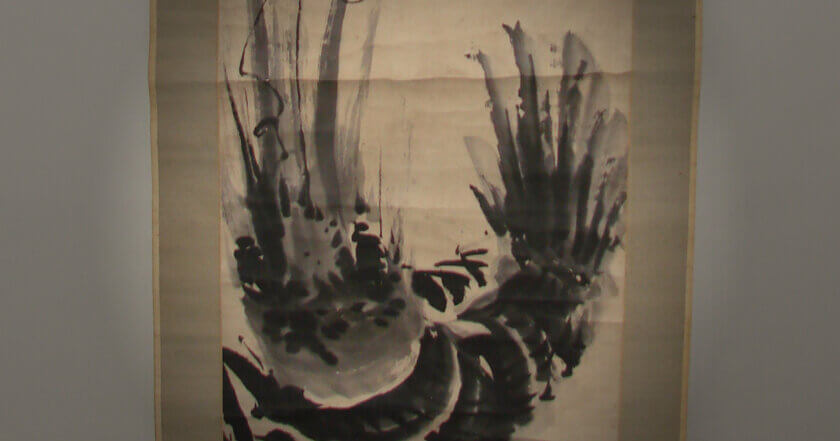
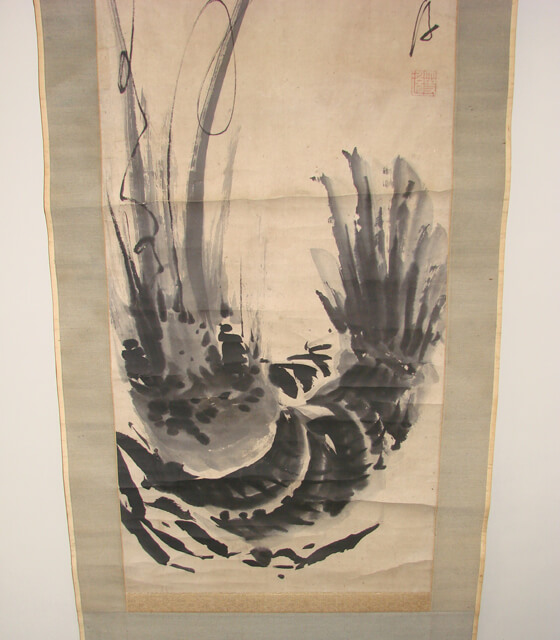
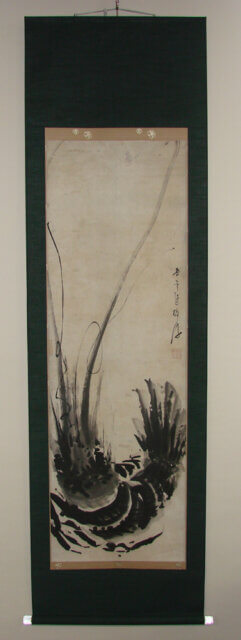
The scroll we received this time features a shrimp painted in bold, expressive sumi ink. The dynamic brushwork, particularly the long whiskers of the shrimp rising powerfully from the lower to the upper part of the composition, makes for a very striking and energetic piece.
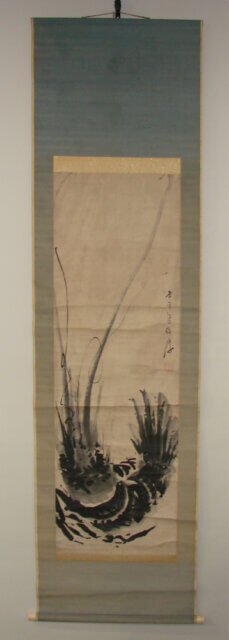
However, due to long years of aging, the entire scroll was heavily soiled, and numerous severe creases had formed throughout the artwork. These damages significantly affected both its appearance and its long-term preservation.
Recommendation of Futomaki Storage

Such deep creases are often difficult to correct completely with standard reinforcement alone, and there is a high risk of the damage recurring. For this reason, we proposed storing the scroll in a paulownia-wood box with a futomaki to reduce stress on the artwork. Our client kindly accepted this recommendation.
Selection of Mounting Fabrics

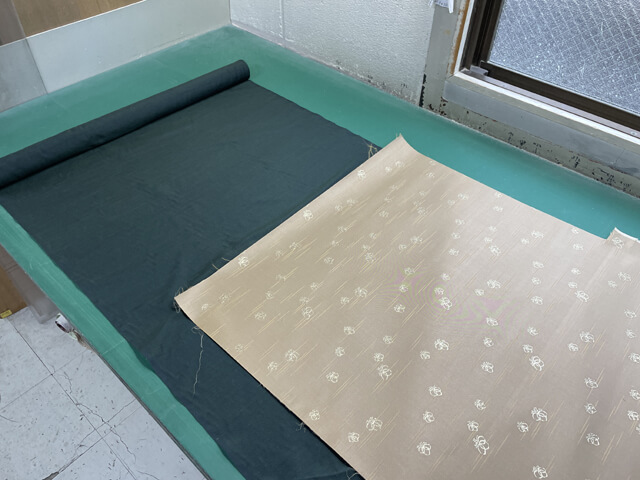
After careful consultation with the client regarding the mounting fabrics and overall design, we proceeded with remounting using the selected combination shown in the photograph.
Details of the Restoration Process

This restoration was carried out through the following steps:

1. Dismantling the Scroll
The old mounting fabrics and roller components were carefully removed from the original scroll. Every step was performed with great care to avoid placing unnecessary stress on the artwork.

2. Removal of Old Backing Paper
The deteriorated backing papers adhered to the reverse side of the artwork were patiently removed. Since the scroll was in a highly fragile condition, this process required far more time and caution than usual.

3. Washing and Stain Removal
The accumulated dirt and stains caused by aging were gently removed through a controlled washing process.

4. Hadauchi (the 1st Backing) and Crease Reinforcement (Orefuse)
A new lining was applied to reinforce the artwork, and areas weakened by creases were strengthened through traditional fold-reinforcement techniques.

5. Remounting
Finally, the painting was remounted as a new kakejiku using the fabrics selected by the client.

Completion of the Mounting Work

As expected, removing the old backing paper proved to be one of the most challenging stages of the restoration. However, by proceeding carefully through each step, we were able to return the scroll to a condition suitable for display once again.
スライドショーには JavaScript が必要です。

スライドショーには JavaScript が必要です。


Storage in a Futomaki Paulownia Box

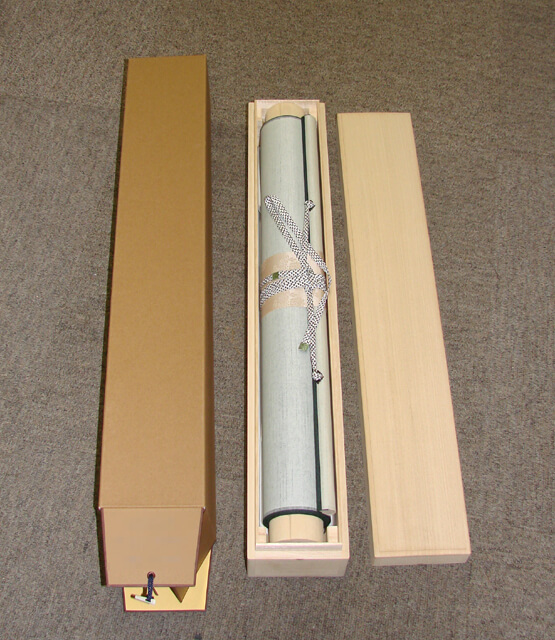
The restored scroll is now stored in a paulownia-wood box with a futomaki, as shown in the photograph. By rolling the scroll with a larger diameter, the physical stress on the artwork is greatly reduced, contributing to its long-term preservation.
At the Client’s Home

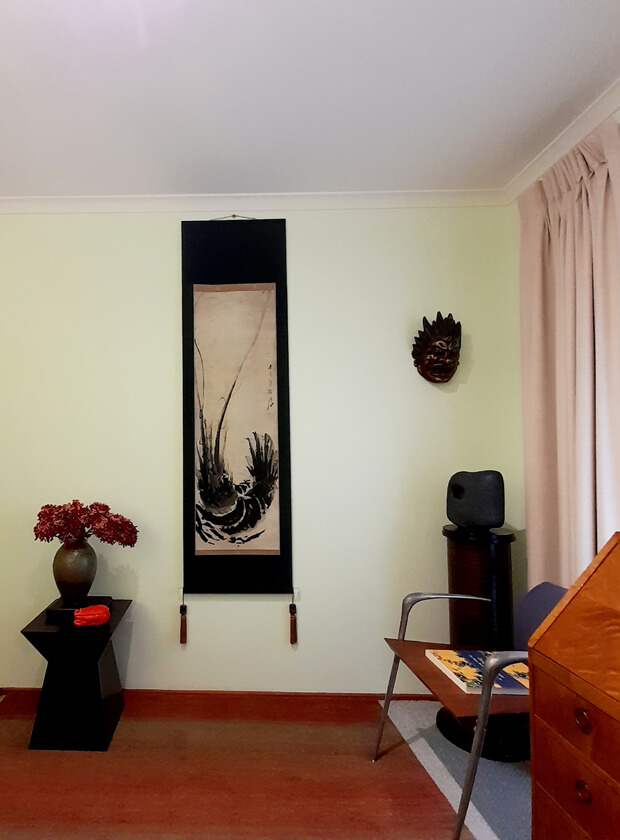
After the scroll arrived safely in Australia, the client immediately displayed it in their home. Rather than placing it in a traditional Japanese alcove (tokonoma), it is displayed on a white wall in a Western-style room. The surrounding interior elements harmonize beautifully with the scroll, creating a refined and elegant atmosphere.
International Restoration Services

We regularly handle restoration and remounting requests not only from within Japan, but from clients all over the world.

If you have a treasured artwork that you wish to display once again, or preserve for future generations, please feel free to consult us. After carefully examining the condition of your piece, we will propose the most appropriate restoration and preservation method for you.
 

Contact Us

Please fill out the form below and submit for your inquiry.

❈FirstName
❈LastName
Country
❈E-mail
(❈Confirm E-mail)
❈Inquiry category Question
Consultation
Impression
Request
Others
❈Comment

is the mark for required item.


Your privacy is important to us. We are committed to protecting your privacy.

(or press ESC or click the overlay)

CEO Message

Our Feelings For Kakejiku


 The Japanese people have long set a high value on aesthetic senses since ancient times. As a result, the
peculiar culture which is not seen in other countries blossomed and many aspects of the modern Japanese
culture come from it. Parts of Japanese culture has been introduced to people in other countries recently,
so the number of people from other countries who are interested in Japanese culture has been increasing.
However, the Japanese aesthetic senses, which are the bases of Japanese culture, have been nurtured
through a long history, intertwining various elements intricately, such as climate, geographical features,
religion, customs and so on. Therefore, they are very difficult to understand not only for people from other
countries, but even for the Japanese people. I think the best tool which conveys these difficult senses
understandably is a “kakejiku.”
 The kakejiku (a hanging scroll; a work of calligraphy or a painting which is mounted and hung in an
alcove or on a wall) is a traditional Japanese art. It's no exaggeration to say that paintings are what
express aesthetic senses at all times and places. The kakejiku is an art which expresses the Japanese
aesthetic senses. The kakejiku has long been used in traditional Japanese events, daily life and so on since
ancient times. As a result, there are various customs of kakejiku in Japan; kakejiku and the life of the
Japanese are closely related. We can see Japanese values through kakejiku.
 The kakejiku is a cultural tradition which the Japanese people should be proud of. However, many people
in other countries don't know much about it because it hasn't been showcased as much. This is why I
decided to try to introduce it. The kakejiku world is very interesting and beautiful. We want not only the
Japanese, but also many people from other countries to know and enjoy it. I hope that many people will
love kakejiku someday.

(or press ESC or click the overlay)
Company Profile
syaoku.jpg(120220 byte)

Name Art Nomura


President Tatsuji Nomura


Founded1973


Established1992


Address7-23 Babadori, Tarumi-ku, Kobe city,
Hyougo Prefecture, 655-0021, Japan


Capital10 million yen


URLhttp://nomurakakejiku.com


Our Business

 Art Nomura is an art dealer which produces kakejiku (hanging scrolls). We mount many paintings and calligraphic works in kakejiku in my factory. Kakejiku are our main product. We also remount and repair old or damaged kakejiku. We share the traditional Japanese art of kakejiku with people all over the world.


(or press ESC or click the overlay)
Access Map

Access Map


 The Japanese people have long set a high value on aesthetic senses since ancient times. As a result, the
peculiar culture which is not seen in other countries blossomed and many aspects of the modern Japanese
culture come from it. Parts of Japanese culture has been introduced to people in other countries recently,
so the number of people from other countries who are interested in Japanese culture has been increasing.
However, the Japanese aesthetic senses, which are the bases of Japanese culture, have been nurtured
through a long history, intertwining various elements intricately, such as climate, geographical features,
religion, customs and so on. Therefore, they are very difficult to understand not only for people from other
countries, but even for the Japanese people. I think the best tool which conveys these difficult senses
understandably is a “kakejiku.”
 The kakejiku (a hanging scroll; a work of calligraphy or a painting which is mounted and hung in an
alcove or on a wall) is a traditional Japanese art. It's no exaggeration to say that paintings are what
express aesthetic senses at all times and places. The kakejiku is an art which expresses the Japanese
aesthetic senses. The kakejiku has long been used in traditional Japanese events, daily life and so on since
ancient times. As a result, there are various customs of kakejiku in Japan; kakejiku and the life of the
Japanese are closely related. We can see Japanese values through kakejiku.
 The kakejiku is a cultural tradition which the Japanese people should be proud of. However, many people
in other countries don't know much about it because it hasn't been showcased as much. This is why I
decided to try to introduce it. The kakejiku world is very interesting and beautiful. We want not only the
Japanese, but also many people from other countries to know and enjoy it. I hope that many people will
love kakejiku someday.

(or press ESC or click the overlay)