
Shikoku Pilgrimage Temple: No. 14 Jōrakuji
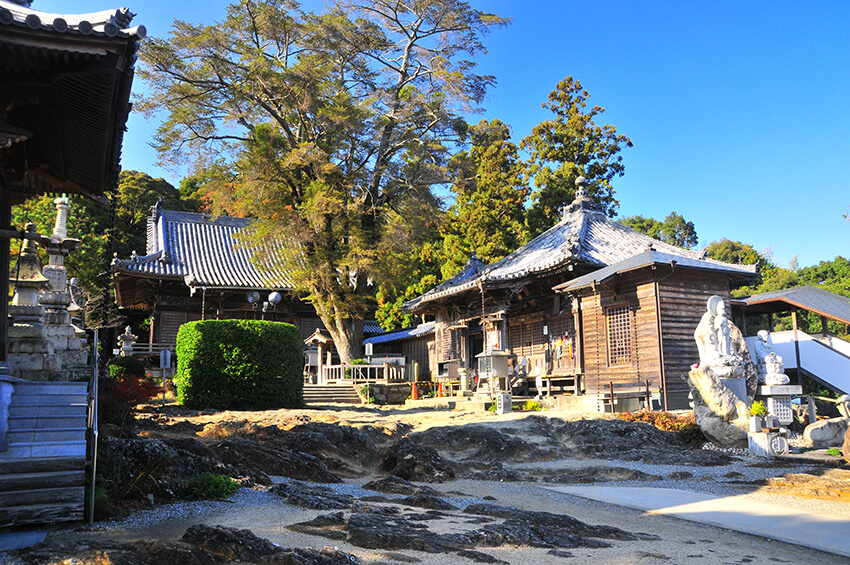
Jōrakuji

Jōrakuji: It is the only temple in the Shikoku Pilgrimage dedicated to Maitreya Bodhisattva.

  • Name: Seijuzan Enmei-in
  • Main Deity: Maitreya Bodhisattva (Miroku Bosatsu)
  • Goeika (Pilgrimage Song):
  • If I do not miss the ship of Vow,
  • I shall someday reach the shore of Jōraku.

Access From Temple No. 13 (Dainichiji Temple):

  • On Foot: Exit onto the road along the Akui River and cross the Ichinomiya Bridge. Follow the signposts through the countryside, and you will see a stone wall reminiscent of a castle enclosure. This is Jōrakuji. Distance/Time: 2.4 km, 40 minutes.
  •  
  • By Car: Go via Prefectural Road 21, cross the Ichinomiya Bridge, and turn into Jōrakuji from the area near the Jōrakuji bus stop. The road here is wide and easy to drive. Distance/Time: Approx. 3 km, 5 minutes.
  •  
  • Public Transport: Take the Tokushima Bus Kamiyama Line bound for Tokushima Station (via Enmei) from the Ichinomiya Fudasho bus stop. Alight at Jōrakuji-mae (5 minutes), then walk 5 minutes. (Depending on the bus schedule, walking might be faster.)

The Magnificent and Beautiful Garden of Flowing Water Rocks (Ryūsui-iwa no Niwa)

Jōrakuji is situated on a small hill in the suburbs of Tokushima City. From the edge of the Hōjō Pond, you ascend about 50 stone steps to reach the temple grounds. There is no traditional main gate (Sanmon), but rather a gate made of stone pillars.

The grounds themselves are astonishing. A vast, rugged bedrock spreads out everywhere, appearing to undulate like waves, creating a dynamic and wild landscape.
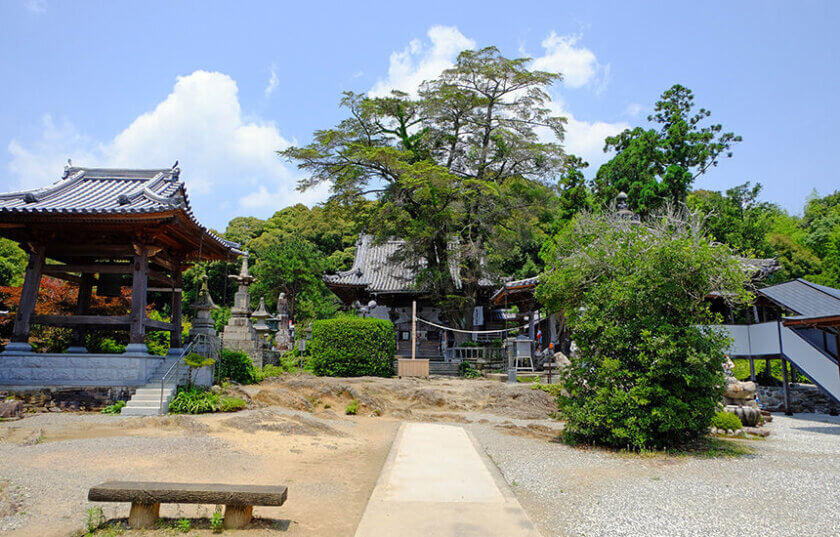
While the path is maintained, some sections require walking directly over the bedrock, which is bumpy and difficult to traverse. The stone steps leading up were not constructed from laid stone materials but were carved directly into the bedrock itself.

The Main Hall (Hondō) and Daishi Hall (Daishidō) stand upon this massive bedrock. This incredible view truly allows one to feel the wonder of nature. This natural bedrock displays unique patterns, giving it a beauty that resembles the flow of water in a mountain stream. For this reason, it is also known as the “Garden of Flowing Water Rocks.” When viewed as a garden, the arrangement of the Flowing Water Rocks in the foreground, and the temple halls and the giant Araragi tree (yew tree) adorning the landscape, gives the impression of a large-scale bonkei (tray landscape).

Araragi Daishi: Potent Spiritual Benefits for Eye Diseases

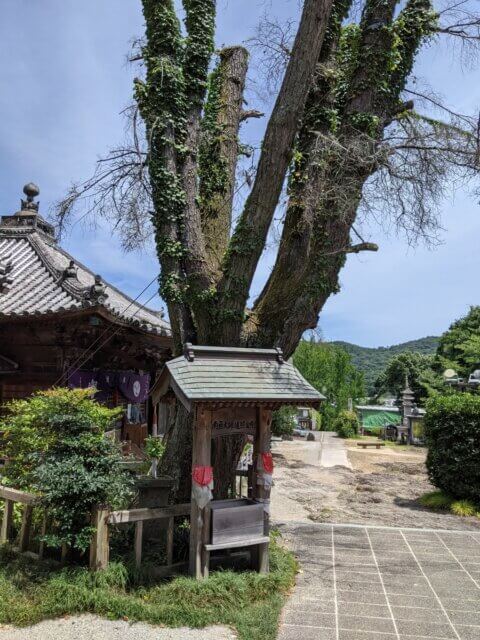
The giant Araragi tree that towers over the building in front of the Main Hall is said to have grown from a cutting planted by Kōbō Daishi (Kūkai). A signpost for “Araragi Daishi” stands nearby, and a statue of the Daishi is placed in the fork of the tree’s branches. It is believed that devout prayer here brings great spiritual benefits, healing eye diseases and various other ailments.
The Hidden Main Deity is Maitreya Bodhisattva

This is the location where Maitreya Bodhisattva is said to have appeared before Kōbō Daishi during his training. At that time, the Daishi carved the image of Maitreya Bodhisattva into a sacred tree, and this image serves as the main object of worship. Although it is a hidden Buddha (Hibutsu) and cannot be viewed by the public, Jōrakuji is the only temple among the 88 Shikoku Pilgrimage sites to have Maitreya Bodhisattva as its main deity.

Maitreya Bodhisattva is the Buddha of the future, prophesied to appear 5.67 billion years after the passing of Shaka (Shakyamuni) to save all sentient beings. It assumes the role of Shakyamuni and is said to bring salvation to those who were missed by Shakyamuni’s teaching.

DATA

Address: 606 Enmei, Kokufu-chō, Tokushima City, Tokushima Prefecture
Phone: 088-642-0471
Access: From JR Tokushima Station, take the Tokushima Bus Kamiyama Line (via Enmei), alight at Jōrakuji-mae (20 min.), then walk 5 min.
Parking: Available (Free)
Lodging: None

Your Pilgrimage, Your Art

Completing the Shikoku Pilgrimage is a once-in-a-lifetime journey—but what if you could preserve it in a form that lasts forever?

Many pilgrims collect red stamps and calligraphy from each temple on a special silk scroll called a nōkyōjiku.

This sacred record of your path can be transformed into a kakejiku—a traditional Japanese hanging scroll—not only preserving the memories, but turning them into a work of cultural and spiritual art.

It’s more than a souvenir—it’s a way to honor your journey, your prayers, and your growth.

To learn more about how a nōkyōjiku becomes a kakejiku, and what makes this transformation so meaningful, please refer the below link.


Contact Us

Please fill out the form below and submit for your inquiry.

❈FirstName
❈LastName
Country
❈E-mail
(❈Confirm E-mail)
❈Inquiry category Question
Consultation
Impression
Request
Others
❈Comment

is the mark for required item.


Your privacy is important to us. We are committed to protecting your privacy.

(or press ESC or click the overlay)

CEO Message

Our Feelings For Kakejiku


 The Japanese people have long set a high value on aesthetic senses since ancient times. As a result, the
peculiar culture which is not seen in other countries blossomed and many aspects of the modern Japanese
culture come from it. Parts of Japanese culture has been introduced to people in other countries recently,
so the number of people from other countries who are interested in Japanese culture has been increasing.
However, the Japanese aesthetic senses, which are the bases of Japanese culture, have been nurtured
through a long history, intertwining various elements intricately, such as climate, geographical features,
religion, customs and so on. Therefore, they are very difficult to understand not only for people from other
countries, but even for the Japanese people. I think the best tool which conveys these difficult senses
understandably is a “kakejiku.”
 The kakejiku (a hanging scroll; a work of calligraphy or a painting which is mounted and hung in an
alcove or on a wall) is a traditional Japanese art. It's no exaggeration to say that paintings are what
express aesthetic senses at all times and places. The kakejiku is an art which expresses the Japanese
aesthetic senses. The kakejiku has long been used in traditional Japanese events, daily life and so on since
ancient times. As a result, there are various customs of kakejiku in Japan; kakejiku and the life of the
Japanese are closely related. We can see Japanese values through kakejiku.
 The kakejiku is a cultural tradition which the Japanese people should be proud of. However, many people
in other countries don't know much about it because it hasn't been showcased as much. This is why I
decided to try to introduce it. The kakejiku world is very interesting and beautiful. We want not only the
Japanese, but also many people from other countries to know and enjoy it. I hope that many people will
love kakejiku someday.

(or press ESC or click the overlay)
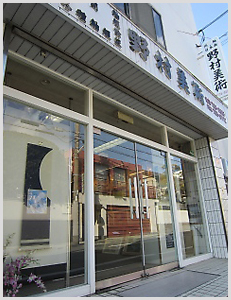
Company Profile
syaoku.jpg(120220 byte)

Name Art Nomura


President Tatsuji Nomura


Founded1973


Established1992


Address7-23 Babadori, Tarumi-ku, Kobe city,
Hyougo Prefecture, 655-0021, Japan


Capital10 million yen


URLhttp://nomurakakejiku.com


Our Business

 Art Nomura is an art dealer which produces kakejiku (hanging scrolls). We mount many paintings and calligraphic works in kakejiku in my factory. Kakejiku are our main product. We also remount and repair old or damaged kakejiku. We share the traditional Japanese art of kakejiku with people all over the world.


(or press ESC or click the overlay)
Access Map

Access Map


 The Japanese people have long set a high value on aesthetic senses since ancient times. As a result, the
peculiar culture which is not seen in other countries blossomed and many aspects of the modern Japanese
culture come from it. Parts of Japanese culture has been introduced to people in other countries recently,
so the number of people from other countries who are interested in Japanese culture has been increasing.
However, the Japanese aesthetic senses, which are the bases of Japanese culture, have been nurtured
through a long history, intertwining various elements intricately, such as climate, geographical features,
religion, customs and so on. Therefore, they are very difficult to understand not only for people from other
countries, but even for the Japanese people. I think the best tool which conveys these difficult senses
understandably is a “kakejiku.”
 The kakejiku (a hanging scroll; a work of calligraphy or a painting which is mounted and hung in an
alcove or on a wall) is a traditional Japanese art. It's no exaggeration to say that paintings are what
express aesthetic senses at all times and places. The kakejiku is an art which expresses the Japanese
aesthetic senses. The kakejiku has long been used in traditional Japanese events, daily life and so on since
ancient times. As a result, there are various customs of kakejiku in Japan; kakejiku and the life of the
Japanese are closely related. We can see Japanese values through kakejiku.
 The kakejiku is a cultural tradition which the Japanese people should be proud of. However, many people
in other countries don't know much about it because it hasn't been showcased as much. This is why I
decided to try to introduce it. The kakejiku world is very interesting and beautiful. We want not only the
Japanese, but also many people from other countries to know and enjoy it. I hope that many people will
love kakejiku someday.

(or press ESC or click the overlay)