The Founder of Kyō Kanō and a Maverick Genius Who Lived Through a Turbulent Age: The Lives of Kanō Sanraku and Kanō Sansetsu
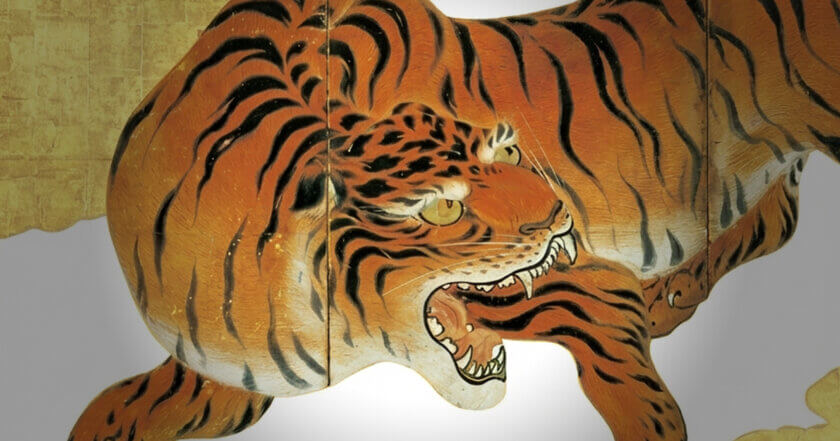
The opulent, dazzling aesthetic of the Momoyama period—cast aside by Kanō Tan-yū of Edo, who took the country by storm with a smart “beauty of empty space.”
Meanwhile, Kyō Kanō carried forward the sumptuous Momoyama style yet remained in Kyōto even after the Tokugawa era began, spinning an independent lineage of its own.
Kanō Sanraku, who laid the foundation for Kyō Kanō, and Kanō Sansetsu, his son-in-law who is also named in Kisō no Keifu (Lineage of Eccentrics). These two painters—whose reevaluation in Japanese art history has been gaining momentum—lived lives filled with strange turns of fate and hardship.
In this article, we unravel their dramatic lives.
Contents
Kanō Sanraku (1559–1635): The “Heir to Eitoku”
Kanō Sanraku was not born into the orthodox bloodline of the Kanō school; he was born as the son of a Sengoku warrior’s retainer. His life was continually buffeted by the destruction of his lord’s house and by the succession of rulers who came to dominate the realm.
The Fall of the Azai and an Encounter with Hideyoshi
Sanraku was born in Ōmi Province (today’s Shiga area). His father served Azai Nagamasa, and Sanraku grew up as the child of an Azai retainer.
In 1573, however, the Azai were destroyed by Oda Nobunaga, and Sanraku and his father were left wandering without a place to go.
A turning point came when he was taken in as a page to Hashiba Hideyoshi (later Toyotomi Hideyoshi). Hideyoshi recognized Sanraku’s talent for painting and had him enter the studio of Kanō Eitoku, who was then the head of the Kanō school. Sanraku was around sixteen at the time.
The Rise as the “Heir to Eitoku”
Under Eitoku, Sanraku rapidly distinguished himself. In the late 1580s, he is said to have completed the ceiling painting “Unryū-zu” (Cloud Dragon) in the Dharma Hall of Tōfuku-ji in place of Eitoku after Eitoku fell ill. He came to be regarded as the successor who most strongly inherited Eitoku’s grand and powerful style.
Favored by the Toyotomi household and Yodo-dono (Hideyoshi’s consort and the mother of Toyotomi Hideyori), he entered the very height of his career.
The Toyotomi’s Downfall and the Budding of Kyō Kanō
That glory did not last. After the Battle of Sekigahara (1600) and the Ōsaka Summer Campaign (1615), the Toyotomi fell. As a painter long associated with the Toyotomi, Sanraku was suspected by the Tokugawa side as a remnant of the defeated faction; he became a target of crackdowns and was forced into hiding for a time.
The crisis was averted through the efforts of cultural figures such as Shōkadō Shōjō and court aristocrats such as the Kujō family.
Spared, Sanraku—unlike Kanō Tan-yū and others who shifted their base of activity to Edo—continued to remain in Kyōto. The lineage he protected would later come to be called Kyō Kanō.
Under Tokugawa rule, the mainstream of the art world shifted toward a light and crisp Edo Kanō style, yet Sanraku steadfastly continued to paint the “powerful Momoyama beauty” he had inherited from his teacher Eitoku. Working under the protection of families such as the Kujō, he completed, for example, the shōheiga (wall and sliding-door paintings) of Tenkyū-in at Myōshin-ji (1631). Overcoming hardship, he continued painting to the end and died in 1635.
Kanō Sansetsu (1590–1651): A Geometric Labyrinth Born of Complexes and “Stubborn Eccentricity”
The painter who inherited Kyō Kanō as Sanraku’s son-in-law was its second-generation master, Kanō Sansetsu. After he was featured in 1970 in art historian Tsuji Nobuo’s Kisō no Keifu (Lineage of Eccentrics), Sansetsu was reappraised as an “eccentric painter,” alongside figures such as Itō Jakuchū.
A Father’s Death and Becoming Sanraku’s Disciple
Sansetsu was born in 1590 in Hizen Province (today’s Saga and Nagasaki areas). He later moved to Ōsaka with his father, but in 1605, when Sansetsu was sixteen, his father died and Sansetsu was left without family support.
At that time, an uncle—said to have been a monk—who had perceived Sansetsu’s talent earnestly appealed to Kanō Sanraku, who was then a painter serving the Toyotomi household, and Sansetsu succeeded in becoming Sanraku’s disciple.
A Solitary, Scholarly Temperament
Sansetsu is said to have been a solitary, scholarly painter who immersed himself in production and reading rather than socializing. Perhaps out of rivalry with the Edo Kanō, he pursued ruler-straight geometric compositions and persistent, logic-driven detailing. His distinctive manner has been described as “a geometric labyrinth.”
“Geometric Madness” Born from Pent-Up Feelings
In such a lonely environment, Sansetsu is thought to have intensified either a strong competitive spirit toward the Edo Kanō or a pent-up sense of complex and frustration. As he continued to pursue geometric structure and obsessive depiction grounded in reason, his unique style began to emit a cold, eerie beauty—a world that could truly be called a “geometric labyrinth.”
Years of Fulfillment and Honor as a Painter
After his father-in-law Sanraku died in 1635, Sansetsu displayed remarkable activity as the head of Kyō Kanō.
- Kiyomizu-dera “Tsunagiuma-zu” Ema (1637): a gigantic votive plaque depicting a black steed raising its forelegs powerfully; because few of Sansetsu’s works bear dates, it is valued as an important benchmark work.
- Sennyū-ji “Unryū-zu (Banryū-zu)” (1647): a huge dragon painted on the ceiling, known as a masterpiece associated with the “crying dragon.”
- Tenshō-in (Myōshin-ji Subtemple) “Rōbai-zu Fusuma” (same year): the plum’s form writhing across the surface in geometric fashion is often called the culmination of the Sansetsu manner.
- Supplementary Paintings for Tōfuku-ji’s “Sanjūsan Kannon-zu” (Same Year): In the medieval master Minchō’s thirty-three-scroll set, two scrolls were later supplemented, and Sansetsu’s paintings complete the set.
Around this time, Sansetsu also received the rank of Hokkyō (the 3rd highest rank for Buddhist priests), becoming in both name and reality a leading figure in the Kyōto art world.
Imprisonment at His Peak, and a Bitter Death
Just as people began to think, “Kyō Kanō will prosper even further,” Sansetsu’s life suddenly darkened.
In 1649, as he approached sixty, he was caught up in a financial dispute caused by his brother-in-law Kanō Iori (Sanraku’s second son) and was abruptly arrested and imprisoned. At the very time his powers were at their peak as a Hokkyō-ranked painter, he suffered the humiliation of having his brush taken away and being bound in a cold prison.
About two years later, he finally left prison thanks to the efforts of the Kujō family, but imprisonment in old age had already eaten away at his mind and body. In 1651, soon after his release, Sansetsu died at sixty-two.
To have the later years—when he should have been able to create still more masterpieces—taken from him: his end can only be described as bitter and regretful.
Conclusion: The Treasured Works of Kyō Kanō, Now Reappraised
Kanō Sanraku, who safeguarded the Momoyama aesthetic—the beauty of the defeated—under Tokugawa rule, and Kanō Sansetsu, who sublimated that spirit into his own kind of intellectual madness.
Works by these two painters, once easily buried in the shadow of history, are now being cast in a new light through major exhibitions such as the Tokyo National Museum’s “Former Saga Imperial Villa: Daikaku-ji” exhibition (2025) and the Ōsaka City Museum of Fine Arts’ “Myōshin-ji: The Inheritance of Zen” exhibition (2026).
When you stand before the fusuma paintings and folding screens they created, you may hear not merely “paintings,” but the “cry of the soul” of painters who survived a violently changing age.