Yamato-e and Nihonga: A Lineage of “Japanese-ness” in Painting
From Kara-e to Yamato-e: The Invention of Painting Japan’s Own World
Japanese painting was not “Japanese” from the very beginning. From the Asuka through Nara periods, what entered Japan along with Buddhism was Chinese-style painting. The traditions seen in temple murals and Buddhist images are commonly grouped under the name kara-e—literally, “Tang/Chinese pictures.”
At first, the distinction people had in mind was largely a matter of subject matter—what was being depicted. That said, what was called kara-e in the Heian period was not a single, uniform style; techniques and modes of expression varied widely. Even so, in broad terms kara-e came to be associated with a “Chinese” way of seeing—through brushwork, the handling of light and shade, and compositional sensibility—and it gradually came to be contrasted with painting centered on Japanese themes.
In the Heian period, court culture matured, and what is often called kokufū bunka (“national-style culture”) flourished: waka poetry, narrative literature, and Japanese-style calligraphy, among others. Within this current, paintings developed that took as their themes:
- the changing seasons of Japan,
- annual ceremonies and courtly entertainments,
- and the narrative worlds of works such as The Tale of Genji and The Tales of Ise.
Paintings that portrayed “Japanese things, through Japanese sensibilities” came to be called yamato-e, in contrast to kara-e.
Yamato-e Grows from a Category of Subjects into a Distinctive Mode
The emergence of yamato-e does not mean that techniques suddenly shifted into something entirely different. In its earliest stages, yamato-e functioned primarily as a category of subject matter, and in practice it often relied on existing pictorial resources while turning its attention to Japanese stories and customs.
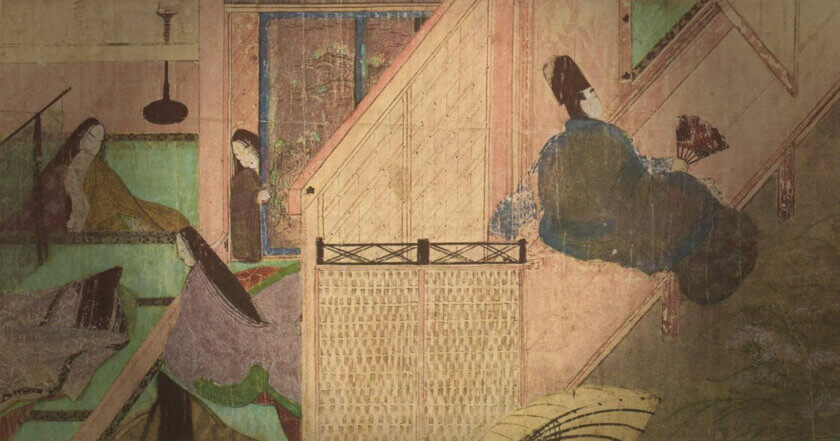
Yet as painters continued to depict Japan’s world, a manner characteristic of yamato-e gradually took shape. Gentle color harmonies, delicate line work, and decorative compositions came to the fore. A well-known device in narrative handscrolls is fukinuki yatai (the “blown-off roof” style), in which the roof is removed to reveal interior scenes. Such approaches helped define yamato-e as a visual language.
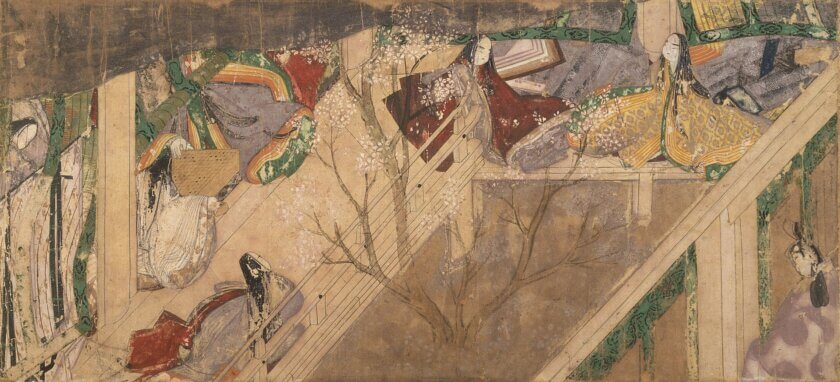
Yamato-e began as painting “Japanese subjects,” and in the process it acquired a distinctive “Japanese way of seeing.”
The Continuation of Yamato-e and the Idea of “Revival”
After reaching a peak in the Heian period, yamato-e did not disappear. It was inherited across the centuries, changing its appearance as times changed.
From the Kamakura period onward—against the backdrop of the rise of the warrior class and the expanding influence of temples and shrines—pictorial expressions indebted to yamato-e spread into a wider range of imagery, including:
- battle scenes and warrior pictures,
- engi handscrolls narrating the origins of temples and shrines,
- and works illustrating Buddhist tales and didactic stories.
As a result, pictorial worlds began to form in which religion, history, and narrative intermingled.
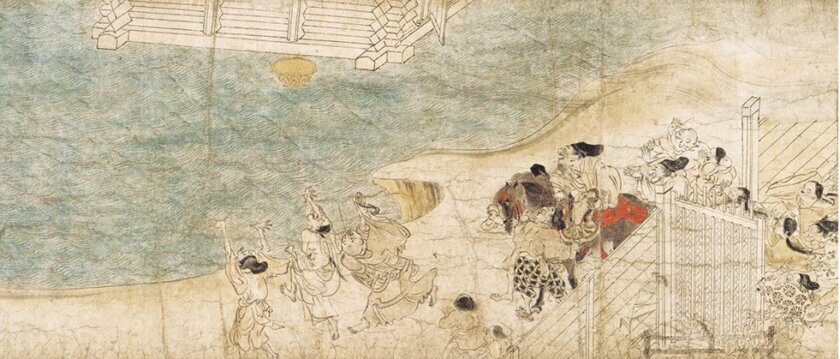
In the early modern period, major schools such as the Kanō school absorbed elements of both Chinese-mode painting and yamato-e, reconstructing them within their own idioms.
For this reason, yamato-e increasingly functioned less as an independent “school” and more as a broader current—painting characterized by Japanese themes and sensibilities—diffused across many lineages.
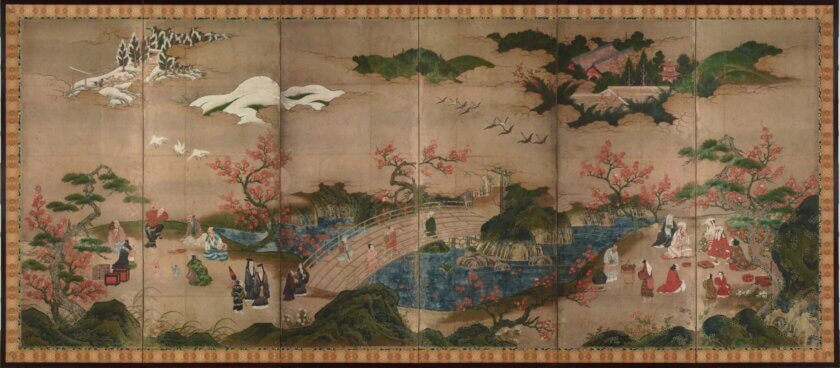
By the late Edo period, as kokugaku (National Learning) and reverence for the imperial tradition grew, so too did the impulse to reexamine classical Japanese culture. In this context, a movement emerged that reinterpreted the Heian legacy of yamato-e as an ideal source of Japanese art and sought to recreate and revalue its world.
What matters here is that “revival yamato-e” is best understood not as the achievement of a single artist but as a broader trend encompassing multiple painters. Reizei Tamechika is often cited as a representative figure, and the movement is more securely grasped when seen alongside artists such as Tanaka Totsugen and others.
Why the Name “Nihonga” Was Born
With the advent of the Meiji period and Japan’s opening to the world, Western culture was actively adopted, and oil painting took root in earnest. This raised a fundamental question: how should Japan’s existing painting traditions be positioned in relation to this new presence?
One answer was the label nihonga (“Japanese painting”). In contrast to Western-style oil painting, called yōga, the term nihonga came to be used as a comprehensive name for painting on the Japanese side. Figures such as Ernest Fenollosa and Okakura Tenshin played major roles in shaping the institutional framework in which this category was articulated and supported.
At the same time, Japanese painting traditions had always been remarkably diverse, including:
- the Tosa school connected to the court painting office,
- the Kanō school patronized by the shogunate,
- the Maruyama–Shijō school with its emphasis on observation and sketching,
- the highly decorative Rinpa tradition,
- and ukiyo-e born from urban commoner culture.
It is possible to group all of these under the name “nihonga,” but if one asks, “What do they share in common?” the answer is not simple.
In confronting that question, people repeatedly looked for clues in elements such as:
- approaches to nature and seasonality,
- approaches to line and negative space (including ma, the meaningful interval of space),
- the incorporation of craft-like design and ornament,
- and a sustained gaze toward classical literature and history.
Within that search, the legacy of yamato-e became one of the important reference points.
History Painting: Portraying the Past to Speak to the Present
As a supplementary perspective, it is useful to touch on history painting. In Japan, the term “history painting” is sometimes used as a broad concept for works that take as their subject people and events found in classical literature, historical chronicles, legends, and origin narratives (engi).
Examples include:
- narrative worlds such as The Tale of Genji and The Tale of the Heike,
- battle paintings and warrior images,
- and temple-and-shrine origin handscrolls.
From today’s perspective, these can all be seen as images depicting “historical worlds.” That said, scholars differ on whether narrative handscrolls as a whole should be straightforwardly labeled “history painting,” so it is best to keep this point as an interpretive guideline rather than a rigid definition.
In the modern period, the Western concept of History Painting—especially as understood within the academic hierarchy of genres—was introduced, and Japan too saw the production of many large-scale works depicting national history, heroic figures, and famous battles.
Here the goal was not merely to reconstruct past events with accuracy, but to pursue pictorial expression that asked how the past might be used to speak about the present.
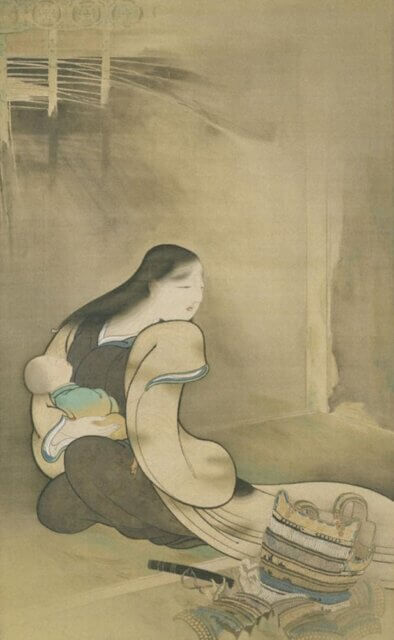
The “Core” of Nihonga Suggested by Yamato-e and History Painting
The turn toward yamato-e—depicting Japan’s stories and lived world in contrast to kara-e—and the modern development of history painting, in which Japan revisited its classics and history while facing Western art, are both lineages that grapple with the same question: How should we depict Japan, through Japan’s own eyes?
Out of that question emerges something like a “core” of nihonga—one that cannot be reduced simply to materials or techniques.
Yamato-e can be understood as one of the earliest fully developed forms through which Japanese stories and feelings were made visible. History painting can be seen as a modern form of expression that confronted the present through the lens of the past.
Following both lines allows us to glimpse the long accumulation of time behind the word “nihonga,” and the repeated reexamination of Japanese identity that has taken place within that history.