
Ikeda Shōen and the “Three Capitals, Three ‘En’ Artists”——Reading an Era When Modern Bijin-ga Was Transforming
Bijin-ga (pictures of beautiful women) is a genre in Japanese art that depicts women not only as ideals of beauty, but also as embodiments of contemporary fashion, manners, and social taste—making it a sensitive barometer of its era.
“Three Capitals, Three ‘En’ Artists” Indicates More Than Rivalry Between Cities
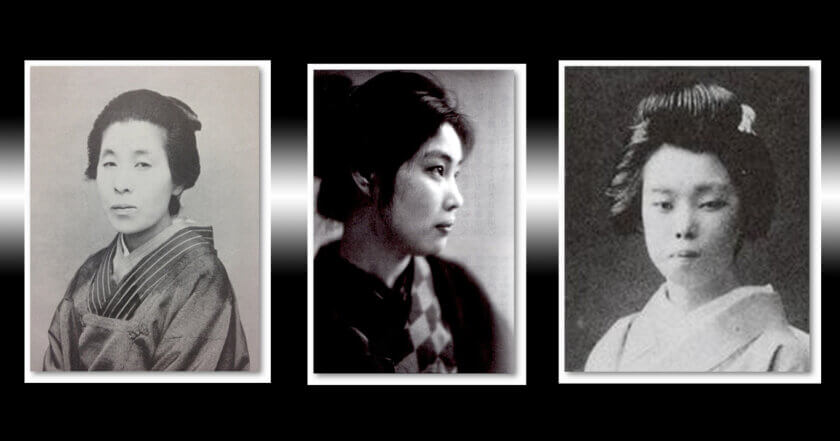
“Three Capitals, Three ‘En’ Artists” (Santo San’en) is a term used to refer collectively to three popular female bijin-ga painters associated with major cities in modern Japan: Uemura Shōen of Kyoto, Ikeda Shōen of Tokyo, and Shima Seien of Osaka.
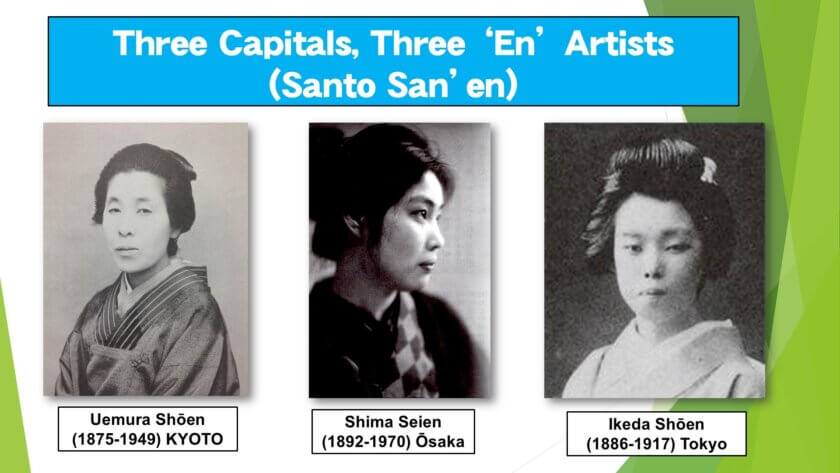
Because all three artists share the character “en” (園) in their names, they came to be discussed as representative figures among modern female bijin-ga painters.
What makes this label interesting is not only that it evokes a sense of rivalry among Kyoto, Tokyo, and Osaka. It also helps us grasp—in a single phrase—how bijin-ga as a genre changed its form as Japan entered the modern era.
From Edo-period Bijin-ga to Modern Bijin-ga: New Factors Enter the Picture
Bijin-ga had already become an established genre in the Edo period through ukiyo-e, gaining support by depicting courtesans and popular women of the towns, and thriving within the marketplace.
In the modern period, new factors were added. Government-sponsored exhibitions such as the Bunten and Teiten provided a circuit of public evaluation, while commercial venues like department stores and mass media such as magazines expanded public interest in images of beautiful women.
As a result, bijin-ga developed not only as “art that sells,” but also as a genre accompanied by public recognition, acquiring an even stronger presence.
And from the three urban spheres—Kyoto, Tokyo, and Osaka—“stars” emerged within their respective environments. That is what “Three Capitals, Three ‘En’ Artists” refers to.
The Context in Which Stars Emerged Differed Subtly by City
In Kyoto, there was a strong cultural foundation for refining a classical, “idealized image of womanhood” with high dignity and elegance.
In Tokyo, as the center of official exhibitions and fashion, the channels for quickly fixing “contemporary beauty” into pictorial form were particularly robust.
In Osaka, along an extension of urban culture different from Kyoto and Tokyo, another kind of reality for bijin-ga took root and grew.
Keeping these differences in view, “Three Capitals, Three ‘En’ Artists” becomes more than a simple catchy phrase—it can be understood, with greater clarity, as a term that points to differences in the environments surrounding modern bijin-ga.
Ikeda Shōen at the Center of Tokyo
It was Ikeda Shōen (1886–1917) who represented “Tokyo.” Ikeda Shōen is known as one of the most popular bijin-ga painters in Tokyo.
Her works held the highest number of “sold” designations at the Bunten (Note 1), and in her time she was regarded—together with Kyoto’s Uemura Shōen—as one of the two leading female bijin-ga painters.
However, one reason she is not as widely known today as Uemura Shōen may be that she died young at thirty-one, which limited both the accumulation of large-scale works and opportunities for retrospective appreciation.
The Appeal of Ikeda Shōen’s Works作品の魅力
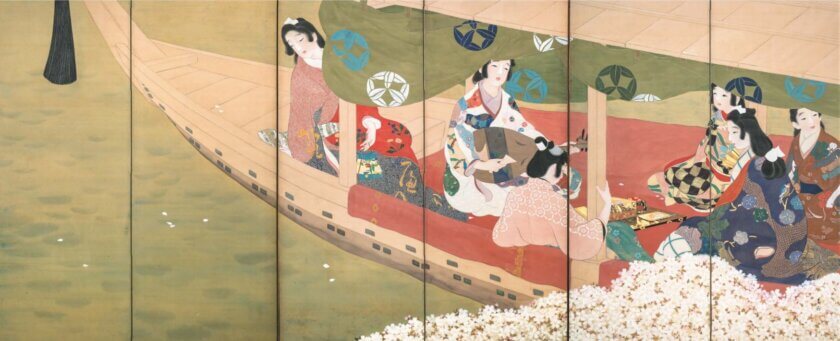
In her time, Ikeda Shōen enjoyed immense popularity as one of the “Three Capitals, Three ‘En’ Artists.” The strength of her work lies in the palpable sense of human presence that rises from within the picture plane. If we put that appeal into terms useful for viewing, three points form the core:
1) Confident contour lines, with an aftertaste that never hardens into rigidity
Her lines run cleanly and set the figure upright with poise, while still leaving a lingering resonance that invites us to imagine expression and the warmth of skin.
2) Costume depiction that connects to “air,” beyond mere information
Alongside the precision of patterns and textures, the weight of cloth, the feeling of the season, and the humidity of the setting link to the figure, giving the entire image a single, shared breath.
3) Gaze and gesture that create “a story in midstream”
The slightly averted eyes, tension in the fingertips, and a subtle pause held in posture allow the figure to exist not as a mere model, but as “someone carrying something” in the present moment.
Conclusion
“Three Capitals, Three ‘En’ Artists” not only evokes competition among Kyoto, Tokyo, and Osaka; it is also a label that makes it easier to grasp how, in the modern era, bijin-ga unfolded in connection with official exhibitions and urban media.
Ikeda Shōen, who symbolizes Tokyo within this trio, gathered strong support in her own time—which is also confirmed by Bunten records of works marked “sold.”
Even if her early death resulted in a gap in later recognition, her works themselves are of the highest caliber. It is precisely her way of fixing human presence and emotional nuance onto the picture plane that makes viewing Ikeda Shōen so compelling.
Note
- (1) “Authors, Titles, and Purchasers of Sold Works from the First through the Eleventh Exhibition,” in Yoshioka Hanrei (ed.), Teikoku Kaiga Hōten (Imperial Painting Compendium), Teikoku Kaiga Kyōkai, 1918.